
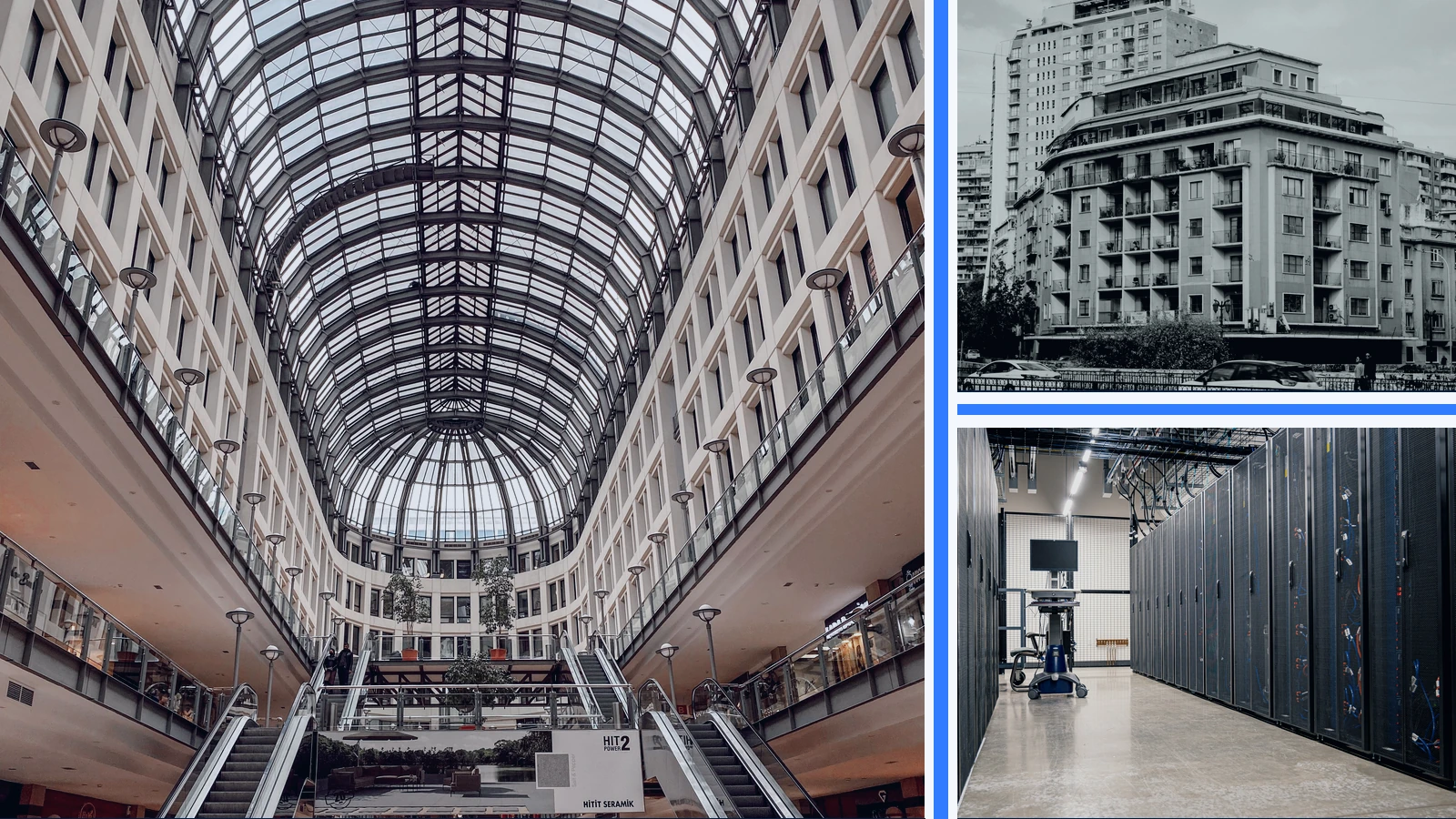
A vacant shopping mall is not automatically a failed building. A new study of one Italian mall finds that its next use could range from healthcare and housing to a data centre, but the best answer depends on the structure, local demand and the cost of changing it.
That distinction is useful at a time when online buying is still growing. US Census Bureau estimates put e-commerce at 17.1% of US retail sales in the second quarter of 2026, up 12.2% from a year earlier. The figures do not mean that shops or malls have become obsolete. They do mean that a large retail building needs to offer something customers cannot get from a delivery box.
Some malls still do. Recent UK sales data also showed a recovery in non-store retailing, though it measures goods bought rather than the health of every mall. In the US, CBRE reported US retail availability of 4.9% in the second quarter, with average asking rents 2.4% higher than a year earlier. JLL also recorded 10.2 million square feet of positive net absorption, meaning more retail space was occupied than vacated. Its data put malls in positive territory.
The harder question concerns an older centre that has lost its main tenants and no longer fits its local market. For an owner, lender and town, the choice is rarely as simple as finding another clothing retailer.
One building can have several plausible futures
In a paper published in Cities, researchers Sergio Copiello, Mauro Cristina Marzo, Eleonora Morbin and Pietro Bonifaci examined nine reuse options for a former shopping mall. Their case study compared the likely financial performance of projects such as housing, healthcare and a data centre while accounting for the building’s physical constraints and the costs of conversion.
In their base case, a data centre produced the highest net present value, a way of putting future income and costs into today’s money. Senior housing and medical uses followed. The rankings should not be read as a universal league table for dead malls. They are the result of one property’s assumptions about demand, building works, finance and operating costs.
The study’s more durable point is that a large, empty retail box can be valuable in different ways. It may have a prominent location, road access, parking and utility connections. Those assets can support a new use even after the original retail model has stopped working.
A data centre is not a plug-and-play conversion
Data centres are an attractive possibility because they can use large floor areas and create long leases. Yet a former department store does not become a data centre simply because it has a big roof and an empty car park.
Operators need substantial, reliable power, fibre connections, cooling equipment, security and planning approval. They also need a location where local grid capacity and their customers’ network needs line up. The cost of reinforcing the electrical supply or rebuilding floors can erase the apparent advantage of a cheap building.
That is why the study treats conversion costs as central, rather than assuming every vacant mall is ready for high-tech use. A site with the wrong utilities may be better suited to services that need access and parking more than a heavy power connection.
Healthcare and housing use the site differently
Healthcare can work well on a former mall site because the location is familiar, accessible by road and often served by public transport. It can also bring regular footfall back to nearby shops and restaurants. But clinics, laboratories and surgical facilities need new layouts, specialist systems and, in many cases, a much higher level of construction work than retail space.
A real example is the former Sears building at Marketplace Mall in suburban Rochester, New York. The University of Rochester says its new Orthopaedics Campus occupies roughly 330,000 square feet and includes eight operating rooms, outpatient care and research space. The university bought the former Sears building for $18.3 million in 2020 before developing the larger project, according to its project announcement.
Housing offers another route, especially where there is a shortage of homes. It can be more difficult than it looks. Deep floor plates that worked for department stores can leave flats too far from natural light and windows. Developers may need to cut courtyards, remove sections of the structure or replace much of it. That can turn a low purchase price into a costly redevelopment.
The accounting value can get in the way
The paper also highlights a less visible problem: the mall may be worth less as a property than the amount recorded on an owner’s books or secured against a loan. A sale or conversion can force that loss into the open.
This can delay a decision even when a new use makes economic sense. A lender may prefer a short-term lease extension, while an owner may wait for the market to improve. The community is left with a partly empty building that still occupies a major site.
There is no single future for shopping malls. Strong centres can continue to attract tenants and shoppers, while weaker ones may become housing, healthcare, education, logistics or another use that fits the site. The important question is not whether retail has disappeared. It is whether the existing building and land can do a better job for the people and businesses around it.
