
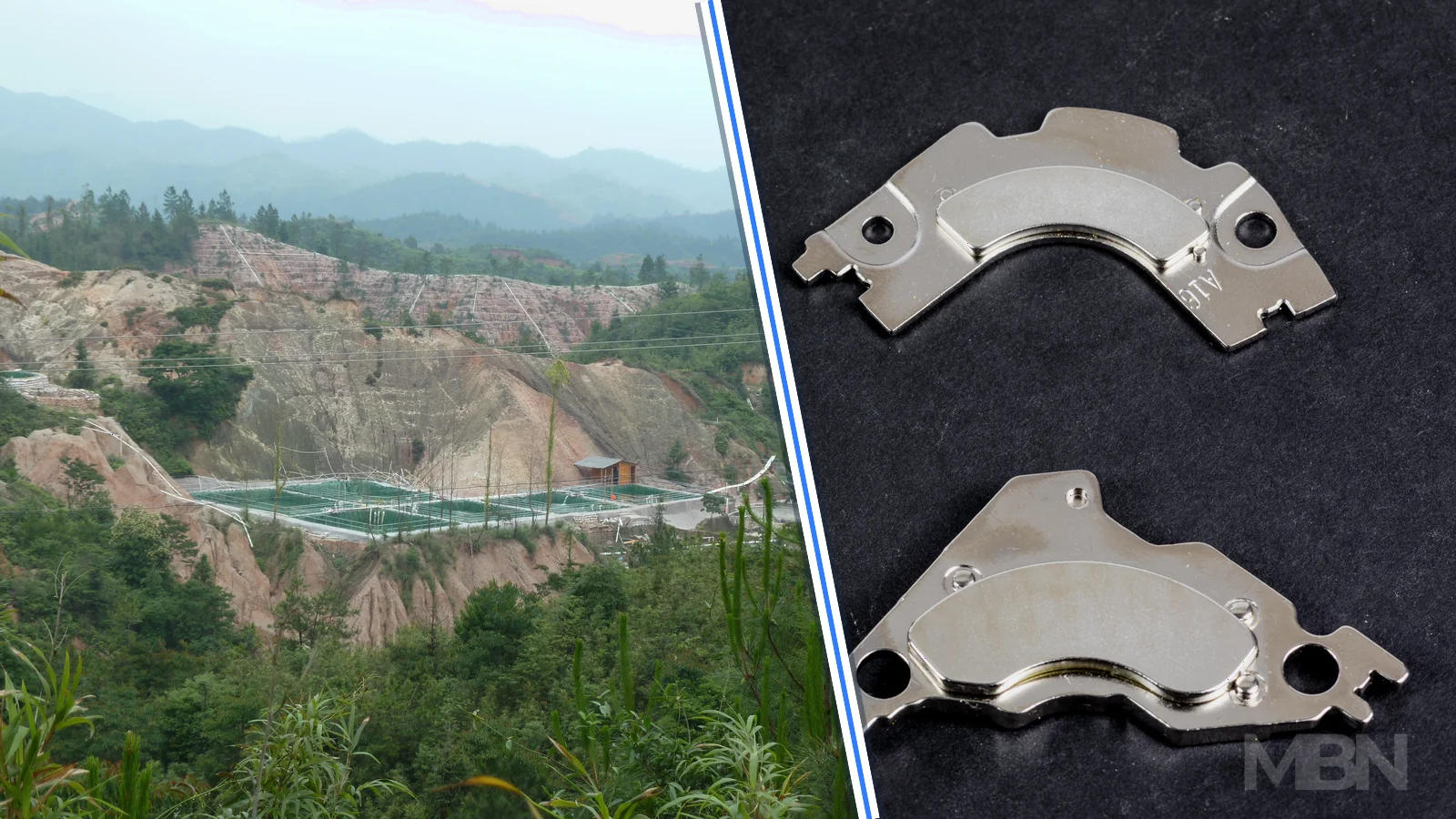
China supplied about 60% of the world’s mined magnet rare earths in 2024, but its share rose to 91% at the refining stage and 94% in sintered permanent magnet production. The figures explain why opening mines elsewhere will not, by itself, create an independent rare earth supply chain.
The numbers come from the International Energy Agency’s Rare Earth Elements report, published in April 2026. Its main warning is easy to miss when policy debates concentrate on mineral deposits: the tightest constraints sit farther along the route from ore to finished magnet.
Those magnets are used in electric vehicles, wind turbines, industrial motors, robotics, data centres, medical equipment and defence systems. The IEA estimates that permanent magnets account for about 95% of rare earth consumption by value.
A mine produces a mixture, not a magnet
Rare earths are a group of 17 metallic elements. Many are relatively plentiful in the Earth’s crust, but deposits containing economically recoverable concentrations are less common.
The elements also tend to occur together and have similar chemical properties. A mine therefore produces ore containing a mixture, rather than a convenient stream of individual materials ready for manufacturing.
As the IEA’s mine-to-magnet outline shows, the material must pass through crushing, concentration, chemical upgrading and separation before individual rare earth oxides emerge. The oxides are then converted into metals, alloys or powders and, finally, finished magnets.
Separation is one of the hardest steps. The main industrial method, solvent extraction, repeatedly mixes and separates liquids so that chemically similar rare earths can be isolated from one another.
A US Department of Energy assessment says a solvent-extraction line can contain hundreds of mixer-settlers. The process uses acid, alkaline chemicals and water, while wastewater and naturally occurring uranium or thorium in some ores must be managed safely.
Even a high-purity oxide is not yet a magnet. Producers still need metallisation equipment, precisely formulated alloys, magnet-making machinery and tight quality control. Each stage requires its own technical knowledge, customers and capital.
China’s advantage grows downstream
The IEA’s 60%, 91% and 94% figures apply specifically to neodymium, praseodymium, dysprosium and terbium, the four principal rare earths used in high-performance permanent magnets.
Neodymium and praseodymium form the basis of widely used neodymium-iron-boron magnets. Dysprosium and terbium can be added when a magnet must retain performance at higher temperatures.
China’s position is therefore industrial as well as geological. Its refiners, metal and alloy producers, magnet makers, equipment suppliers and customers operate within a large connected market.
That creates economies of scale and dependable demand between each stage. In 2005, China made about half of the world’s sintered permanent magnets. By 2024, its share had climbed to 94%, according to the IEA.
Demand is still rising. Consumption of the four magnet rare earths has doubled since 2015, and the IEA expects it to grow by roughly another third by 2030 under current policy settings.
Diversification plans thin out after mining
The project pipeline outside China illustrates the problem. Existing and announced projects could provide more than 50 kilotonnes of magnet rare earth mining capacity by 2035. Planned refining and separation capacity is below 40 kilotonnes.
At the next stages, announced metals, alloys and magnet projects total only about 18 kilotonnes on a rare-earth-content basis. That is roughly one-third of the diversified mining capacity.
Measured against expected demand outside China in 2035, current and planned projects would cover about half of mining requirements, one-quarter of refining requirements and less than one-fifth of magnet demand.
This produces a practical risk for governments backing new mines. They could diversify where the ore is extracted while remaining dependent on the same country for the products manufacturers actually buy.
It also leads to a broader policy lesson. A separation plant without reliable feedstock or customers may struggle, just as a magnet factory without dependable metals and alloys may struggle. Building one stage in isolation can move the bottleneck rather than remove it.
Export controls showed how quickly shortages spread
The consequences became visible in April 2025, when China introduced export controls covering seven heavy rare earth elements, related compounds and magnets containing them.
Exports of the affected materials and magnets dropped sharply in April and May. The IEA says some manufacturers in the United States, Europe and elsewhere had difficulty obtaining magnets, while some carmakers reduced factory utilisation or temporarily stopped production.
Shipments later recovered as licences were issued. Even so, the episode demonstrated how a shortage of a relatively small input can interrupt production of far more expensive vehicles and equipment.
The IEA estimates that $6.5 trillion of annual economic activity outside China could be exposed if extensive rare earth export controls were implemented in full. That is the value of downstream production potentially at risk under its scenario, not a forecast that $6.5 trillion will be lost.
“Recent disruptions have underlined how quickly these vulnerabilities can translate into real economic risks,†IEA Executive Director Fatih Birol said when the report was released.
Why downstream capacity is difficult to finance
The IEA estimates that building enough diversified capacity to meet projected magnet rare earth demand outside China will require about $60 billion over the next decade. Nearly half would go into refining and roughly one-third into magnet manufacturing.
Money is only part of the problem. Developers outside the established supply base often face higher costs, smaller plants, longer permitting procedures and limited access to specialised machinery and skilled workers.
They also face a financing loop. Investors want evidence of long-term customer demand before funding a plant. Customers often want proof that the proposed plant can produce material to an exact specification before signing an offtake agreement, which is a contract to buy future output.
Rare earth deposits create another difficulty because several elements are produced together. A processor cannot always concentrate only on valuable magnet materials. It may also produce larger quantities of lower-value cerium and lanthanum, whose markets affect the economics of the whole operation.
Equipment can be a bottleneck as well. The IEA says suppliers outside China are scarce for separation cells, alloy strip casters, high-efficiency electrolysis cells and specialist magnet-production machinery. Some equipment can take years to obtain.
Europe is targeting processing and recycling
The European Union has written the downstream problem into law. Under the Critical Raw Materials Act, the EU’s 2030 benchmarks include domestic extraction equal to at least 10% of annual consumption of strategic raw materials, processing equal to at least 40%, and recycling equal to at least 25%.
The Act also sets a diversification benchmark under which no more than 65% of annual consumption at a relevant processing stage should come from one non-EU country.
Recycling could become a useful source of material because discarded motors and generators already contain processed rare earths. The IEA estimates that recycling could reduce the need for primary rare earth supply by as much as 35% by 2050.
However, much of today’s recycled supply comes from manufacturing scrap, which is concentrated where magnets are already made. Larger end-of-life volumes from electric vehicles and wind turbines will take time to develop.
This is why finding another deposit is only the first part of the rare earth race. The harder prize may go to countries that can connect separation, refining, metallisation and magnet production into an industry that works at commercial scale.
