

Amazon is acquiring the San Francisco AI-powered wristband startup Bee.
The deal marks Amazon’s latest push into wearable AI technology, putting the tech giant in direct competition with Meta’s smart glasses and other always-listening devices.
What is Bee?
Bee makes a $49.99 Fitbit-like bracelet that records and transcribes the owner’s activities, using that information to populate to-do lists and summarize conversations. The device also requires a $19 monthly subscription to access its AI features.
The product records everything it hears (unless the user manually mutes it) with the goal of listening to conversations to create reminders and to-do lists for the user. Users can also give the device permission to access emails, contacts, location data, reminders, photos, and calendar events to help inform its AI-generated insights.
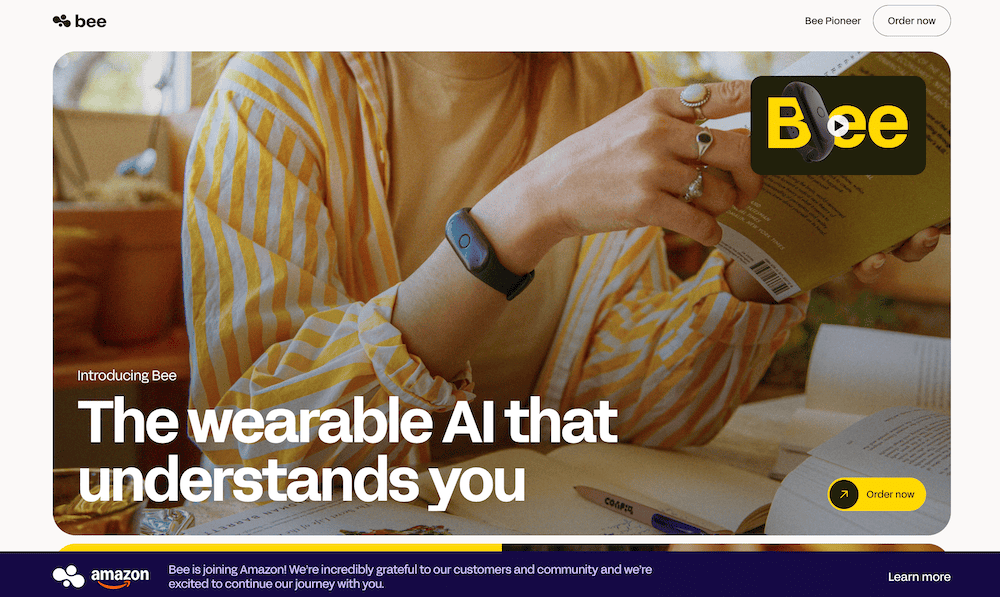
The acquisition details
Maria de Lourdes Zollo, a cofounder of the San Francisco startup, announced the deal in a brief post on LinkedIn. In her post, Zollo expressed excitement about the development, saying “What began as a dream with an incredible team and community now finds a new home at Amazon.”
All Bee employees received offers to join Amazon as part of the deal, according to Alexandra Miller, an Amazon spokesperson, as reported by Bloomberg. However, Amazon hasn’t yet revealed just how much it offered for the company.
Bee’s Background and Funding
Incorporated as Bluush Inc., Bee was founded in 2022 and has raised about $8.5 million from investors. The young company positioned itself in the growing market for AI wearables, competing against devices like the Humane AI Pin and Rabbit R1.
At a $50 price point, Bee’s devices are more cost-accessible to a curious consumer who doesn’t want to make a big financial commitment. (The ill-fated Humane AI Pin was $499.)
Privacy concerns and policies
The always-listening nature of Bee’s device could raise privacy questions. As stated earlier, the device records everything it hears unless the user manually mutes it.
In its current privacy policies, Bee says that users can delete their data at any time and that audio recordings are not saved, stored, or used for AI training. The app does store data that the AI learns about the user, however, which is how it can function as an assistant.
Bee also says it’s working on a feature to allow users to define boundaries, both based on topic and location, that will automatically pause the device’s learning.
Amazon’s wearables history
This isn’t Amazon’s first venture into wearable technology. Amazon previously built its own wrist-worn wearables, under a line of Halo-branded devices pitched as health trackers. The project was axed in 2023, part of a broader series of cuts to experimental or marginal hardware in Amazon’s devices unit.
The company also produces Echo Frames, smart glasses embedded with Amazon’s Alexa voice assistant. Earlier this year, the company updated its AI assistant Alexa, powered by generative AI, to be even smarter. Bee’s wristband could be just the type of wearable hardware that Amazon wants to integrate with its AI tech.
The competition
Amazon’s acquisition of Bee comes as tech giants race to develop the next generation of AI-powered wearables. Other companies like Rabbit and Humane AI have tried to make AI-enabled wearables like this but have not found much success thus far.
ChatGPT maker OpenAI is working on its own AI hardware, while Meta is integrating its AI into its smart glasses. In fact, OpenAI bought former Apple designer Jony Ive’s AI device startup called io for about $6.5 billion.
In short, big things are coming for AI wearables and this acquistion is just further proof of that.
