
Large ancient settlements – ancient cities – were more productive than smaller ones, just like big cities are today, researchers at the University of Colorado Boulder and the Santa Fe Institute discovered in a new study.
In spite of clear differences in governance and appearance, ancient human settlements functioned in much the same way as cities today, the authors reported in the AAAS open-access journal Science Advances (citation below) this month.
Previous studies have shown that efficiency and productivity increase as modern cities grow in population. A modern city’s population outpaces its development of urban infrastructure, for example, and it produces goods and services at a faster pace of growth than its population.

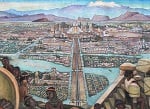
Tenochtitlan was an Aztec altepetl (city-state) located on an island in Lake Texcoco, in the Valley of Mexico. It was once the largest city in the Pre-Columbian Americas. (Image: Wikipedia)
Moreover, these patterns follow a surprising degree of mathematical regularity and predictability, a trend town planners call “urban scaling”.
Has this pattern always existed?
Professor Luis Bettencourt, from the Santa Fe Institute, is lead investigator at the Institute’s Cities, Scaling, and Sustainability research program. Scott Ortman, assistant professor at CU Boulder’s Department of Anthropology, heard Prof. Bettencourt give a talk on urban scaling theory in 2013.
Prof. Ortman noted that the trends Prof. Bettencourt described were not exclusive to modern cities. Their conversation sparked a research project on the effects of settlement (city) size through history.
In this latest study, the team gathered and analyzed archaeological data from the Basin of Mexico (the Valley of Mexico), i.e. where Mexico City is today plus its nearby regions. The Aztecs called this region Anahuac.
In the 1960s, before Mexico City’s population started to grow rapidly, surveyors had examined all the region’s ancient settlements, spanning 2,000 years and four cultural eras in pre-colonial Mesoamerica.
Professors Ortman, Bettencourt and colleagues used these data to analyze the dimensions of hundreds of ancient temples and thousands of houses to estimate how big the settlements were, their population densities, construction rates of buildings and monuments, and intensity of site use.
They found that, just like cities today, the bigger an ancient settlement, the more productive it was.

The underlying organizational components of modern cities were present in ancient settlements in the Basin of Mexico. (Courtesy of Gabriel Garcia for the Santa Fe Institute)
Prof. Ortman said:
“It was shocking and unbelievable. We were raised on a steady diet telling us that, thanks to capitalism, industrialization, and democracy, the modern world is radically different from worlds of the past. What we found here is that the fundamental drivers of robust socioeconomic patterns in modern cities precede all that.”
Prof. Bettencourt added:
“Our results suggest that the general ingredients of productivity and population density in human societies run much deeper and have everything to do with the challenges and opportunities of organizing human social networks.”
Despite excitement at their findings, the researchers say their discovery is just the first step in a long process. They now plan to carry out a similar study on ancient settlements in Europe, China and Peru, and try to determine what factors make urban systems emerge, thrive (grow) or collapse.
Citation: “Settlement scaling and increasing returns in an ancient society,” Scott G. Ortman, Andrew H. F. Cabaniss, Jennie O. Sturm & Luís M. A. Bettencourt. Science Advances. 01 Feb 2015: Vol. 1 no. 1 e1400066. DOI: 10.1126/sciadv.1400066.
