

[showads ad=”rectangle”]According to the IMF’s Finance & Development magazine, Asia faces five challenges: promoting financial development, stemming increasing inequality, coping with an aging population, improving its institutions and governance, and overcoming the middle-income trap.
If the Asian economy continues growing at its current pace, it will overtake those of Europe and the US combined in less than 20 years. Many have dubbed the 21st century the “Asian century”.
Success likely but not guaranteed
Asia’s future may appear bright, but “its success is not guaranteed,” writes Changyong Rhee, the IMF’s Asia director, “It depends crucially on choosing the right policy mix to contain risks and secure growth.”
The latest issue of the Finance & Development magazine says that all parts of Asia face challenges. There are still nearly 700 million people who live in poverty, i.e. sixty-five percent of the world’s poor. The IMF defines poor people as those living on less than $125 per day.
The emerging markets of Asia face the task of going through the transition of being middle-income nations to becoming advanced economies. A growing number of Asia’s industrial economies have embarked on the difficult process of altering their growth model.
China and Japan
If China’s current, relatively moderate annual GDP (gross domestic product) growth slows down more than forecast, other Asian nations will pay the price, says the IMF.
Although China’s economic outlook improved in April, The Conference Board says growth continues to be weaker than in 2013. Investors worldwide are concerned about China’s housing slowdown.
There is also a risk that Japanese Prime Minister Shinzo Abe’s “three arrows” economic plan (Abenomics) may not be as effective in boosting growth as predicted, especially if structural reforms in product and labor markets fall short of expectations and do not increase consumer and investor confidence.
Japan’s economy picked up in Q1 2014, as consumers hurried to get their shopping done ahead of April’s sales tax hike. GDP during the first quarter grew by 1.5% (5.9% per year).
Domestic and political tensions worldwide could undermine trade and affect growth and investment across the Asian economies.
The IMF believes that if any of these risks were to occur, their effect on economic growth would be moderate and would not halt the positive momentum in the region.
Addressing the deeper structural problems
As economies across the region pursue sustained growth, deeper structural problems are likely to present more difficult hurdles.
Juzhong Zhuang and Shikha Jha, of the Asian Development Bank, examined the role of governance in Asia’s prosperity. They write that different components of governance come into play depending on what stage of development a country is in.
The link between growth and regulatory quality and government effectiveness is stronger in Asia than elsewhere in the world.
While the financial systems in the Asian economies become larger, more interconnected and complex, it is vital that they remain nimble and ready to adapt to new realities, James Walsh, a Senior Economist in the Asia Pacific Department at the IMF, concludes.
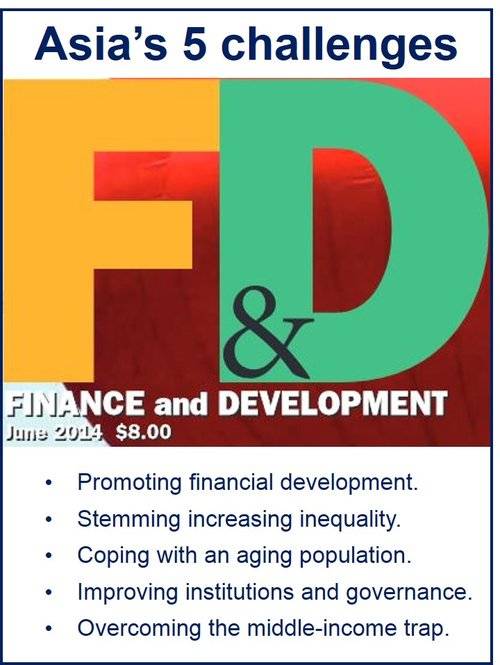
(Source: IMF)
About Asia
Asia is the world’s largest and most populous continent. It covers 8.7% of the Earth’s surface and comprises 30% of its land area.
- Population: approx. 4.3bn. 60% of the world’s population.
- Countries: 49 (+ five disputed).
- Economy: Asia has the 2nd largest nominal GDP after Europe.
- Largest economies: 1. China. 2. Japan. 3. India 4. South Korea. 5. Indonesia.
- Languages: There are thousands of languages in Asia. India and Indonesia have more than 800 and 100 languages respectively.
