
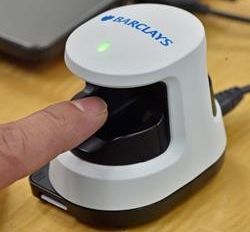
The Barclays Biometric Reader that uses finger vein authentication technology has been launched in the UK. Customers can easily access their online bank accounts and authorize payments by simply scanning their finger, with no need for authentication codes or passwords.
With the dramatic growth in online banking across the globe, and concern about the rising incidence of internet banking fraud, financial institutions are forever trying to find ways of being one step ahead of cyber criminals.
The Barclays Biometric Reader is a partnership between the London-based high-street bank and Hitachi Europe Ltd., and is aimed at fighting the ever-growing problem of fraud.
The compact device, which can read and verify your finger’s unique vein patterns, will initially be available to Barclays Corporate Banking clients, starting in 2015.
Unlike fingerprints, vein patterns are virtually impossible to falsify or replicate. The scanned finger will only authorize entry into a customer’s online banking pages if it is attached to a live human body, making it impossible for fraudsters to bypass the system by removing a person’s finger.
Barclays emphasized it will not hold the customer’s vein pattern, neither will there be any record of it.
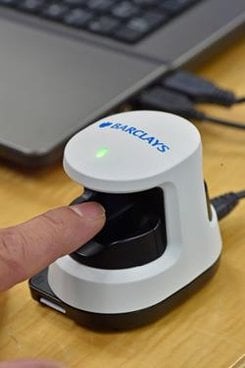 Barclays Biometric Reader – no need for passwords or authentication codes
A first for the global financial sector
Hitachi’s VeinID is already in use for password replacement, single sign on and cash machines in Europe, North America and Japan.
“However, the combination of vein biometric and highly secure digital signature technology in the Barclays Biometric Reader is a first for the global financial sector. There is future potential for it to be introduced more widely in UK branch networks, bringing this powerful technology to millions of consumers,” Barclays wrote in a press release.
The Barclays Biometric Reader follows its introduction of voice biometrics for Barclays Wealth customers. The voice-recognition technology has been successful; it removes the need for security questions or passwords – the customer is automatically identified during a phone call.
CEO of Barclays Personal and Corporate Banking, Ashok Vaswani, said:
“This solution is at the leading edge of innovation and is in direct response to client concerns about the threat of online fraud while making our customers’ lives easier through its convenience. We have shown the technology to a range of businesses and the interest and enthusiasm for the product is tremendous. The technology has also been tested by Hitachi for many years and it will be game-changing for UK businesses and consumers.”
“Ultimately, I hope this will pave the way for other institutions to adopt equally robust technology in the fight against online crime.”
Video – Barclays device scans veins in your fingers
As this BBC video explains, the device does not scan your fingerprint, it uses infrared light to scan the veins inside your finger.
