
Average wage growth UK thumbnail

Fastest wage growth rate since 2008, UK

Published: 15:29, December 11, 2018

The United Kingdom has registered its fastest wage growth rate since 2008. According to the Office for National Statistics, wages rose by 3.3% for the three months to October 2018, the greatest increase in a decade. The increase excludes bonuses.

A bonus is extra money that an employer pays a worker because he or she performed well. Sometimes, employees may also get a bonus because the employer has performed well.

The average weekly wage in the UK today stands at £495. When adjusted for inflation, it is at its highest level since 2011.

Wage growth and other highlights

Below are some highlights from the Office for National Statistics’ press release today:

  • Employment rose by 79,000 compared to the previous quarter. Employment reached a record 32.48 million in the three months to October 2018.
  • Unemployment rose by 20,000 to 1.38 million.
  • Economic inactivity declined by 95,000 to 8.66 million.
  • Regular average weekly wages rose by 3.3% on the year. Weekly earnings reached £495 in October 2018.
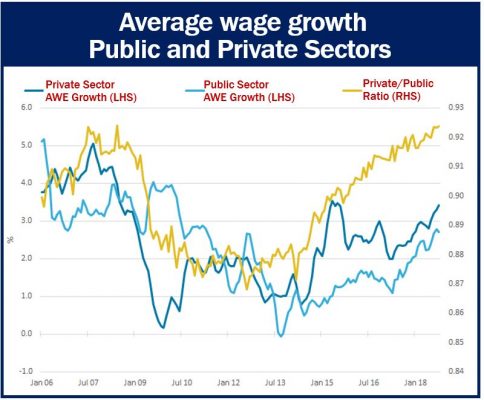
  • The gap between private sector and public sector earnings is narrowing.
Average Wage Growth
Average wage growth in public/private sectors in the UK. Seasonally adjusted, January to March 2006 to August to October 2018. (Image: adapted from ons.gov.uk)

Wage growth since global financial crisis

Since the global financial crisis of 2007/8, wage growth has been a persistent problem. Even when the UK economy began expanding again after the Great Recession, wage growth was extremely weak. In fact, for most of the time, until recently, it had not managed to keep up with inflation.

The Office for National Statistics says the following regarding average earnings (wages):

“Our employment earnings analysis is based on average weekly earnings (AWE) paid to workers in Great Britain.”

“The average weekly earnings measure the amount of money paid to each worker per job per week, excluding benefits in kind, unearned income and arrears of pay. The estimates exclude earnings of people who are self-employed, and are calculated before tax and other deductions.”

Veronica Salvador Avatar

Other News

Proofpoint agrees to buy Varonis in $6.3 billion data security deal

Oct 16, 2026

EU tourist accommodation records 3.14 billion nights in 2025

Oct 16, 2026

Travelers profit edges higher as investment income sets a record

Oct 16, 2026

Euro-area inflation reaches 3.8% as energy pressure intensifies

Oct 16, 2026

UK regulator proposes new oversight of Microsoft business software

Oct 16, 2026

US industrial output rises 0.7% as utilities outpace factories

Oct 16, 2026

Mercedes-Benz extends Nvidia partnership for automated driving

Oct 16, 2026

Drought can disrupt food supplies far beyond affected farms

Oct 15, 2026

ManpowerGroup picks Becky Frankiewicz to lead its recovery

Oct 15, 2026

Euro area industrial output falls for a third month

Oct 15, 2026

GTCR and Elliott agree $6.1 billion takeover of insurance software group CCC

Oct 15, 2026

UK economy grows 0.1% in August, beating forecasts of a fall

Oct 15, 2026

TSMC forecasts another sales jump after profit rises 68.7%

Oct 15, 2026

EU e-waste collection remains far below its main target

Oct 14, 2026

IMF forecasts 3.1% growth with less room to absorb another shock

Oct 14, 2026

ASML weighs more capacity after a record €11.7 billion quarter

Oct 14, 2026

Buying robots does not always make factories more productive

Oct 13, 2026

Making electronics entirely in the US could raise costs by 41% to 152%

Oct 13, 2026

6G standards take shape while 5G investment continues

Oct 13, 2026

Five growth markets shaped by aging populations and infrastructure needs

Oct 13, 2026