
Another general relativity test shows that Albert Einstein was right. Einstein’s General Theory of Relativity predicted that all objects would fall at the same rate. They would fall at the same rate regardless of their composition or mass.
While his theory has passed countless tests here on our planet, things have not been so clear-cut in outer space. Specifically, regarding the densest and most massive objects in the Universe. When talking about outer space, we are referring to the ‘Strong Equivalence Principle.’
A team of scientists from The Netherlands, Australia, the USA, and Canada have carried out a test. Their general relativity test showed that Einstein’s insights into gravity were right. Put simply; they held sway even in the Universe’s most extreme scenarios.
General relativity test – using stars
Apollo 15 astronaut David Scott dropped a feather and a hammer on the Moon. They both hit the lunar surface at the same time.
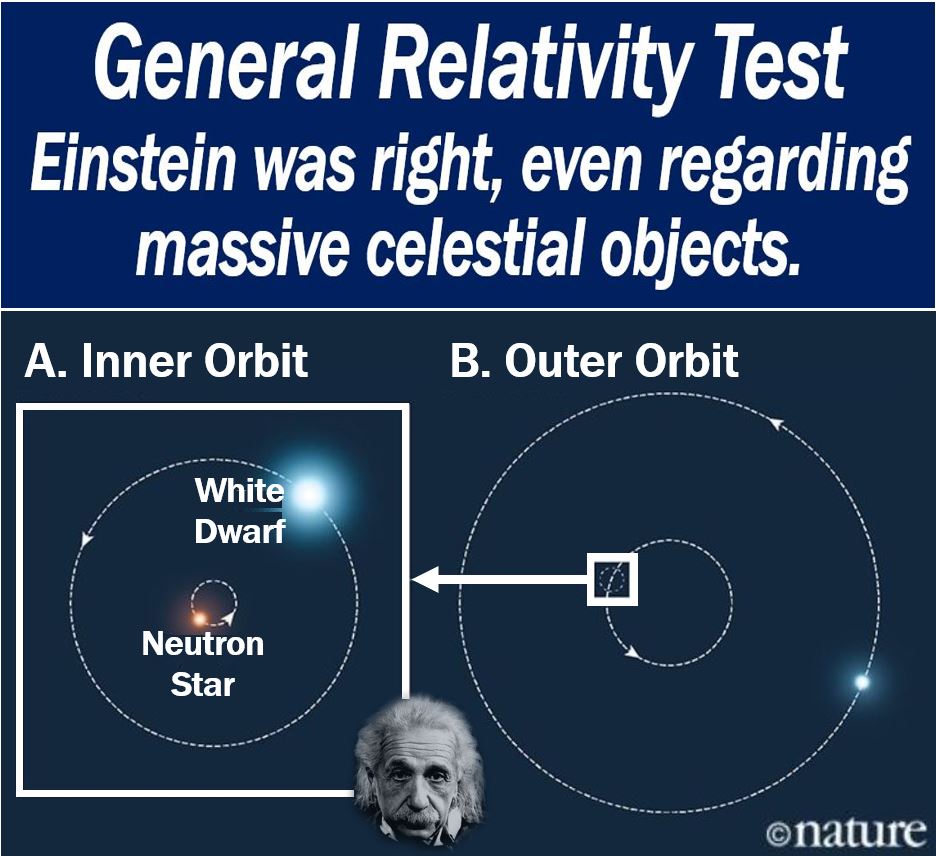
In this latest study, Archibald et al. used two falling celestial objects:
1. A neutron star.
2. A white dwarf.
Their general relativity test using a spinning neutron star and a white dwarf showed that Einstein was right. Therefore, his theory applies to everything, even giant objects in outer space.
Commenting on the study, Clifford M. Will, from the Department of Physics at the University of Florida, wrote the following in Nature:
“The authors have provided what is known as a strong-field test of general relativity. Unlike the Solar System, for which Einstein’s theory predicts only small deviations from Newton’s theory of gravity, the motion of a neutron star in a gravitational field invokes full general relativity in all its complex glory. Einstein’s theory passes this strong-field test with flying colors.”
Reference:
‘Universality of free fall from the orbital motion of a pulsar in a stellar triple system,’ Anne M. Archibald, Nina V. Gusinskaia, Jason W. T. Hessels, Adam T. Deller, David L. Kaplan, Duncan R. Lorimer, Ryan S. Lynch, Scott M. Ransom & Ingrid H. Stairs. Nature 559, pages 73–76 (2018). O4 July 2018. DOI: 0.1038/s41586-018-0265-1.
