
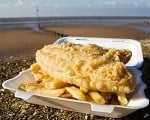
British fish and chips favourites like plaice and haddock will become less common and much more expensive, making way to red mullet and John Dory as North Sea water temperatures rise due to global warming, researchers from the UK, Ireland and Australia reported.
Fish distributions are limited by the temperature of the water, and some species can only exist in certain habitats and depths.
Over the last four decades the North Sea has been warming four times faster than the global average. Over the next century it is forecast to continue getting warmer. Leading fisheries researchers set out to determine how this might affect commercial species.

Will our plaice and chips become John Dory and chips?
A team of scientists, who published their findings in the academic journal Nature Climate Change (citation below), developed a model that combined climate model projections from the UK’s Met Office with long-term fisheries datasets to forecast the distribution and abundance of the UK’s favourite fish over the next five decades.
The team found that as the North Sea warms, species will have little capacity to move further north to avoid rising temperatures, since habitat with the right depth is not available.
Several populations will decline
Because of higher temperatures, several of the species studied are likely to become less abundant, and consequently much more expensive, the authors wrote.
Postgraduate researcher in biosciences at the University of Exeter, Louise Rutterford, said:
“Our study suggests that we will see proportionally less of some of the species we eat most of as they struggle to cope with warming conditions in the North Sea.”
“We provide new insight into how important local depths and associated habitats are to these commercial species. It’s something that is not always captured in existing models that predict future fish distributions.”
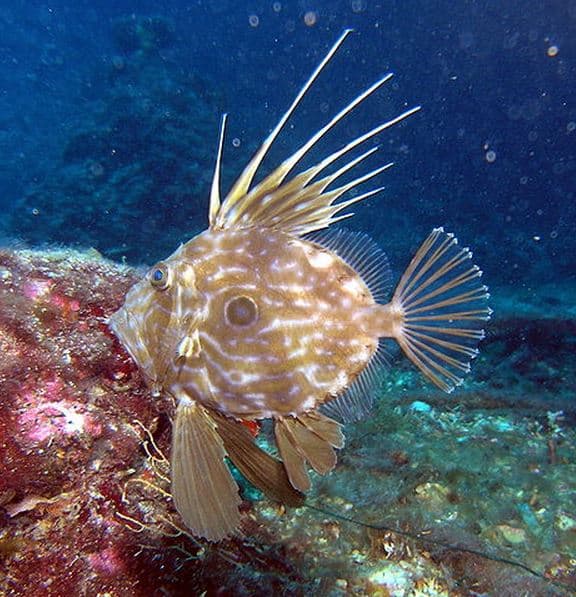
Sardines, Red Mullet, gurnard, John Dory (pictured above), anchovies, cuttlefish and squid would become more common in warmer North Sea waters, while the populations of haddock, plaice and Dover sole would decline significantly.
Dr. Martin Genner, Senior Lecturer in Fish Ecology and Evolution at the University of Bristol, added:
“Long-term standardised fisheries surveys from many European countries, alongside leading climate models for the region, mean it is a unique region to develop and test new modeling approaches.”
“The modeling technique used in this analysis performed remarkably well when tested on available long-term datasets. This provides real confidence in the model’s ability to predict future patterns of fish distributions around the UK.”
Changes will soon be noticeable
The authors say their findings are important for both the fishing industry and consumers. We are likely to see noticeable changes in the next few decades.
Dr. Steve Simpson, Senior Lecturer in Marine Biology & Global Change at the University of Exeter, said:
“Our models predict cold water species will be squeezed out, with warmer water fish likely to take their place. For sustainable UK fisheries, we need to move on from haddock & chips and look to Southern Europe for our gastronomic inspiration.”
Citation: “Future fish distributions constrained by depth in warming seas,” Louise Rutterford, Stephen Simpson, Simon Jennings, Mark Johnson, Julia Blanchard, Pieter-Jan Schön, David Sims, Jonathan Tinker and Martin Genner. Nature Climate Change. Published 13 April, 2015. DOI: 0.1038/nclimate2607.
