
Google has filed a patent for a sticky coating that can be placed on driverless vehicles to help mitigate the amount of damage done to pedestrians when hit.
The patent describes a layer of adhesive, hidden under a protective coating, placed on a car’s bonnet (hood) and side panels, which, upon collision, breaks into a gluey surface; the idea being that pedestrians stick to the front of the car as opposed to bouncing off.
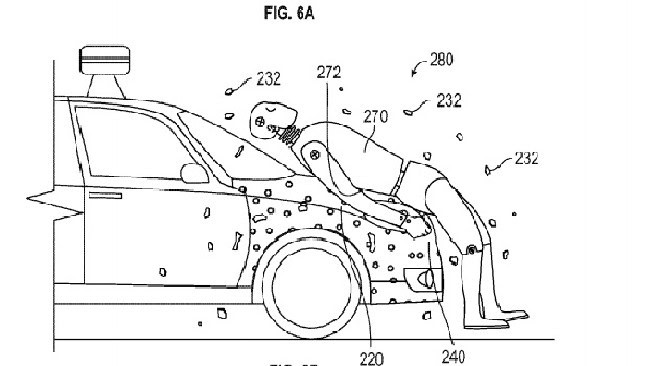
“Upon impact with a pedestrian, the coating is broken exposing the adhesive layer,” read the patent document by Google.
“The adhesive bonds the pedestrian to the vehicle so that the pedestrian remains with the vehicle until it stops, and is not thrown from the vehicle, thereby preventing a secondary impact between the pedestrian and the road surface or other object.”
Google said that there are no immediate plans to begin implementing the technology on vehicles, but stressed that the patent highlights how seriously it is taking road safety.
Andrew Morris, Professor of Human Factors in Transport Safety at Loughborough University, told the BBC: “It does have some merit to it.”
He added: “When pedestrian accidents happen, often the person is thrown up onto the bonnet and there may be injuries from that contact, but sometimes there are not.
“But when a driver brakes in a collision, a totally natural reaction, the pedestrian is thrown onto the ground and you can get injuries from that contact.”
Kevin Clinton, head of road safety at the Royal Society for the Prevention of Accidents, said: “As well as developing new technology that prevents pedestrians from being hit in the first place, it’s also crucial to develop ways of reducing the severity of injuries suffered if a pedestrian is knocked over.”
“This idea is a fascinating example of just how far vehicle technology is changing,” he told the BBC.
“It will obviously need to be developed and tested to ensure that it works reliably and doesn’t cause any unintended consequences.”
Rebecca Thompson, head of public outreach for the American Physical Society, told Gizmodo:
“Getting hit by a car once is much preferable to getting hit by a car and then the ground and then another car. Cyclists wear helmets not as much to prevent their head’s impact with the car as much as their head’s impact with the ground when they fall.”
