
Humans have been consuming honey for at least the past 8,500 years, a new study has found, after detecting traces of beeswax in cooking vessels from the Stone Age.
Previous evidence from prehistoric rock art appeared to show honey hunters, while Pharaonic Egyptian murals contain early scenes of beekeeping. However, the close association between the honeybee and early farmers has long remained uncertain.
In this study, an international team of researchers – from the UK, France, Germany, Finland, Slovenia, Spain, Poland, Tunisia, Italy, Ireland, Portugal, Hungary, Algeria, Turkey, Greece, Serbia, and Austria – gathered together evidence for the presence of beeswax in the pottery vessels of Europe’s first farmers by analyzing the chemical components trapped in the clay fabric of over 6,000 potsherds (broken pieces of ceramic material) from more than 150 Old World archaeological sites.
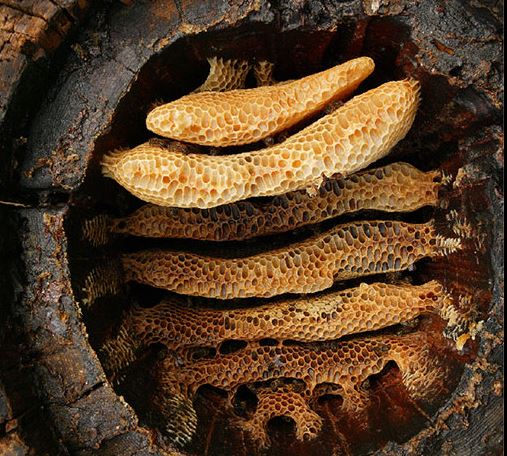 We have been exploiting bees as far back as the Stone Age. (Image: humanities.exeter.ac.uk Credit: Eric Tourneret)
Honeybees and humans linked since prehistoric times
The researchers detected the chemical ‘fingerprint’ of beeswax at several Neolithic sites across Europe, showing how widespread the relationship between honeybees and humans was in prehistoric times. The Neolithic Age (New Stone Age) dates from about 10,200 BC to between 4,500 and 2,000 BC.
For example, they detected beeswax in the cooking pots unearthed at a Turkish archaeological site dating back to the seventh millennium BC – the oldest evidence so far of bee products used by Neolithic farmers.
The paper brings together more than 20 years of research conducted at Bristol University’s Organic Geochemistry Unit, led by Prof. Richard Evershed.
Lead author, Dr. Mélanie Roffet-Salque, a Postdoctoral Research Assistant at the University of Bristol’s School of Chemistry, said:
“The most obvious reason for exploiting the honeybee would be for honey, as this would have been a rare sweetener for prehistoric people. However, beeswax could have been used in its own right for various technological, ritual, cosmetic and medicinal purposes, for example, to waterproof porous ceramic vessels.”
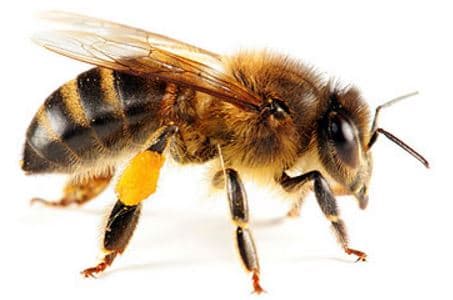 It is sad that after several thousand years of maintaining a relationship with these lovely insects, there is today a 13-million shortfall of honeybee colonies in Europe.
Prehistoric honeybees did not like very cold climates
There is no evidence of any beeswax usage at Neolithic sites above the 57th parallel North, as in Scotland and Scandinavia, suggesting that honeybees did not exist that far north at the time.
Professor Evershed said:
“The lack of a fossil record of the honeybee means it’s ecologically invisible for most of the past 10,000 years. Although evidence from ancient Egyptian murals and prehistoric rock art suggests mankind’s association with the honeybee dates back over thousands of years, when and where this association emerged has been unknown – until now.
“Our study is the first to provide unequivocal evidence, based solely on a chemical ‘fingerprint’, for the palaeoecological distribution of an economically and culturally important animal. It shows widespread exploitation of the honeybee by early farmers and pushes back the chronology of human-honeybee association to substantially earlier dates.”
Nature News quoted Helen Anderson, a rock-art specialist at the British Museum in London, who said:
“The paper is fantastic for what it shows about how bees are being used as a resource.”
Professor Alan Outram, Head of Archaeology at the University of Exeter, who was involved in planning the project, said:
“At a time when bee populations are being threatened, this is a timely reminder of how important this species has been to humans over many millennia.”
Citation: “Widespread exploitation of the honeybee by early Neolithic farmers,” Mélanie Roffet-Salque, Martine Regert, Richard P. Evershed, Alan K. Outram, Lucy J. E. Cramp, Orestes Decavallas, Julie Dunne, Pascale Gerbault, Simona Mileto, Sigrid Mirabaud, Mirva Pääkkönen, Jessica Smyth, Lucija Šoberl, Helen L. Whelton, Alfonso Alday-Ruiz, Henrik Asplund, Marta Bartkowiak, Eva Bayer-Niemeier, Lotfi Belhouchet, Federico Bernardini, Mihael Budja, Gabriel Cooney, Miriam Cubas, Ed M. Danaher, Mariana Diniz + et al. Nature 527, 226–230. 12 November, 2015. DOI: 10.1038/nature15757.
