
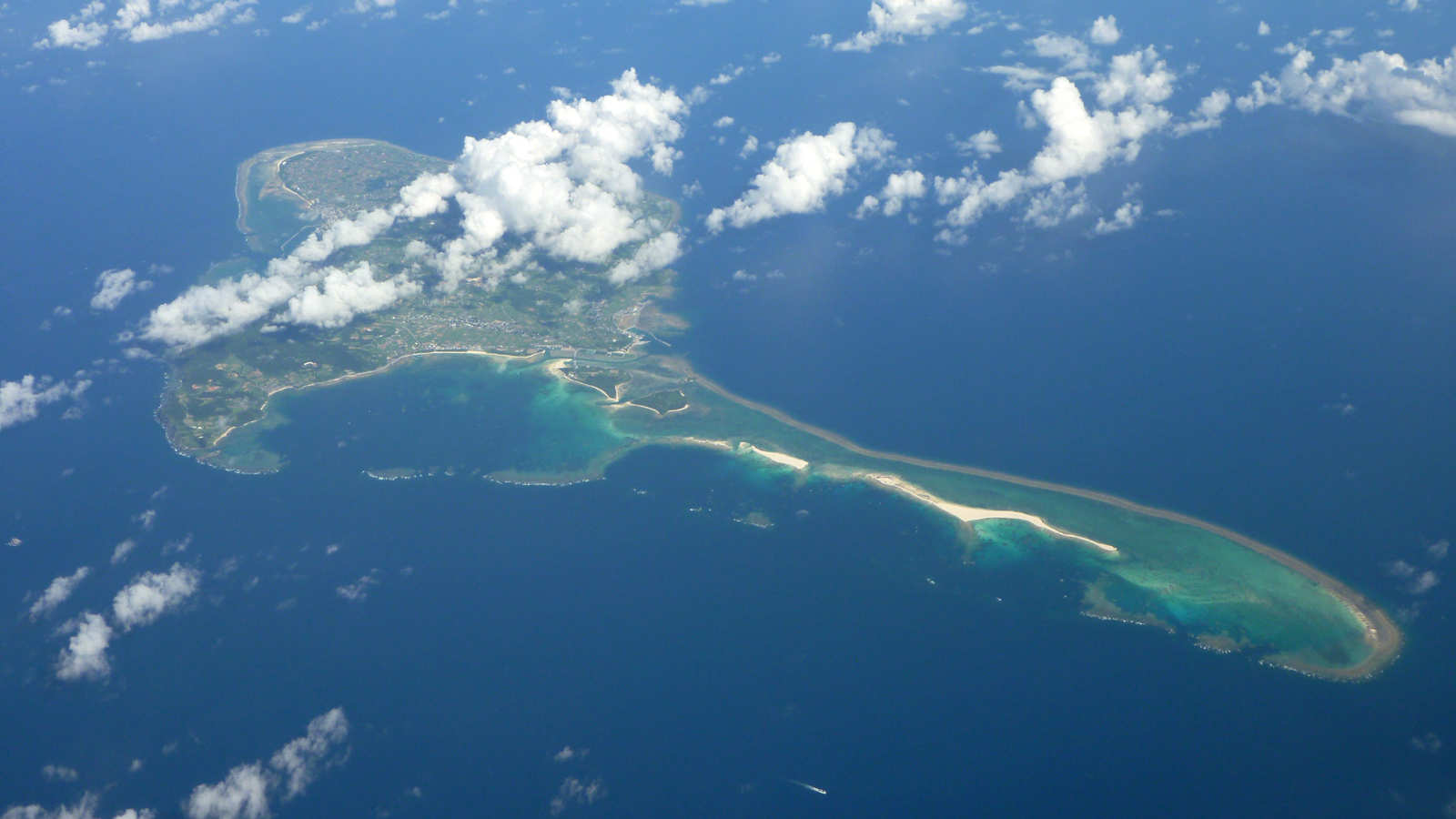
A remote Japanese island could become a testing ground for a new kind of carbon economy, one that begins by extracting carbon dioxide from seawater and could eventually supply verified carbon-removal credits or raw material for synthetic aviation fuel.
Hitachi, Mitsui O.S.K. Lines and Japan Airlines have signed an agreement to conduct a direct ocean capture pilot on Kume Island in Okinawa Prefecture.
The immediate goal is relatively narrow. The companies want to determine whether the technology can operate effectively with seawater from around the island and collect data on its energy use, operating challenges and possible environmental effects.
The pilot is not described as producing aviation fuel. The companies see it as an early step toward a broader system in which captured carbon could be measured, verified and put to commercial use.
That longer-term vision includes using carbon dioxide from seawater to help produce synthetic aviation fuel, commonly known as E-SAF.
How carbon can be removed from seawater
The ocean and atmosphere constantly exchange carbon dioxide. As the concentration of the gas in the atmosphere changes, the ocean absorbs or releases carbon as it moves toward a chemical balance with the air above it.
Direct ocean capture, or DOC, attempts to use this natural process to remove carbon dioxide from the atmosphere indirectly.
The planned Kume Island pilot will use containerized equipment installed on land. Seawater will be drawn into the system, processed to separate some of its dissolved carbon and then returned to the sea.
The technology was developed by US company Captura, in which all three Japanese companies have invested.
Captura’s standard process uses electrodialysis, a technique that applies electricity across special membranes. This produces acidic and alkaline streams from seawater.
The acidic stream changes the water’s chemistry so that dissolved carbon can be released and collected as carbon dioxide gas. The alkaline stream is then used to neutralize the water before it is discharged.
Because the returned water contains less carbon, it has more capacity to absorb carbon dioxide from the atmosphere as it mixes with the surrounding ocean.
How quickly and completely this atmospheric uptake happens depends on factors such as water chemistry, ocean circulation, mixing and air-sea gas exchange. Measuring that process will be important if the technology is eventually used to claim verified carbon removal.
Why use the ocean instead of capturing carbon from air?
Carbon dioxide is extremely diluted in the atmosphere. Technologies that capture it directly from air must move large amounts of air through filters or chemical systems.
Seawater contains carbon in more concentrated forms, including dissolved carbon dioxide, bicarbonate and carbonate. The project partners say the relevant concentration is approximately 100 to 150 times greater by volume than in the atmosphere.
In theory, this could allow a system to recover carbon using less energy than some direct-air-capture methods. However, the Kume Island pilot has not yet produced data showing how much energy the system will consume under local conditions.
Captura says its technology is designed to operate using seawater and renewable electricity. The companies have not disclosed what source of electricity will power the Japanese pilot.
From captured gas to carbon credits
Separating carbon dioxide from seawater is only the first part of the proposed business model. The companies would also need to prove how much carbon was ultimately removed from the atmosphere and what happened to it afterward.
Hitachi will measure the amount of carbon dioxide captured and the electricity consumed during the pilot. It also plans to monitor operating conditions and changes in seawater, including dissolved inorganic carbon and pH.
The company intends to use this information to help build a monitoring, reporting and verification system, commonly known as MRV.
MRV is essential for carbon markets. A buyer needs reliable evidence that a claimed removal actually happened, that it would not have happened without the project and that emissions created by operating the system have been properly counted.
For the captured carbon to qualify as durable carbon removal, it would also need to be stored for the long term.
The US National Oceanic and Atmospheric Administration defines carbon dioxide removal as taking carbon from the atmosphere and storing it for a long period. NOAA also notes that marine carbon-removal technologies still involve uncertainties over their effectiveness, cost, scalability and effects on ecosystems.
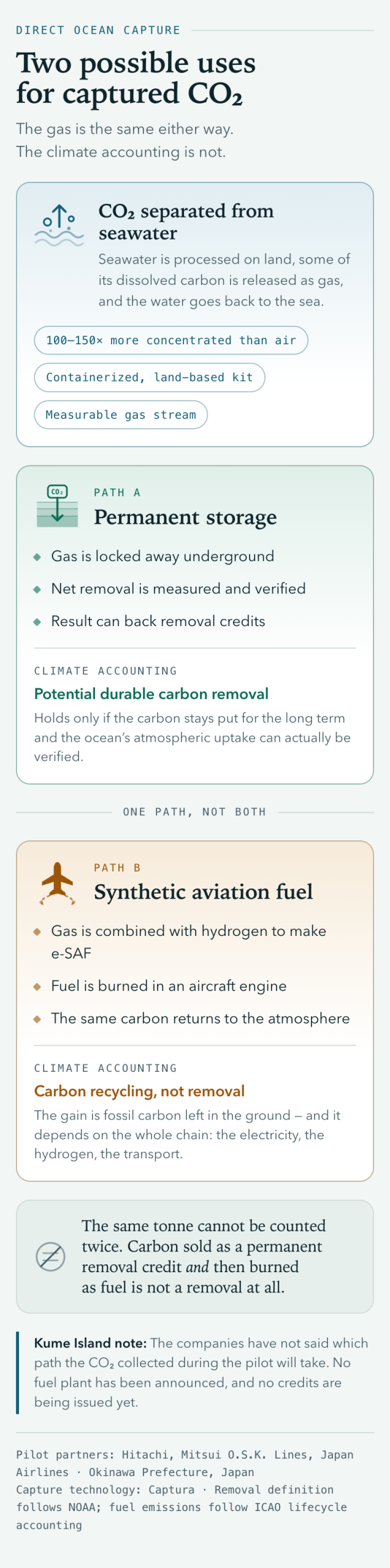
Captura says carbon dioxide produced by its systems can be sent for permanent geological storage or used as an industrial raw material. The companies have not said how the carbon collected during the Kume Island pilot will be handled.
Could the captured carbon become aviation fuel?
The project’s more unusual ambition is to use carbon dioxide recovered from seawater as an ingredient in synthetic aviation fuel.
E-SAF can be produced by combining captured carbon dioxide with hydrogen. The hydrogen is generally made by using electricity to split water into hydrogen and oxygen.
If the electricity comes from renewable or other low-carbon sources, the resulting fuel may have substantially lower lifecycle emissions than conventional jet fuel.
Japan Airlines says it will evaluate the usefulness of direct ocean capture with a view toward possibly procuring E-SAF made from captured carbon dioxide in the future.
However, the announced pilot will not test the complete fuel-production process. No E-SAF facility has been announced for Kume Island, and the companies have not provided a timetable for producing fuel from the captured gas.
There is also an important difference between using carbon to make fuel and permanently removing it.
When E-SAF is burned in an aircraft engine, the carbon dioxide in the fuel is released back into the atmosphere. The approach therefore recycles carbon rather than storing it permanently.
Its potential benefit comes from reducing the need to extract and burn additional fossil carbon. The actual reduction in emissions depends on the complete production chain, including the source of electricity, the method used to make hydrogen, the source of the carbon dioxide and the energy required to produce and transport the fuel.
The International Civil Aviation Organization evaluates aviation fuels using lifecycle emissions rather than treating every alternative fuel as automatically carbon neutral.
The same captured carbon could not credibly be sold as a permanent carbon-removal credit and then used in fuel that releases it back into the atmosphere.
Why Kume Island?
Kume Island already has experience with projects that use seawater for energy and economic development.
The island hosts an ocean thermal energy conversion demonstration facility. OTEC generates electricity by using the temperature difference between warm surface water and cold water drawn from deeper in the ocean.
Mitsui O.S.K. Lines has an existing partnership with Kumejima Town covering renewable energy, deep-ocean water, industrial development and tourism.
The local government has developed what it calls the Kumejima Model, which uses deep-ocean water for several purposes, including energy generation, aquaculture and other local industries. The town has set a goal of achieving 100% energy self-sufficiency through renewable sources by 2040.
This concentration of marine infrastructure, technical knowledge and local partnerships makes the island a practical place to test another seawater-based technology.
However, the companies have not said that the direct ocean capture pilot will use deep-ocean water, share equipment with the OTEC facility or receive electricity directly from it.
Different commercial interests
Each of the three companies has a different reason to participate.
Hitachi is leading the project and will work on water analysis, operational controls, carbon measurement and equipment that could eventually be supplied to commercial plants.
Mitsui O.S.K. Lines will use its existing relationship with Kumejima Town to work with local stakeholders and prepare the pilot environment. The shipping company also wants to explore new businesses that could develop around the technology.
MOL has already agreed to purchase approximately 30,000 carbon-removal credits from one of Captura’s planned commercial facilities. The credits are expected to be delivered before the end of 2030, provided that the facility is developed and delivers the promised removals.
Japan Airlines will work with regional airline subsidiaries to raise awareness of the project. Its main long-term interest is whether captured carbon could help supply lower-emission aviation fuel.
JAL previously invested in Captura in March 2024 as part of its work on emerging carbon-removal technologies.
The technology has already moved beyond the laboratory
Kume Island will not be Captura’s first real-world deployment.
The company began operating a pilot plant in Kona, Hawaii, in February 2025. Captura says the facility is capable of capturing 1,000 metric tons of carbon dioxide per year.
The Hawaii plant followed two smaller systems in California. Captura says it is now designing its first commercial facility, targeting an annual capacity of between 30,000 and 50,000 metric tons.
Those figures remain small compared with global carbon dioxide emissions. The purpose of the pilots is to establish whether the process can work reliably, efficiently and safely before companies attempt much larger deployments.
What the Japanese pilot still needs to prove
The companies have not disclosed the Kume Island pilot’s planned capture capacity, cost, construction timetable or operating period.
They have also not said how much seawater it will process, where its electricity will come from or what will happen to the captured carbon dioxide.
The pilot will need to produce data on several important questions:
- How reliably the system operates with local seawater
- How much electricity is needed for each metric ton of carbon captured
- Whether the discharge causes measurable changes in nearby water
- How atmospheric carbon uptake can be calculated and verified
- Whether the process can eventually operate at a commercially useful scale
For now, Kume Island is not becoming an aviation-fuel plant or issuing carbon-removal credits. It is preparing to test the first link in a much larger proposed chain: removing a measurable stream of carbon dioxide from seawater.
If that process works reliably and its environmental effects can be managed, Japan could then decide whether future captured carbon should be placed in permanent storage or recycled into products such as synthetic aviation fuel.
The pilot will not prove that an entire island-based carbon economy is commercially viable. It could, however, show whether such an economy has a practical place to begin.
