
Texas has stopped additional data centers from advancing through ERCOT’s grid-connection process until regulators audit every project in that queue.
Governor Greg Abbott issued the directive on August 3, 2026. It orders the Public Utility Commission of Texas and the Electric Reliability Council of Texas, better known as ERCOT, to conduct a comprehensive verification and audit of all data centers advancing through ERCOT’s interconnection process.
Interconnection is the formal process used to decide whether, where and under what conditions a large electricity user can connect to the grid.
The agencies must complete the audit before any additional data centers in that process are approved to move forward. A project that fails to meet requirements set by the commission, ERCOT or state law must be denied a grid connection.
No deadline has been announced for completing the audit. The detailed pass-or-fail rules for individual projects have also not been published.
The order is narrower than a statewide construction ban
The directive applies to data centers seeking to advance through ERCOT’s grid-connection process. It does not order existing data centers to close, and it does not prohibit every data-center construction project across Texas.
A facility that is completely self-supplied and has no connection to the ERCOT grid would generally fall outside the interconnection process. A project that generates some of its own electricity but still seeks a grid connection remains within that process.
Why the size of the queue alarmed officials
In a July 29 presentation, ERCOT said it was tracking approximately 474 gigawatts of large electricity loads seeking interconnection. About 90% of that requested capacity was associated with data centers.
One gigawatt equals 1,000 megawatts, so the queue represented about 474,000 megawatts of requested capacity.
For comparison, ERCOT recorded a preliminary record hourly peak demand of 91,089 megawatts, or 91.089 gigawatts, on July 22, 2026. The queue was therefore about 5.2 times that record.
That comparison shows how large the queue has become. It does not mean Texas is about to add 474 gigawatts of real electricity use.
The number combines requests from projects at different stages. Some may be delayed, reduced, moved to another location or abandoned. The queue is not an official forecast that every project will be built.
The published queue figures rose quickly
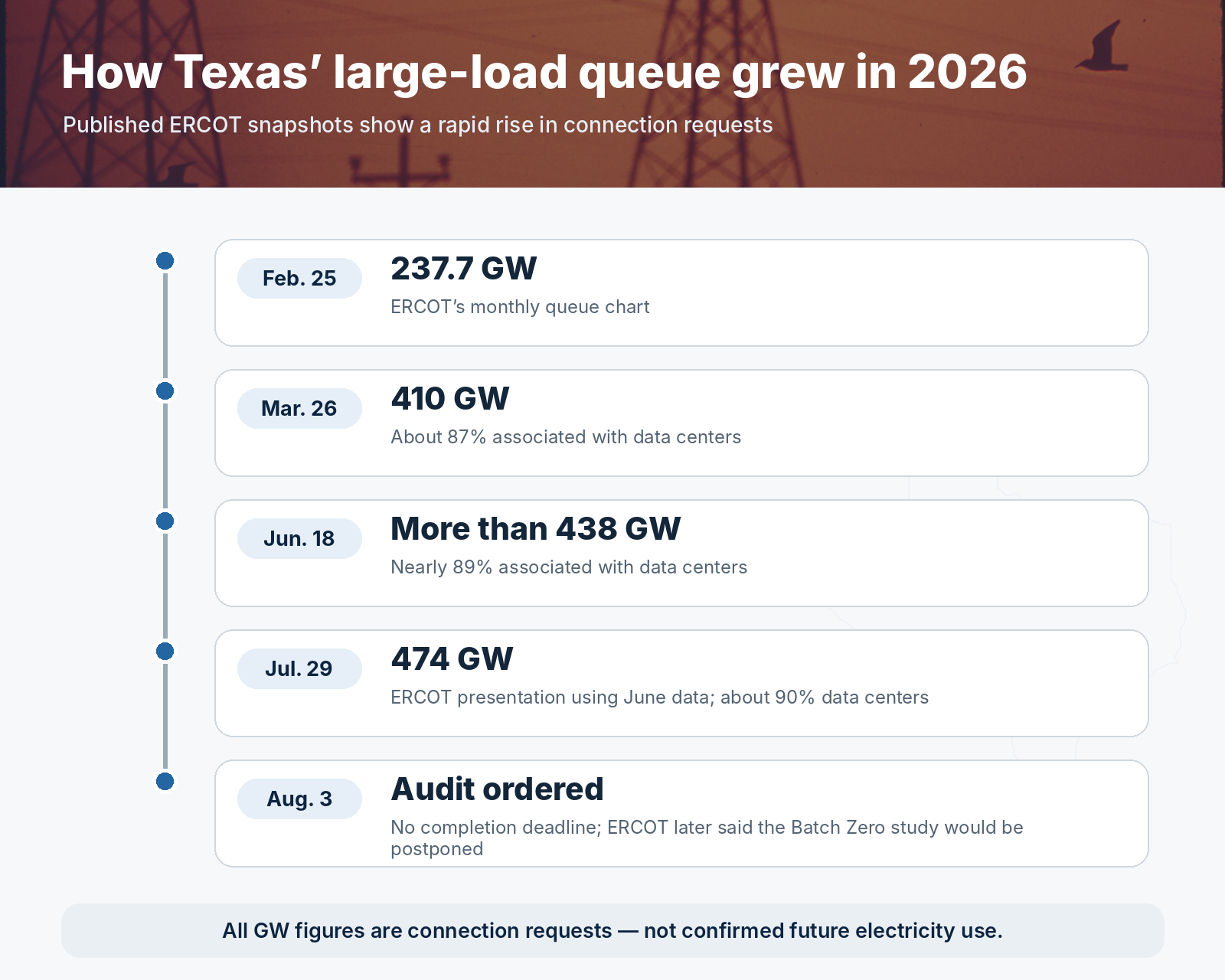
ERCOT’s published snapshots show how rapidly the amount of requested capacity increased during 2026:
- February 25: ERCOT’s monthly queue chart showed approximately 237.7 gigawatts of tracked large-load projects.
- March 26: ERCOT reported approximately 410 gigawatts, with about 87% associated with data centers.
- June 18: ERCOT said it was tracking more than 438 gigawatts, nearly 89% of it associated with data centers.
- July 29: An ERCOT presentation using June data placed the queue at approximately 474 gigawatts, with about 90% associated with data centers.
- August 3: Abbott ordered the project-by-project audit.
The figures come from different ERCOT snapshots. They track requests rather than confirmed construction or guaranteed future consumption.
What data-center developers must disclose
Abbott’s order requires regulators to obtain five broad categories of information from every data-center project covered by the audit.
Public financial assistance
Developers must disclose state and local tax incentives, grants, abatements and other public financial assistance they have received or expect to receive.
Electricity demand and on-site power
Projects must provide their expected annual and peak electricity use. They must also describe any plans to build or buy on-site generation and any other measures intended to reduce demand on the ERCOT grid.
Water use and cooling
Developers must report expected annual and peak water use, planned water sources and water-reuse measures. They must also identify whether the facility will use air cooling, a closed-loop system or another water-efficient cooling design.
Effects on nearby communities
The audit will examine noise controls, lighting, setbacks, traffic improvements, emergency-response coordination and other measures intended to limit effects on surrounding properties and communities.
Ownership and control
Each project must disclose its owners and controlling interests.
Texas’s new Batch Zero process has been postponed
The audit interrupted a new grid-planning system that had only recently been approved.
On June 18, the Public Utility Commission approved ERCOT’s Batch Zero process. Instead of studying large connection requests one at a time, ERCOT planned to examine qualifying projects of at least 75 megawatts together.
The aim was to measure their combined effect, decide how much power could be supplied in different locations and identify the transmission upgrades required to serve them.
ERCOT’s July 29 presentation said approximately 205 gigawatts of proposed large loads appeared eligible for Batch Zero based on existing studies. That was a preliminary eligibility figure, not approval to connect or use that amount of electricity.
ERCOT had planned to issue project classifications by August 7 and begin the Batch Zero interconnection study no later than September 2.
In an August 3 market notice, ERCOT said it would not issue the classifications by August 7. It also said it would request an exception to the Batch Zero timelines before the Public Utility Commission’s August 20 open meeting and then consult the commission on the next steps.
No new start date for the Batch Zero study or completion date for the audit had been announced as of August 4.
Texas had already tightened rules for very large power users
The August order follows an earlier change in state law.
Governor Abbott signed Senate Bill 6 on June 20, 2025, and it took effect immediately. The law directed the Public Utility Commission to create standards for large loads seeking new or expanded connections in the ERCOT region.
The standards generally apply when total demand at one site would exceed 75 megawatts, unless the commission decides that a lower threshold is necessary.
The law requires the commission’s rules to make covered large-load customers contribute toward grid-connection costs. It also calls for a screening-study fee of at least $100,000, proof that the developer controls the proposed site, financial commitments for required infrastructure, disclosure of substantially similar power requests elsewhere in Texas and information about qualifying on-site backup generation.
Why the pause matters for business
For data-center developers, the immediate result is uncertainty.
A company can obtain land, financing, construction contractors and computing equipment but still be unable to operate at its planned size without an approved electricity connection.
The audit adds another review before covered projects can advance. Until regulators publish the process, developers do not know how long it will take, which evidence will be enough or whether previously submitted information will have to be provided again.
The delay can affect construction schedules, equipment orders, financing agreements and contracts that depend on power becoming available by a particular date.
It could also make on-site generation, flexible electricity use and water-efficient cooling more important when developers design projects. None of those measures, however, guarantees approval.
What remains unknown
As of August 4, state officials had not published:
- A deadline for completing the audit
- Detailed standards for passing or failing
- A new start date for the Batch Zero study
- Whether previously submitted documents can be reused
- Which project information will become public
- Whether developers will have a formal appeal process
Those details will determine whether the order creates a short administrative delay or a much longer interruption to data-center development in the ERCOT region.
Electricity is becoming a limiting resource for AI infrastructure
Texas is not rejecting technology investment. Abbott’s letter says the state can protect affordable energy, grid reliability, water supplies and local communities while continuing to create jobs and economic opportunities.
The change is that proposed investment alone is no longer enough. Developers covered by the audit must show regulators how much electricity and water they need, what public support they expect, who controls the project and how they plan to limit effects on surrounding communities.
The 474-gigawatt queue may never become 474 gigawatts of actual demand. Its size still shows why access to electricity is becoming one of the most important commercial constraints on the expansion of AI and data-center infrastructure.
