
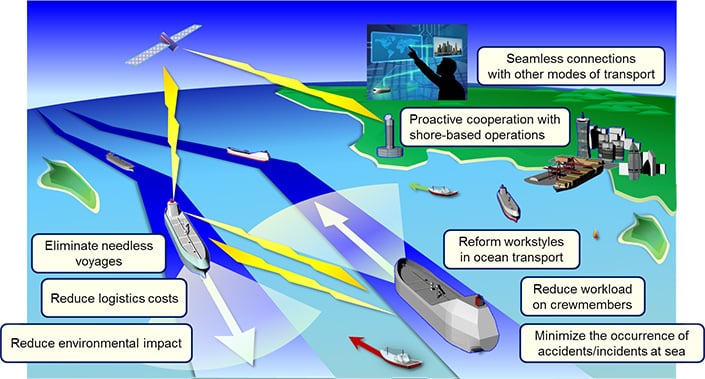
Every year, the Japanese government awards research and development funding to projects that seek to solve traffic and transportation problems. This fiscal year, one of the winning projects concerns the development of technology for autonomous ocean ships and the transport system to support them.
The purpose of the project is to set a course for developing the technology needed to ensure safe, efficient, and reliable autonomous ocean ships.
The award – made by Japan’s Ministry of Land, Infrastructure, Transportation and Tourism – goes to a consortium of Japanese firms, research and technology establishments, and regulators. The research and development (R&D) consortium will be led by Mitsui O.S.K. Lines and Mitsui Engineering & Shipbuilding.
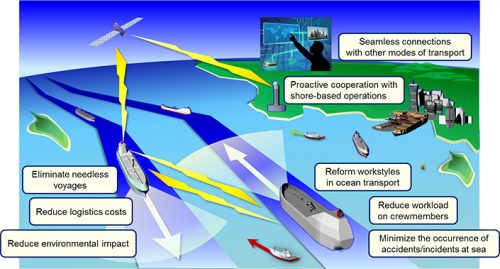 The R&D consortium will be researching how to make autonomous ocean ships reliable, safe, and efficient. Source: MOL
As well as the technology itself, the project will also be looking at how to develop the infrastructure to support such a system, and how to win public support for the concept.
The consortium propose to do this by making the results of their research available to the public and the maritime industry.
Consortium members and specialisms
Each member of the consortium will focus on a particular aspect of the project, as follows:
– Mitsui Engineering & Shipbuilding, Akishima Laboratories (Mitsui Zosen) Inc: shipbuilding and system integration
– Tokyo University of Marine Science: advanced research on ship navigation
– Mitsui O.S.K. Lines: high performance in vessel operations
– Nippon Kaiji Kyokai (class NK): ship class rules and regulations
– Japan Ship Technology Research Association: coordinating and promoting cooperative research
– National Institute of Maritime, Port, and Aviation Technology: assessment of technology to ensure safety
Follows other news about autonomous ocean ships
The news about the Japanese consortium follows other recent announcements regarding autonomous ocean ships.
The One Sea consortium aims to lead the way in establishing an “autonomous maritime ecosystem” in the Baltic Sea by 2025.
The Danish authorities are also inviting proposals from parties interested in analyzing the regulatory barriers – both national and international – to the development of autonomous ocean ships. The Danish Maritime Authority sees this a route to establishing a “knowledge base” to spur the development of autonomous maritime transport.
And earlier this year, Rolls Royce predicted that in the near future we shall be seeing large vessels navigating the oceans with no humans aboard. Such vessels will either be remotely piloted, or fully autonomous.
Autonomous ocean ships are seen to offer the following advantages:
– reduced risk of accidents
– lower construction and operating costs as no facilities for onboard human crew required
– reduced risk of threats from piracy
– remote piloting means easier to recruit skilled staff who can work nearer home
First autonomous containership due 2018
Meanwhile, a fully autonomous containership that is fully electric with zero emissions is due to start working around the coastline of Norway in the second half of 2018.
The ship is being developed by a partnership between two Norwegian companies: the agriculture and environment company Yara and the maritime systems group Kongsberg.
The aim is to cut 40,000 diesel truck journeys per year to deliver fertilizer and agricultural supplies to Norwegian farmers.
The ship – called the Yara Birkeland – will operate between 3 ports in southern Norway, covering a distance of about 12 miles. It will have an automatic mooring system and will be loaded and unloaded automatically by electric cranes and equipment.
The following short video from Kongsberg shows an animated version of the ship in action.
