
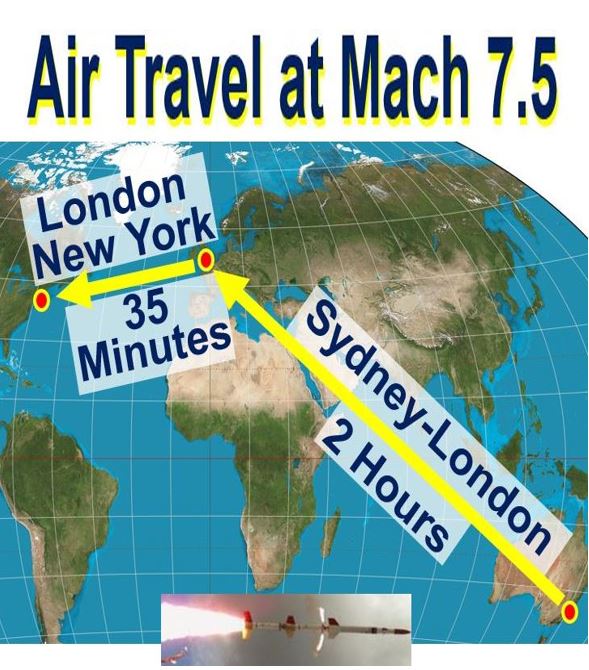
An experimental aircraft could lead to flights from London to New York that take just 35 minutes, or Sydney to Los Angeles or London in two hours. If all tests go according to plan and this new technology is commercialized, no non-stop flight anywhere on Earth would take more than two hours.
The US Air Force Research Laboratory and the Australia’s Defence Science Technology Group successfully completed an experimental hypersonic test flight out of Woomera Test Range in South Australia on Wednesday.
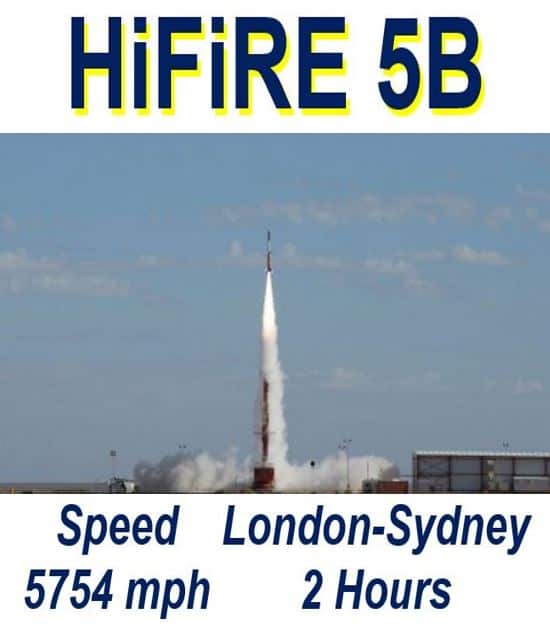 This pioneering technology will eventually completely transform the travel industry. (Image: University of Queensland)
The experimental aircraft-rocket reached a speed of Mach 7.5 – 7.5 times the speed of sound or 5754.52 mph (9261 km/h), and a height of 278 kilometres from Earth.
American-Australian hypersonic programme
The HIFiRE 5b test flight was carried out as part of a joint research effort being conducted by the US Air Force Research Laboratory, Boeing (the world’s largest aerospace company), the University of Queensland, and the Defence Science and Technology Group. HiFiRE stands for the Hypersonic International Flight Research Experimentation program.
Dr. Alex Zelinsky Chief Defence Scientist, congratulated the international hypersonics team, saying the success of this test launch brings everybody one step closer to the realisation of commercial hypersonic flight.
Dr. Zelinsky said:
“It is a game-changing technology identified in the 2016 Defence White Paper and could revolutionise global air travel, providing cost-effective access to space.”
 Kevin G. Bowcutt, Senior Technician Fellow and Chief Scientist of Hypersonics at Boeing, said: “Maturing technologies … will provide means to enable dramatically faster military mission execution and global transportation, and dramatically more affordable space transportation.”
The programme’s aim is to explore the fundamental technologies required to achieve sustained hypersonic flight.
The HIFiRE team says it has already achieved some major milestones including the design, assembly and pre-flight testing of the hypersonic vehicles, as well as the design of complex avionics and flight systems. Over the next two years, the researchers say further test flights will be performed.
Professor Michael Smart, from the University of Queensland’s (UQ’s) School of Mechanical and Mining Engineering, said:
“UQ is pleased to be part of a group of highly skilled individuals doing cutting edge research. We’re excited by the contributions this and future HIFiRE flights will make to the advancement of hypersonic flight technology.”
“The knowledge gained from these experiments will be applied to develop future flight vehicles and testing of advanced air-breathing hypersonic propulsion engines, known as scramjets.”
Kevin Bowcutt, Boeing’s chief scientist for hypersonics, said the HiFiRE program will accelerate the development of operational hypersonic systems by producing key scientific flight data.
Could we fly at 5x the speed of sound? UQ #hypersonic tests suggest yes @ExecutiveDean https://t.co/O7cyl50OUa pic.twitter.com/1agWnQq4Xs
— UQ News (@UQ_News) 19 May 2016
Difference between supersonic and hypersonic
Supersonic refers to anything that goes faster than the speed of sound, i.e. exceeding 343.2 metres per second or 1,126 feet per second (1,236 km/h or 768 mph).
Hypersonic relates to speeds of more than five times that of sound, i.e. exceeding Mach 5 (3,836 mph or 6,174 km/h).
Concorde, the fastest ever commercial passenger plane, travelled at a speed of 2140 km/h or 1334 mph – so it was a supersonic airplane, not hypersonic. The aircraft stopped operating in 2003.
Video – HiFiRE 5B reached Mach 7.5
In this (silent) SciNews video, you can see HiFiRE 5B lifting off and shooting into the sky at amazing speed from several different angles.
