
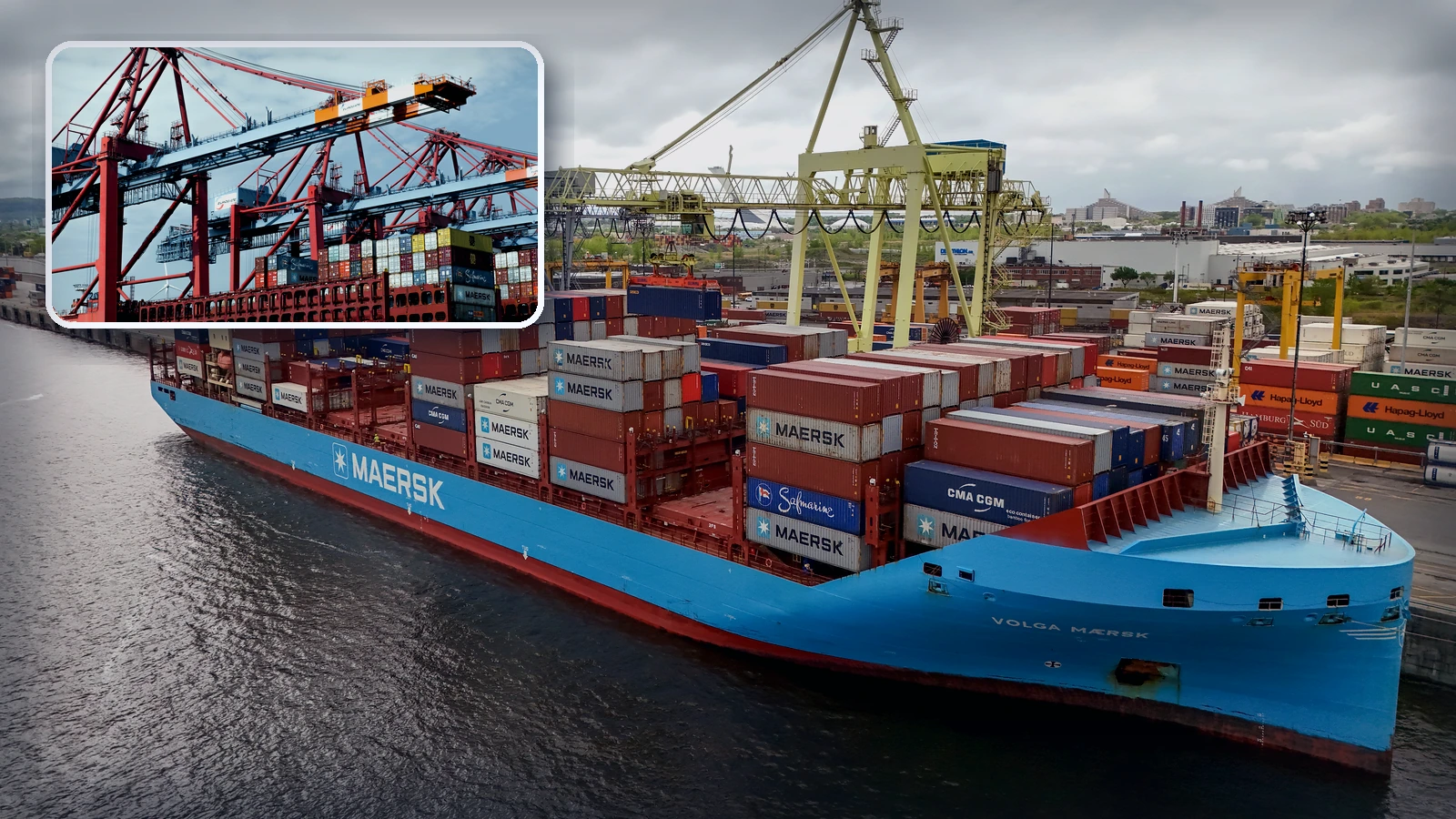
A.P. Moller – Maersk raised its 2026 profit forecast for the second time after higher container freight rates and stronger cargo volumes helped lift second-quarter revenue by 20% to $15.76 billion.
According to Maersk’s second-quarter report, EBITDA increased 30% to $2.99 billion from $2.30 billion a year earlier. EBIT rose 86% to $1.57 billion from $845 million.
EBITDA measures earnings before interest, tax, depreciation and amortisation. EBIT includes depreciation and amortisation but excludes interest and tax.
Net profit more than doubled to $1.31 billion from $639 million. Free cash flow improved to $549 million, compared with negative cash flow of $373 million in the second quarter of 2025.
Maersk chief executive Vincent Clerc said: “The second quarter was yet another proof point of the new era of heightened volatility we have entered.”
Clerc said demand from the Far East had created increasingly unbalanced trade flows, placing pressure on ports and inland transport networks.
Higher freight rates lift Ocean earnings
Most of the improvement came from Maersk’s Ocean division, which operates its container shipping network. Ocean revenue rose 23% to $10.53 billion, accounting for about three-quarters of the group’s revenue increase.
Loaded cargo volumes increased 4.1% to 3.36 million forty-foot equivalent units, or FFE. Maersk’s average loaded freight rate rose 21.6% to $2,746 per FFE and was 32% higher than in the first quarter.
Vessel utilisation increased to 96% from 94% a year earlier.
Ocean EBIT climbed to $935 million from $229 million, while its EBIT margin increased to 8.9% from 2.7%.
However, the entire increase did not come from higher rates and cargo volumes. A change in the estimated useful lives of Maersk’s vessels reduced depreciation expenses and added $175 million to Ocean EBIT during the quarter.
Fuel and operating costs also increased
The disruption affecting traffic through the Strait of Hormuz raised Maersk’s costs as well as freight rates.
Ocean operating expenses increased 19% to $8.52 billion. Bunker costs, which cover the fuel used by ships, rose 36% to $2.11 billion as the average bunker price increased 44%.
Maersk nevertheless reduced its unit cost at fixed energy prices by 0.8%. Bunker consumption fell 4.3% despite the increase in cargo volumes.
The company said the rise in freight rates was not caused by the Middle East situation alone. Demand from Asia, unbalanced trade flows, limited available capacity and port congestion in several regions also contributed.
Maersk rerouted Gulf-bound cargo through alternative ports and inland transport services. Approximately 44,000 of the 47,000 containers affected by the Hormuz disruption had reached their destinations by the end of the quarter.
The company estimated that global container trade increased between 3% and 4% during the quarter. The nominal container fleet was 5.4% larger than a year earlier, but average spot rates measured by the Shanghai Containerised Freight Index were 55% higher than in the first quarter and 42% higher than a year earlier.
Logistics business continues to improve
Maersk’s Logistics & Services division increased revenue by 15% to $4.22 billion. EBIT rose 24% to $217 million, while its EBIT margin increased to 5.1% from 4.8%.
This was the division’s ninth consecutive quarter of year-on-year EBIT margin improvement.
Landside transport benefited from services moving cargo between alternative Gulf ports. Maersk’s forwarding business also handled greater air-freight and project-logistics volumes.
The Terminals division increased revenue by 11% to $1.45 billion. Container moves rose 2.2%, while revenue per move increased 7.1%.
Terminals EBIT was broadly unchanged at $458 million, compared with $461 million a year earlier. Maersk said the comparison was affected by a deferred-tax benefit recorded by a joint venture in 2025.
Maersk raises its forecast again
Maersk now expects full-year underlying EBITDA of between $10.5 billion and $12.5 billion, up from its previous forecast of $8 billion to $10 billion.
The company raised its underlying EBIT forecast to between $4.5 billion and $6.5 billion from $2 billion to $4 billion. It also expects positive free cash flow, compared with its previous forecast of at least negative $1.5 billion.
The updated guidance assumes that global container-market volumes will grow by approximately 4% in 2026.
First-half earnings remain below last year
The second-quarter recovery did not fully offset Maersk’s weaker start to the year.
Revenue for the first six months increased 8.6% to $28.73 billion. However, EBITDA fell 5.3% to $4.75 billion and EBIT declined 8.9% to $1.91 billion.
First-half free cash flow was negative $325 million, compared with positive cash flow of $433 million during the same period in 2025.
Maersk’s own sensitivity estimate illustrates how heavily the full-year result depends on freight prices. All other factors remaining equal, a $100 change in the average container rate per FFE would alter 2026 EBIT by approximately $700 million.
