

Most of the air pollution in London and New York comes from outside the city – the South East of England and New York Tri-State respectively, says Dr. Caralampo Focas, from the Transport Studies Unit at the University of Oxford’s School of Geography and the Environment.
Private car travel and related greenhouse gas emissions per person in London’s outer region are more than double what each person emits within its metropolitan area.
Dr. Focas’ study has been published in the peer-reviewed journal Transport Policy (citation below).
Air pollution is the presence in or release into the atmosphere of substances or particulates which are harmful.
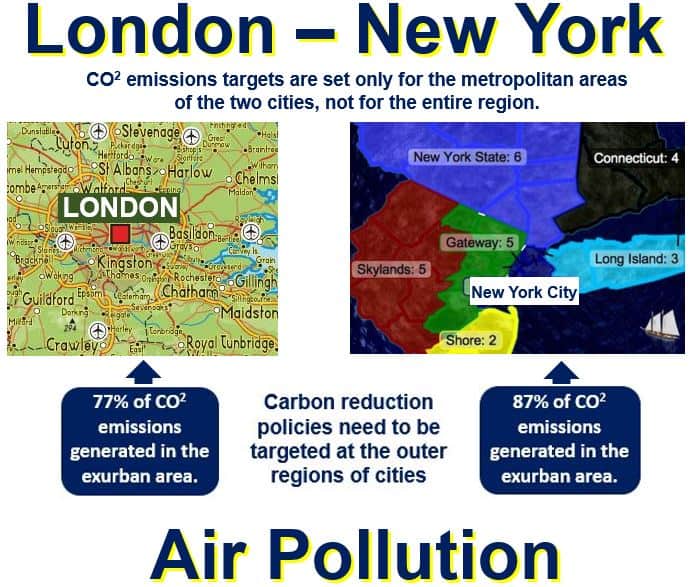
In New York city the difference is astounding – outer-region car travel is four times greater per person compared to what it is within its urban area.
Dr. Focas, a Senior Visiting Research Associate at the Transport Studies Unit, based his study on data from the US National Household Travel Survey and the UK National Travel Survey.
NY State & SE England transport structures
Since the 1950s, the populations outside Greater London’s Green Belt and New York’s periphery have been growing ‘relentlessly’.
The transport structures of the New York Tri-State area and the South East of England have been strongly shaped around the private car.
Dr. Focas wrote:
“Measures that aim to meet CO2 emission targets will need address the nature of the car-dependent developments of London’s and New York’s growing outer fringe.”

His study compared the current travel structure of the peripheral regions of the two cities that are almost exclusively moulded around the automobile.
He gathered and analyzed household travel survey data from both London and New York to help him calculate travel behaviours and greenhouse gas emissions per capita (per head – every man, woman and child), both within and the areas around (outside) the two cities.
Over three-quarters of CO2 emissions from outside
In an Abstract in the journal, Dr. Focas concluded:
“In our study of London and New York regions the exurban areas produce the bulk of car-based CO2 emissions: 77% for the London region and 87% for the New York region.
“Furthermore, using existing population forecasts and estimates of future average CO2 emissions per vehicle, future levels of CO2 emissions from private vehicles are estimated. Our estimates show that the CO2 emission reduction targets that have been set will not be met by a large margin.”
There are several different kinds of pollution. Chemicals, sewage leaks, noise, household waste, and artificial light, for example, are possible pollutants.
Citation
“Travel behaviour and CO2 emissions in urban and exurban London and New York,” Caralampo Focas. Transport Policy, Volume 46, February 2016, Pages 82–91. DOI: 0.1016/j.tranpol.2015.11.003.
Video – Green Party on London’s air pollution crisis
Green Party candidate for Mayor of London, Sian Berry, talks about the public health emergency of dirty air in London and all the monitoring her party is doing inside the city. Surely, if the surrounding areas are where most of the pollution comes from – and they are virtually monitor free – the whole campaign seems rather pointless.
