
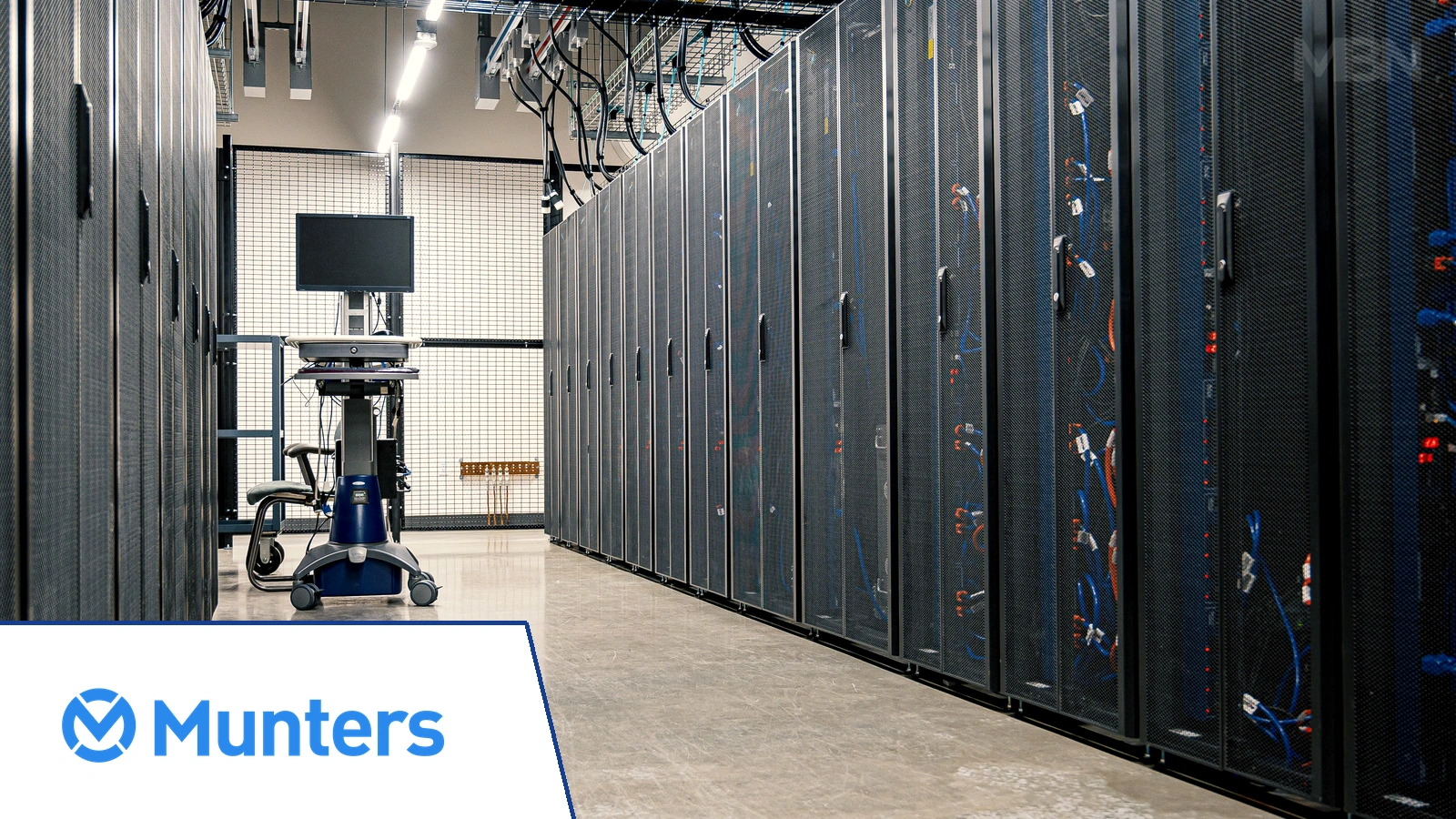
Munters has completed an expansion of its Daleville, Virginia, manufacturing campus, adding local production of data center chillers that it previously made in Italy.
The Swedish cooling equipment company announced the opening on September 11. The enlarged site combines manufacturing, equipment testing and service training as suppliers compete for spending on artificial intelligence infrastructure.
Daleville now covers 565,000 square feet and employs close to 600 people, according to Munters. Those are totals for the campus, not the floor space or jobs added by this expansion. It is the largest of the company’s five dedicated data center manufacturing facilities worldwide.
The announcement does not give the expansion’s cost, a new annual production target or a delivery-time reduction. It describes a broader manufacturing capability, rather than a quantified increase in output.
Cooling equipment needs its own supply chain
A chiller removes heat from a liquid so that the liquid can be used for cooling. In a data center, heat must travel away from computing equipment and ultimately leave the building, even when liquid captures it close to the chips.
The US Department of Energy’s data center design guide explains that liquid cooling can handle higher concentrations of heat than conventional room-air cooling. The choice of equipment still depends on the building, local conditions and the temperature at which the computers can operate.
Daleville’s range includes equipment that handles room air and coolant distribution units, which help transfer heat between cooling circuits. The new chiller production extends that range. Local manufacturing adds a US production option; the release does not say all Italian chiller production is closing.
A factory that can test operating conditions
Munters’ description of the Daleville site gives more detail on what the expansion can do. Its laboratory can test chillers with cooling capacities of up to 3 megawatts in air temperatures ranging from 55°F to 135°F.
The megawatt figure describes the size of chiller the laboratory can test. It is not a claim about the electrical power consumed by the factory or an entire data center.
The facility brings condenser-coil production, end-of-line checks and laboratory testing together. Munters says the controlled conditions allow customers and engineers to check performance and develop control settings before equipment is installed.
That work reaches beyond making a machine pass a factory check. Cooling systems must continue operating as outdoor temperatures and computing loads vary, and equipment efficiency depends partly on those conditions.
Energy savings depend on the whole installation
Munters says its Circlemiser design reduces energy requirements compared with typical air-cooled chillers. The opening announcement supplies no percentage saving or common test conditions, so it does not establish a saving every customer should expect.
The Department of Energy notes that cooling savings depend on factors including local climate and temperature settings. Under suitable outdoor conditions, some systems can reduce or bypass mechanical chilling.
Manufacturers are also expanding through acquisitions. We recently reported on SLB’s agreement to buy heat-exchanger maker Kelvion. Munters’ Virginia investment addresses another part of that competition: producing, testing and servicing cooling equipment close to the US market.
