
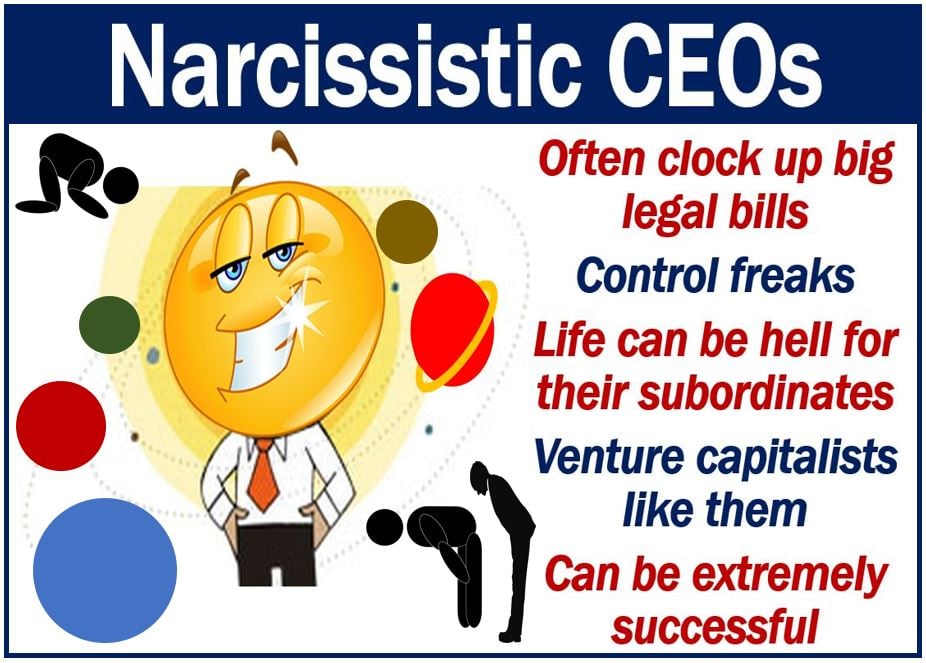
Narcissistic CEOs are typically self-centered, overconfident risk-takers. They also tend to clock up larger legal bills. They typically have heavier legal bills because they are more likely to end up in court compared to other CEOs. This is what Charles A. O’Reilly and colleagues have found.
O’Reilly is The Frank E. Buck Professor of Management at the Stanford Graduate School of Business. He is also Co-Director of Leading Change and Organizational Renewal.
Steve Jobs
Once, Prof. O’Reilly’s wife encountered Steve Jobs, Apple co-founder, in the Whole Foods market car park in Palo Alto.
Prof. O’Reilley recounts:
“She was walking out when he was walking out, and when he climbed in his car and pulled out, he had parked in a handicapped spot.”
That same willingness to ignore rules and self-entitlement was part of what enabled Jobs to disrupt several industries. He also transformed millions of people’s everyday existence with the iPhone.
Visionary executives and narcissists share traits
However, visionary business executives have traits we exalt which narcissists also possess.
In that personality disorder, Prof. O’Reilly explains, is a sense of superiority and overconfidence. Narcissists also suffer from low empathy and tend to take advantage of other people.
“Narcissists like and want admiration. There’s evidence that they seek out positions where they can demonstrate to others how great they are.”
Are narcissistic CEOs good for business?
For company shareholders, at first glance, narcissistic CEOs may be worth it. Given Jobs’ amazing success and that of others like him, tolerating their abusive personality is a small price to pay, isn’t it?
However, narcissistic CEOs suffer from an abundance of hubris, which has a serious downside.
According to studies, they are more likely to manipulate accounting data and overpay for corporate acquisitions. They also tend to seek excessive compensation and engage in questionable tax-avoidance schemes.
Prof. O’Reilly and colleagues wrote in Leadership Quarterly about narcissistic CEOs and the legal risks they pose. His co-authors were Jennifer A. Chatman and Bernadette Doerr of the University of California, Berkeley.
Narcissistic CEOs are more likely to find themselves involved in prolonged litigation, the authors explain.
Their personality traits also make it less likely that they take advice from experts and settle lawsuits. Often, they do not settle even when it is probable that their employer will lose.
Narcissistic CEOs and lawsuits
In their study, the authors utilized a confidential survey of workers from thirty-two large technology companies. In the survey, respondents answered questions about their CEO. Specifically, about their CEOs’ personalities. The survey participants knew that they would remain anonymous.
The researchers also gathered and analyzed data from major lawsuits. In this context, a major lawsuit is one in which damages exceeded 10% of corporate assets. They gleaned the information from company reports.
There was a significant correlation between the length and duration of lawsuits and the level of CEO narcissism.
Role play simulations
In one of their experiments, participants pretended to be CEOs during role-playing exercises. Some participants had to decide whether to proceed with or withdraw from a new product launch. The product launches had a 20% or 80% chance of triggering a lawsuit.
Others pretended they were in the middle of an ongoing lawsuit. They had to decide whether to settle or not settle in lawsuits in which they had a 20% or 80% chance of losing.
The results were striking. Narcissists and non-narcissists were equally likely to take the sure bet when the probabilities of losing were low.
However, when the probability of losing was high, the narcissists were more likely to take the risk, Prof. O’Reilly says.
Prof. O’Reilly explains:
“Narcissists are less sensitive to avoidance of punishment and more sensitive to possibility that they’ll win big. When the risk goes up, what they see is that if they win, they’re going to be heroes.”
“Now most of us say, ‘Ah, the probability of losing is high, so I’m not going to do it.’ But the narcissist says, ‘Yes, the probability of losing is high, but look at what happens if I win!”
Venture capitalists like big egos
Even though narcissists pose greater risks, their excessive confidence is what helps them rise to the top.
Regarding venture capitalists and narcissistic CEOs, Prof. O’Reilly says:
“Venture capitalists like narcissists. Imagine you’re a venture capitalist and you’re thinking about which of two companies to fund. Let’s say, for the sake of argument, that both have the same technology and the same market risk.”
“But one is headed by someone who is confident that she’s going to change the world, who thinks people who disagree with her don’t know what the hell they’re talking about. The other is headed by some introverted engineer. Which are you going to pick?”
A venture capitalist is somebody who invests in startups, young companies, or new ventures.
Narcissists are expert manipulators
It is difficult to turn down a narcissist. They are usually expert manipulators who are brilliant at spinning falsehoods.
Regarding narcissists and their ability to read others, Prof. O’Reilly says:
“They’re often quite good at reading other people. And they don’t have a problem making promises they can’t keep. If I lie to you, and you find out about it, I’ll feel terrible. A narcissist doesn’t feel terrible.”
As soon as they lead the C-suite, narcissistic CEOs’ self-aggrandizing ways can take the company to great places. C-suite executives are top corporate officers in an organization. The ‘C‘ stands for ‘Chief‘ as in Chief Executive Officer or Chief Information Officer.
Narcissistic CEOs – control freaks
However, narcissistic CEOs are also control freaks. It is a personality trait that can wreak havoc and make life hell for subordinates.
Prof. O’Reilly says:
“They want control, so they create these corporate environments full of fear, where people are afraid of what the boss is going to say. There tends to be less collaboration.”
Also, because narcissistic CEOs are rule-breakers, that lowers the organization’s integrity bar.
Narcissistic CEOs often avoid consequences
Unfortunately for others, when narcissistic CEOs get their organization into trouble, they often manage to escape punishment.
“If they fail, they get a golden parachute. It’s others who pay the price,” Prof. O’Reilly notes.
Corporate boards should take a harder look at a prospective CEO’s personality traits before making a decision, Prof. O’Reilly urges. “This is a governance problem,” he says.
Instead of carrying out a psychological test on potential C-suite hires, companies should interview people. Specifically, people who worked for the candidate at several levels of a previous employer.
How much narcissism is tolerable?
Ultimately, however, companies need to decide how much narcissism they are willing to put up with in a leader.
Regarding narcissism, Prof. O’Reilly explains:
Narcissism is a spectrum. We all have varying degrees of it. Some level of it is a good thing, because at the low level, you have people who lack self-confidence and don’t like to take risks, and they’re unlikely to perform well.”
“It’s at the very high levels, the malignant narcissist, where these negative tendencies come through.”
