
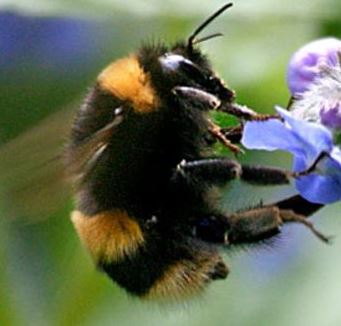
Low-level neonicotinoid pesticides harm bumblebee pollination of apple trees, which significantly affect farmers’ crop yields and the quality of their fruit, say researchers from the University of Reading, England, the Royal Holloway University of London, and the University of Guelph, Canada.
Study leader, environmental sciences professor Nigel Raine, who works at Guelph’s School of Environmental Sciences, and colleagues published their findings in the academic journal Nature.
“Until now, research on pesticide effects has been limited to direct effects on bees themselves. This information provides a new perspective when trying to fully understand the trade-offs involved when deciding whether to use insecticides.”
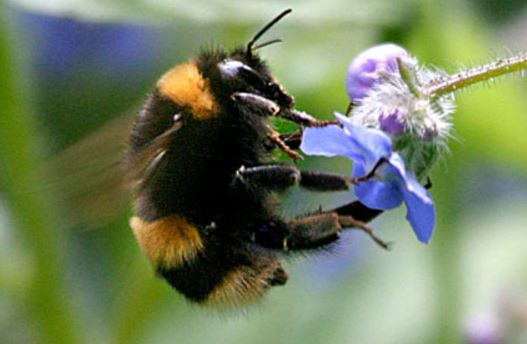 Bumblebees are vital for global crop yields.
Neonicotinoid pesticides widely used worldwide
In prior studies, Prof. Raine and other researchers found that neonicotinoid pesticides – globally the most widely used group of insecticides – affect the behaviour of bees, including reproduction, learning performance and pollen collection.
In this latest study, the scientists demonstrated that exposure to field levels of neonicotinoid pesticides undermines the bumblebee’s ability to pollinate apple trees.
Bumblebees that had been exposed to the pesticide visited apple trees and collected pollen less frequently, compared to the unexposed insects, the study found.
The authors wrote that apples produced by pesticide-exposed bumblebee colonies contained 36% fewer seeds, which indicates fruit quality was inferior and pollination services were reduced.
Bumblebees vital for global crop yields
Prof. Raine, who had previously worked at Royal Holloway and is today the Rebanks Family Chair in Pollinator Conservation, said:
“Bumblebees are major pollinators of apples and many other important crops around the world. Together with other wild and managed insects their pollination services to crops are valued at close to CAN$500 billion (₤246 billion, US$377 billion) worldwide every year.”
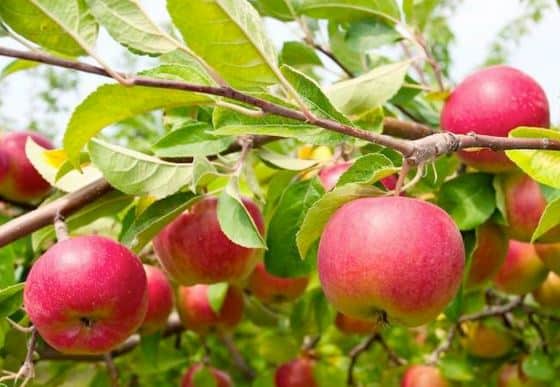 Apple growers who use neonicotinoid pesticides are getting reduced yields and lower-quality fruits.
For this study, Raine and colleagues exposed 24 bumblebee colonies to thiamethoxam, a widely used neonicotinoid pesticide. Exposure levels were comparable to those found in apple farms. The trial, which included control groups, mimicked spring pollination conditions. In experiments, the control group is the one that receives no intervention – it carries on as normal.
Globally, over 75 million tonnes of apples are harvested annually by 95 nations.
Apples benefit significantly from insect pollination with fruit size and shape, seed number and fruit set.
The scientists found that pesticide-exposed bumblebees spent much longer foraging, and switched more often between flowers of apple varieties during foraging trips.
Other crops likely affected too
Prof. Raine said:
“Although individual bees exposed to pesticides visited more flowers, overall their colonies provided lower floral visitation rates and collected less pollen. If they are collecting less pollen they are depositing less pollen.”
“If exposure to pesticides alters pollination services to apple crops, it’s likely that other crops, particularly fruits, vegetables and nuts, and diverse wild plants that rely on bumblebees could also be affected.”
“This makes our study both useful and translatable in a much broader context when considering the potential impacts of pesticide exposure on the pollination services provided by bees.”
In an Abstract in the journal, the authors wrote:
“These results indicate that field-realistic pesticide exposure can have appreciable impacts on learning and memory, with potential implications for essential individual behaviour and colony fitness.”
The study was funded by the U.K. Insect Pollinators Initiative, the Department for Environment, Food and Rural Affairs (Defra), The W. Garfield Weston Foundation, Natural Environment Research Council (NERC), the Welcome Trust, and the Scottish Government.
Citation: “Bumblebee learning and memory is impaired by chronic exposure to a neonicotinoid pesticide,” Dara A. Stanley, Karen E. Smith & Nigel E. Raine. Nature. 16 November, 2015. DOI: 10.1038/srep16508.
Video – Queen bumblebees
In this BBC video, Sir David Attenborough uses a thermal imaging camera to demonstrate the ingenious way a queen bumblebee warms up in the cold morning air to beat the insect traffic.

Comments are closed.