
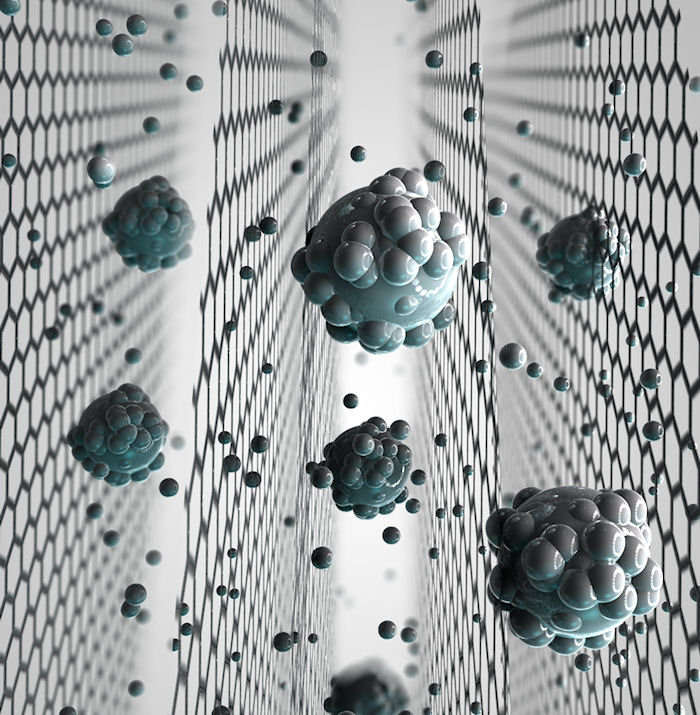
A team of scientists at the University of Manchester in the UK has developed a scalable graphene membrane that can make drinking water by removing the salt from seawater.
The technological breakthrough could help millions of people around the world who do not have access to clean drinking water.
 The team believes their scalable graphene membrane could revolutionize water filtration around the world. Image: The University of Manchester
Graphene is an ultra-thin material comprising a single layer of carbon atoms arranged in a repeating, six-sided honeycomb pattern.
A million times thinner than human hair with an enormous surface area, graphene is ultra-light and transparent, but very tough. It is amazingly flexible, despite being harder than diamond and 300 times stronger than steel.
Graphene oxide membrane
Since it was first isolated at the University of Manchester in 2004, graphene has been hailed as a wonder material with almost limitless applications.
One graphene application that has received a lot of attention is nanofiltration – essentially using the graphene as a sieve to separate molecules.
For this purpose, the sieve or membrane that does the filtering is made of graphene oxide, a version of graphene that is also cheaper and easier to produce than pure graphene.
Breakthrough – scalable graphene membrane
Scientists at the National Graphene Institute at the University of Manchester have already developed graphene-oxide membranes that can filter out organic molecules, nanoparticles, and even large salts.
However, they found they could not get the graphene oxide membranes to sieve common salts, such as sodium chloride. For that, an even smaller sieve was needed.
The breakthrough came when they developed what they call a scalable graphene membrane. This has a pore size that can be manipulated, and overcomes the problem of swelling when the membrane is immersed in water.
In a report in Nature Nanotechnology, the researchers describe how their scalable graphene membrane was able to filter 97 percent of sodium chloride ions.
‘New possibilities for desalination technology’
A particular feature of the scalable graphene membrane is that it contains tiny capillaries of graphene oxide that separate the salt ions from the “shell” of water molecules that surrounds them when dissolved in water.
Professor Rahul Raveendran Nair, who led the research, says: “Realization of scalable membranes with uniform pore size down to atomic scale is a significant step forward and will open new possibilities for improving the efficiency of desalination technology.”
He says their study is the “first clear-cut experiment” of its kind and it also shows “realistic possibilities to scale up the described approach and mass produce graphene-based membranes with required sieve sizes.”
Water scarcity is one of the biggest challenges facing our world today. According to the United Nations, in less than 20 years, nearly 2 billion people could be facing water shortages.
Prof. Nair and colleagues believe their scalable graphene membrane could revolutionize water filtration around the world: even countries that cannot afford large-scale desalination plants should be able to make use of the technology on a smaller scale to produce high quality drinking water from seawater.
