

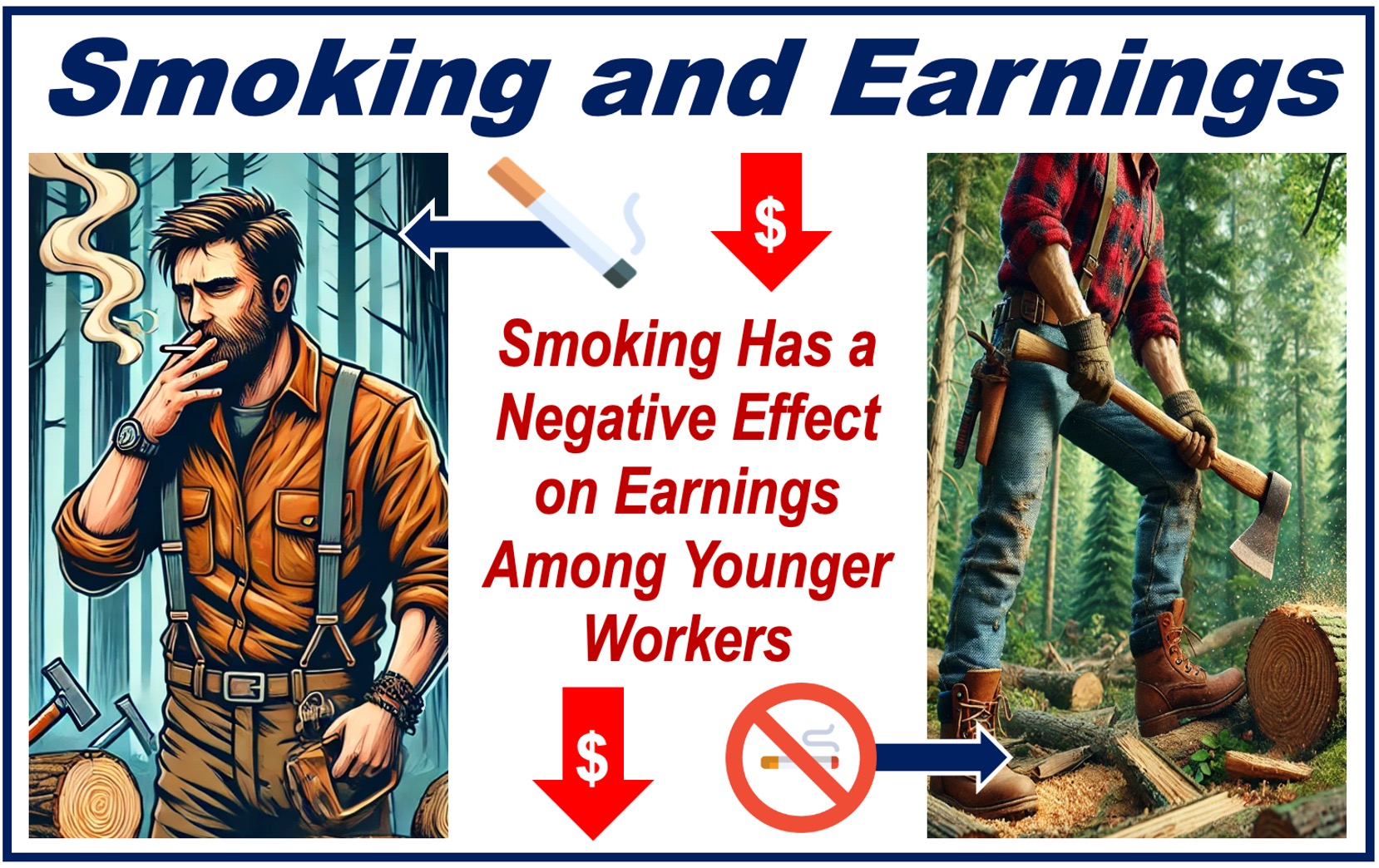
Smoking may lead to younger workers earning less, a new study has found. According to a team of Finnish researchers, this is especially the case among less educated individuals.
They wrote about their study and findings in the peer-reviewed academic journal Nicotine & Tobacco Research (citation below).
Most of us know about the adverse health effects of smoking tobacco, that is, cigarettes, cigars, and pipes. It increases our risk of developing several types of cancer, heart disease, chronic obstructive pulmonary disease (COPD), and complications during pregnancy. It also weakens the body’s immune system.
In 2019, the authors noted that smoking caused 14% of all deaths in high-income countries. Although smoking rates have decreased significantly over the last few decades, a considerable number of people still smoked that year—27% of men and 18% of women.
Smoking and the Labor Market
Smoking has also been linked to lower success at work, likely due to its negative impact on worker productivity. This is especially true in physically demanding jobs, where non-smoking workers are physically fitter and stronger than their smoking counterparts.
The authors wrote that the stigma surrounding smoking may also induce discrimination and bias against smokers.
The Study
In this latest study, the researchers gathered and analyzed data from the Cardiovascular Risk in Young Finns Study, a *longitudinal analysis comprising 3,596 participants from rural and urban areas of five university regions in Finland. The participants were born between 1962 and 1977.
* A longitudinal analysis is a type of study where researchers collect and analyze data from the same participants over a long period.
The researchers linked these data with labor market outcomes provided by Statistics Finland and parental background details obtained from the Longitudinal Population Census, utilizing personal identifiers. The study focused on individuals aged 24 to 39 during the observation period, which began in 2001.
-
Pack-Years
They measured smoking using “pack-years,” a common method for calculating cumulative tobacco exposure.
Pack-years are determined by multiplying the average number of cigarettes a person smoked daily by the difference between their current age and the age at which they began smoking.
If you have a 1-pack-year history of smoking, for instance, you have smoked one pack of cigarettes per day for one year.
Smoking’s Impact on Earnings
According to their study, a one-unit increase in pack-years was linked to a 1.8% decline in earnings, the authors wrote.
This suggests that if a smoker reduced their smoking by five pack-years, their earnings could increase by 9%.
They also found that a one-unit increase in pack years led to a 0.5% decline in years employed.
-
Young and Unskilled Workers
According to their findings, there was a significant difference between smokers’ and nonsmokers’ earnings among younger workers, especially regarding the least skilled or lowest educated individuals.
They found no significant difference in earnings or years worked among older workers. This implies that smoking, which is less common among younger generations, might have a more severe negative impact on their job market opportunities.
The authors pointed out that their study did not observe this trend in people who had given up smoking.
Lead author, Jutta Viinikainen, explained:
“Smoking in early adulthood is closely linked to long-term earnings and employment, with lower-educated individuals experiencing the most severe consequences.”
“These findings highlight the need for policies that address smoking’s hidden economic costs and promote healthier behaviors.”
Citation
Viinikainen, J., Böckerman, P., Hakulinen, C., Kari, J. T., Lehtimäki, T., Pahkala, K., Pehkonen, J., Viikari, J., & Raitakari, O. T. (2025). Tobacco Smoking in Early Adulthood and Labor Market Performance: The Cardiovascular Risk in Young Finns Study. Nicotine & Tobacco Research. https://doi.org/10.1093/ntr/ntae296
