
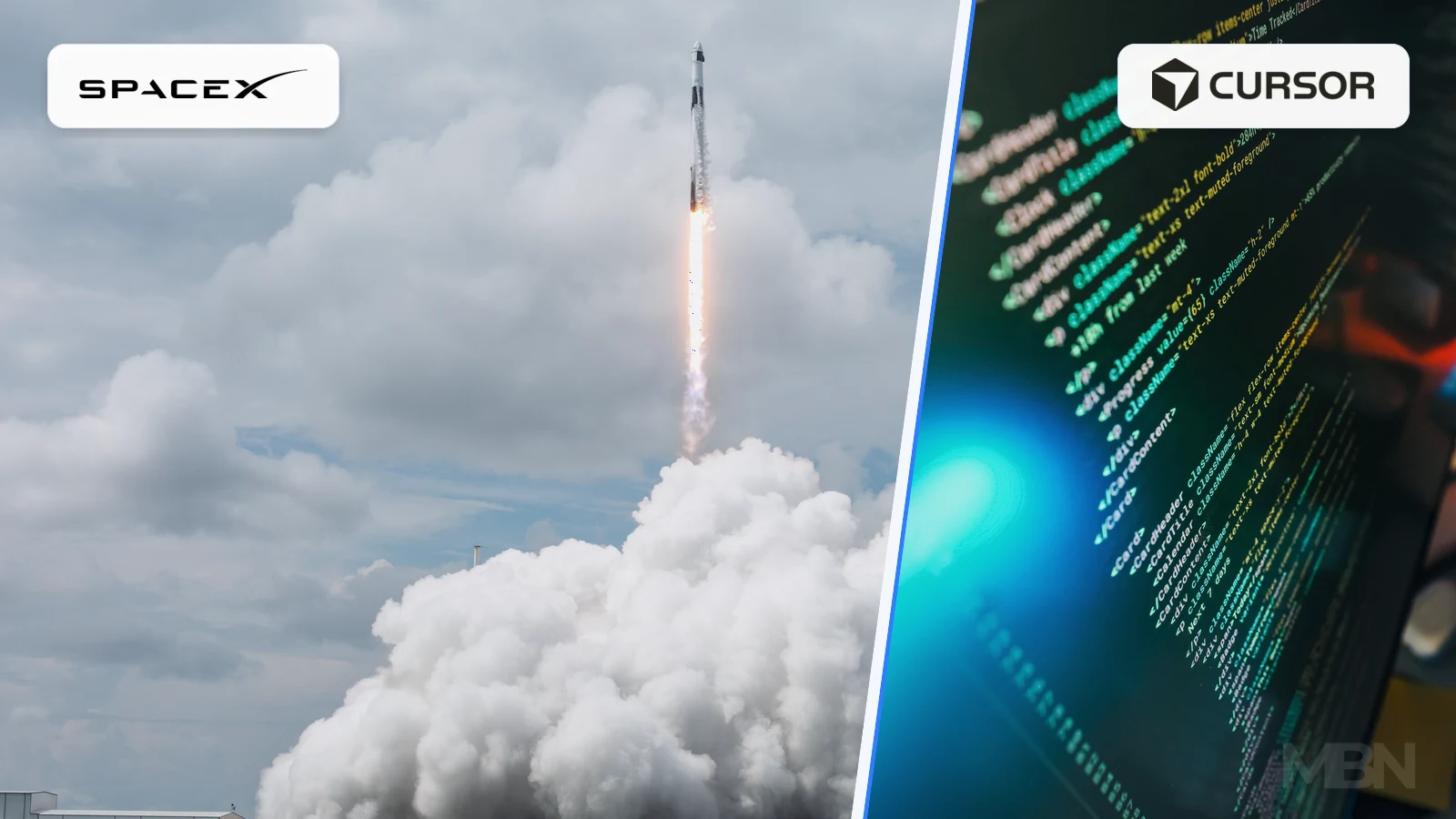
SpaceX has completed its all-stock acquisition of Anysphere, the company behind AI coding platform Cursor, at an implied equity value of $60 billion. The merger became effective on August 14, making Anysphere a wholly owned SpaceX subsidiary.
The closing follows the merger agreement announced on June 16. It also converts an April computing partnership between Cursor and SpaceXAI into full ownership by SpaceX.
SpaceX issued shares rather than paying cash
According to SpaceX’s closing filing with the US Securities and Exchange Commission, Anysphere’s outstanding common and preferred shares converted into rights to receive 389,289,254 SpaceX Class A shares.
Vested Cursor restricted stock units converted into rights to another 1,752,426 SpaceX shares before tax withholding. SpaceX also assumed approximately 29.1 million unvested restricted stock units and 44.4 million outstanding options, converting them into replacement SpaceX awards.
Those unvested awards and options were not shares issued at closing. They remain subject to their applicable vesting and exercise terms.
The $60 billion figure is therefore not a cash payment or an enterprise value. It is the implied equity value agreed for Anysphere on a fully diluted basis. The number of SpaceX shares issued was calculated using the volume-weighted average closing price of its Class A stock during the seven trading days immediately before completion. Cash is used only in place of fractional shares.
SpaceX reported 13.18 billion Class A and Class B shares outstanding on July 28. The 391.04 million shares allocated for Anysphere stock and vested restricted stock units equal about 3% of that total, according to an MBN calculation. That comparison excludes the unvested replacement awards, which may add further dilution later.
Cursor adds an enterprise software business
Cursor is an AI-native integrated development environment, or IDE. It provides software developers and engineering teams with agents that can generate, edit, review and reorganize computer code.
SpaceX had already expanded into artificial intelligence when it acquired xAI on February 2. SpaceX now reports an AI division that includes computing infrastructure, Grok and X. Cursor adds a developer-facing application and an existing enterprise customer base to that division.
In its stock market prospectus, SpaceX said AI coding produces structured information and rapid feedback that can be used when training models. It said Cursor’s place in developers’ daily work could provide context-rich data for improving model performance.
SpaceX said the partnership could help it improve Grok, place its models directly inside software-development workflows and distribute its AI services through a widely used business application.
Computing capacity is central to the acquisition
SpaceX and Cursor began working together in April. Under their model-training partnership, SpaceX agreed to provide GPU-cluster capacity. Cursor contributed personnel, datasets, technical documentation, workflows, prompts and software code.
Cursor said at the time that a shortage of computing capacity had limited how far it could scale its own models. The company planned to use SpaceXAI’s Colossus infrastructure for larger training runs.
In its announcement confirming the completed acquisition, Cursor said SpaceX’s computing resources should allow it to develop stronger models that cost less to operate. Cursor described Grok 4.6, released on August 12 and trained jointly with SpaceXAI, as an early example of their work together.
These are the companies’ stated expectations. Neither the SEC filing nor Cursor’s announcement provides a forecast for cost savings, customer growth or additional revenue from the combined operation.
The valuation assumes rapid commercial growth
Reuters reported in June, citing company data, that Cursor had approximately $2.6 billion in annualized business-to-business revenue. The $60 billion implied valuation is about 23 times that annualized figure, according to an MBN calculation.
Annualized revenue is a current run rate rather than audited revenue earned over a completed financial year. The August 14 closing filing did not disclose Cursor’s profit or provide updated revenue figures.
SpaceX’s prospectus said Anysphere had $3.1 billion in assets as of January 31, including $2.7 billion in cash and cash equivalents, along with $550 million in liabilities. SpaceX expected most of the purchase price to be recorded as goodwill, an accounting asset that reflects the amount paid above the fair value of identifiable net assets.
The purchase also joins an AI division that is spending heavily. SpaceX reported AI revenue of $2.56 billion for the second quarter of 2026, an operating loss of $1.26 billion and capital expenditure of $15.83 billion. Most of the division’s quarterly revenue came from AI services and computing infrastructure rather than advertising.
Product and management plans remain undisclosed
SpaceX has not said whether Cursor’s name, prices or management structure will change. The companies have also not disclosed whether Cursor will continue offering the same access to models supplied by SpaceX’s competitors.
The completion filing settles ownership and consideration, but it does not show how quickly Cursor can turn SpaceX’s computing capacity into new products or lower operating costs. SpaceX has not yet published its final purchase-accounting allocation or a forecast for Cursor’s contribution to group revenue and earnings.
