
Scottish scientists say they slowed down the speed of light in free space for the first time by applying a mask to an optical beam. This is the first time ever that light has been shown to travel slower than 299,792,458 metres per second (186,282 miles per second) in a vacuum.
When they passed the photons through the mask, their shaped changed, which made them travel more slowly.
The researchers, from Heriot-Watt University, Edinburgh, and the University of Glasgow published their findings in Science Express.
It is common knowledge in the scientific community that light travels at a slightly slower speed when it is going through glass or water, but not through free space.
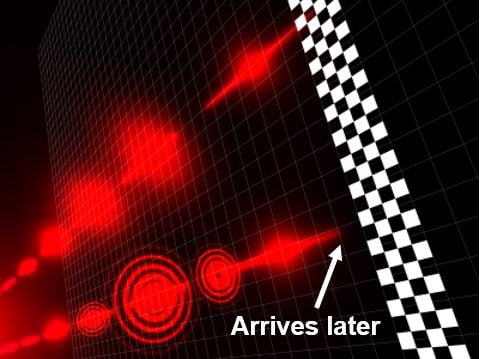
The photon that passed through the mask arrived at the finish line later. (Image: University of Glasgow)
The team in this latest experiment applied a mask – a software controlled liquid crystal device – to an optical beam to give photons a spatial structure which slowed them down.
Their experiment was set up like a two-horse race – two photons were released simultaneously, and travelled the same distance towards a finish line.
Photons like a peloton of cyclists
The photons in a beam of light travel in a similar way to a team of cyclists, the scientists explained. The riders work by constantly changing positions. Although they are travelling along a road as a unit, the speed of each cyclist is not constant because they keep changing positions.
Just as it is hard to determine what the single speed is for all cyclists, the same applies to photons. One pulse of light is made up of several photons which travel at speeds that are continuously changing.
Over a distance of one metre in this two-horse race, the researchers measured a slowing of up to 20 wavelengths, which is several times greater than the measurement precision.
Mask slowed down the photon permanently
The experiment demonstrated that after passing the light-beam through a mask, the photons travelled through space at a slower speed (than the normal speed of light).
This is completely different to the slowing down observed when a beam of light travels through glass or water. In such cases, as soon as the photons have left the material they return to normal light speed. The mask appears to slow down the photons’ speed permanently even after they have passed through and are back in free space.
The study was performed by a University of Glasgow’s Optics Group team, led by Professor Miles Padgett, who worked with theoretical physicists led by Stephen Barnet, and in partnership with Daniele Faccio from Heriot-Watt University.
Co-lead author, Daniel Giovannini, said:
“The delay we’ve introduced to the structured beam is small, measured at several micrometres over a propagation distance of one metre, but it is significant. We’ve measured similar effects in two different types of beams known as Bessel beams and Gaussian beams.”
Co-lead author, Jacquiline Romero, commented:
“We’ve achieved this slowing effect with some subtle but widely-known optical principles. This finding shows unambiguously that the propagation of light can be slowed below the commonly accepted figure of 299,792,458 metres per second, even when travelling in air or vacuum.”
“Although we measure the effect for a single photon, it applies to bright light beams too. The effect is biggest when the lenses used to create the beam are large and when the distance over which the light is focused is small, meaning the effect only applies at short range.”
Professor Padgett said:
“It might seem surprising that light can be made to travel more slowly like this, but the effect has a solid theoretical foundation and we’re confident that our observations are correct.”
“The results give us a new way to think about the properties of light and we’re keen to continue exploring the potential of this discovery in future applications. We expect that the effect will be applicable to any wave theory, so a similar slowing could well be created in sound waves, for example.”
Video – Scottish scientists slow speed of light
