
The British government’s gambling tax revenue has grown dramatically since 2007 when the Gambling Act 2005 came into force. The increase in government income has also been due to the growth of online games.
The Gambling Act of 2005 paved the way for online casinos, online poker, and TV advertising for sports betting. In other words, the new legislation got companies right into people’s living rooms.
Gambling tax revenue
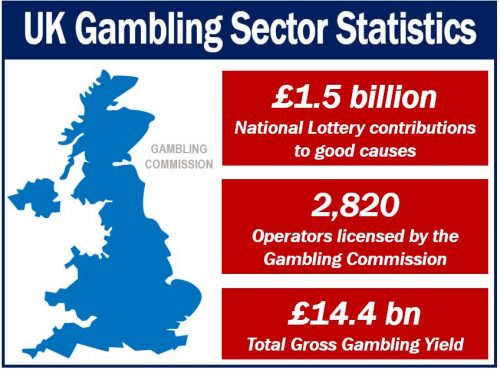
The gambling sector’s income, together with government gambling tax revenue, was £8.36 billion in the period Apr 2007 – Mar 2008. In the period Apr 2017 – Mar 2018, the figure soared to £14.4 billion. The National Lottery, online gaming, and FOBTs were responsible for the surge.
What are FOBTs?
According to According to topbettingsites.co.uk, which has a list of betting sites, the letters FOBTs stand for Fixed-Odds Betting Terminals.
FOBTs are electronic gaming machines on which players can place bets on the outcome of several simulated games and events. They can bet on horse races, bingo, blackjack, roulette, etc. The odds that are offered are fixed from game to game.
Gambling Commission – Industry statistics
The Gambling Commission is the UK’s gambling regulatory authority. It is an executive non-departmental public body of the British Government. Apart from regulating gaming law, it is also the sector’s supervisor. Its remit covers lotteries, slot machines, bingo, casinos, betting, and arcades. Its remit also includes remote gambling.
Remote gambling refers to any type of gambling that gaming operators provide remotely. Internet gambling and interactive TV gambling, for example, belong to this category. Cell phone gambling is also a form of remote gambling.
Gaming Commission headline findings
Below are some headline findings from the Gaming Commission regarding the gaming sector in the UK (Apr 2017 – Mar 2018):
- Gross Gambling Yield (GGY) of UK’s gambling industry – £14.4 billion.
- GGY for the Remote Casino Category (Slots) – £2 billion.
- GGY for the Remote Sector – £5.3 billion.
- Contribution to good causes from Large Society Lotteries – £296 million.
- Contributions to good causes from The National Lottery – £1.5 billion.
- Number of workers that the gambling industry employs in the UK – 107,950.
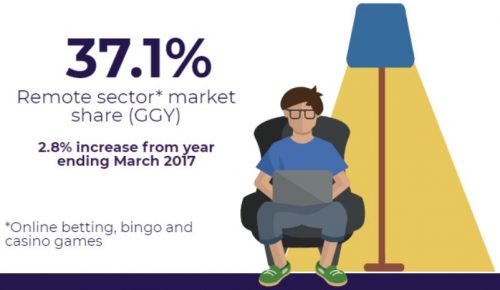
- Market share of remote casino, bingo, and betting sector – 37.1%.
- Total number of betting shops in UK – 8,406 in September 2018. This represented a 1.8% decline compared to March 2018.
- Total number of casinos in the UK – 152.
- Number of gaming machines in the UK – 181,309.
- Total number of bingo premises in the UK – 644.

We’ve been gambling a very long time
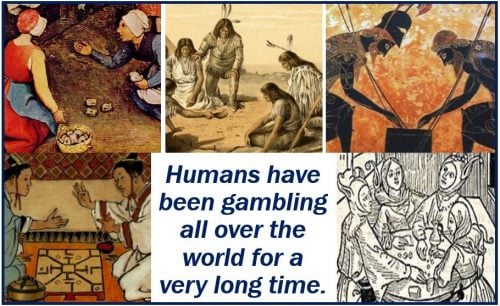
Humans have been gambling for many thousands of years. The earliest six-sided dice date back to about 3000 BC in Mesopotamia.
Gambling houses in China were widespread around 1000 BC, as was betting on fighting animals.
Dominoes and lotto games have been around in China since the 10th century AD.
Poker is the most popular card game associated with gambling in the US today. It derives from As-Nas, a Persian game which dates back to the 17th century.
In 1638, the Ridotto, the world’s first known casino, opened in Venice.
Expanding online gambling and problem gamblers
Over the last ten years, online gambling has expanded dramatically in North America and Europe. We would, therefore, expect the number of problem gamblers to have increased too. However, according to a team of US researchers, this is not the case.
Researchers from the University of Buffalo say that the percentage of problem gamblers in the United States has remained stable.
From 1999 to 2013, the percentage of problem gamblers in the US remained within the 3.5% and 5.5% range. Rates of pathological gambling also remained stable – staying within the 1% and 2.4% range.
In fact, the overall participation in gambling activities declined over this period.
