

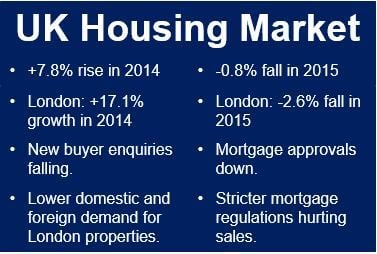
After increasing by 7.8% in 2014, UK house prices are forecast to fall by -0.8% in 2015, says the Centre for Economics and Business Research (Cebr) in a new report published on Monday, which describes Britain’s housing market as “at a turning point.”
The change of fortunes will be even more marked in London, which will see prices tumble by -2.6% in 2015 after rising by 17.1% in 2014.
Signs of a declining property market are already starting to emerge in London. Houses are taking longer to sell, while the number of buyer inquiries has fallen.
The main problem in London is affordability. More and more homes are pricing themselves out of the market.
Foreigners are also becoming less interested in buying property in London now that their prices have exceeded pre-crisis peaks in euro and dollar terms.
(Data source: Centre for Economics and Business Research)
London no longer a safe investment?
There is also more concern among foreigners that London may not be a safe investment any more. There is uncertainty regarding the general elections next year, London’s relationship with the European Union is looking increasingly more fragile, and who knows what the fallout from the Scottish independence referendum might be. London is seen today as inherently more unstable than it used to be.
Overseas investors will also be put off by the proposed mansion tax increases and the prospect of wealth expropriation in the future.
The MMR (Mortgage Market Review) guidance, which was introduced in April 2014, has halted mortgage approval growth now that it is more difficult to get one.
Head of Macroeconomics at Cebr and the report’s leading author, Scott Corfe, said:
“Tougher mortgage eligibility criteria, high deposit requirements and concerns about future rate rises are starting to take steam out of the UK housing market.”
“But the risks should not be exaggerated – the price falls forecast for next year will be modest and we shouldn’t be too worried about this – we are not anticipating a crash. The market is adjusting after getting ahead of itself at the start of 2014.”
Executive Chairman at Cebr, Douglas McWilliams, says the property market in London is being hit by a “double whammy” of weaker domestic and overseas demand. The pound sterling’s increase since the beginning of 2013 has made London homes less attractive as an investment compared to a few years ago.
Mr. McWilliams added:
“In addition, fears of a future mansion tax are eroding the UK’s international safe haven status. This will bring down prices at the top end of the capital’s housing market.”
Other reports point to a cooling housing market
On September 30, the Nationwide Building Society reported that British house prices declined by -0.2% in September compared to August after rising for 16 consecutive months. Compared to September 2013, house prices were 9.4% higher, while in August 2014 they were 11% higher than in August 2013.
According to Nationwide, the UK property market has been losing steam since early summer, when regulators forced lenders to carry out tougher affordability checks on people applying for mortgages. There was also a limit placed on how much applicants could borrow.
The Bank of England says the total number of mortgage approvals in August was 64,212, compared to the six-month average before August of 65,738.
The Nationwide Building Society reported on October 30th that house price growth is slowing down.
