
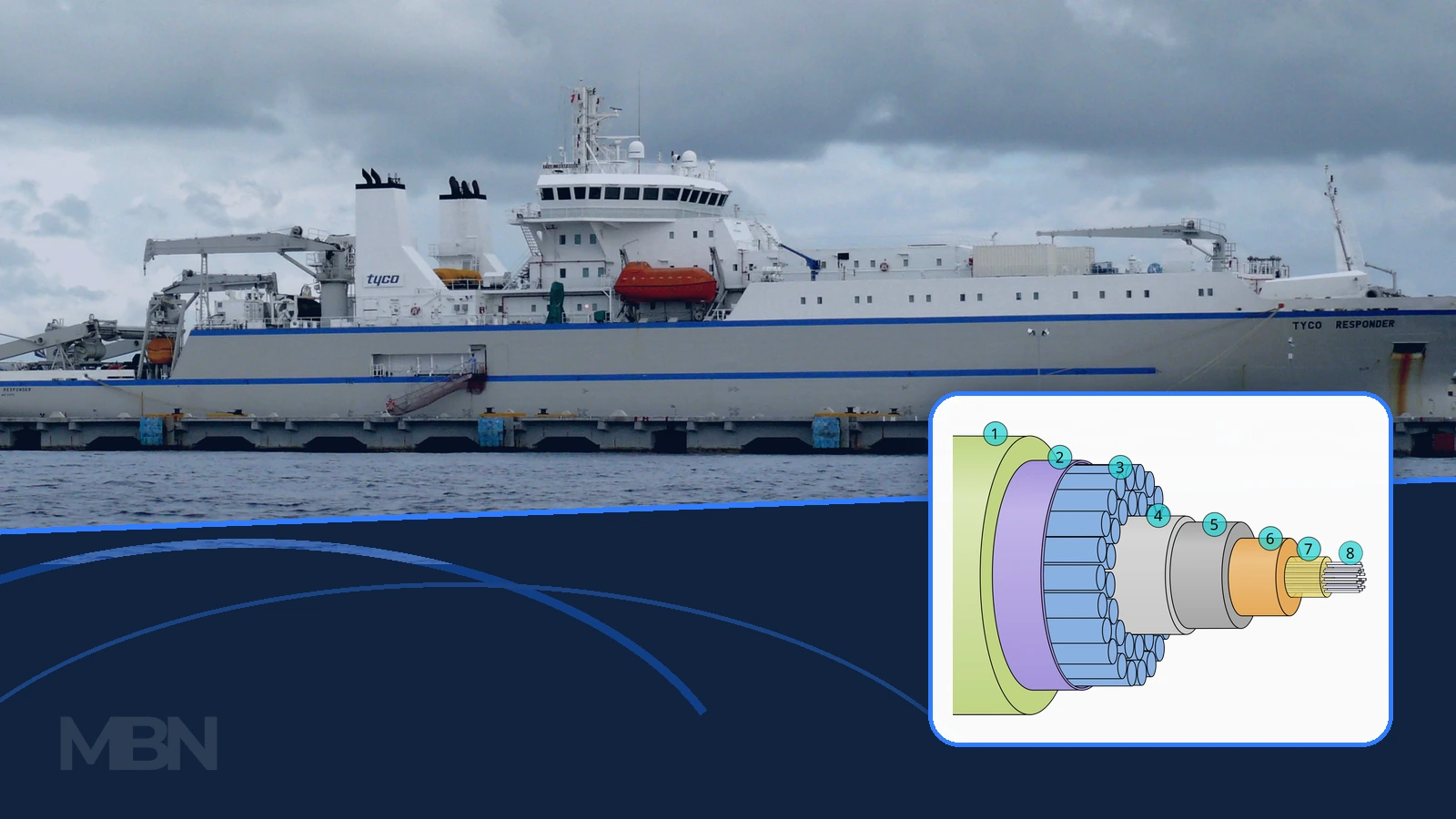
A June 2025 industry study estimates that roughly $3 billion in 2025 dollars may be needed by 2040 to replace 15 ageing submarine cable-maintenance ships and add the equivalent of up to five more in Asia. The forecast does not describe an immediate worldwide shortage. It identifies a financing problem: repair vessels need spare capacity to be useful, yet that waiting time makes them difficult to pay for.
Submarine telecommunications cables carry almost all intercontinental internet traffic. The International Cable Protection Committee (ICPC) counts approximately 500 cable systems and about 1.8 million kilometres of cable around the world.
Most of that infrastructure receives little public attention until something breaks. The much smaller fleet that maintains it is easier to overlook still.
Most cable faults are accidental
The ICPC says around 150 to 200 faults occur in submarine telecommunications cables each year. The International Telecommunication Union (ITU) recorded more than 170 repairs during 2025, equivalent to almost four a week.
Between 70% and 80% of faults result from accidental human activity, principally commercial fishing and ships’ anchors. The remainder includes equipment failures and natural events such as submarine landslides, storms and strong seabed currents.
Damage is particularly common in water shallower than 300 metres, where cables are more exposed to fishing and shipping. The middle of an ocean may sound more dangerous, but many routine faults occur much closer to land.
Most incidents do not produce a visible internet outage. Where alternative routes have sufficient capacity, network operators can redirect traffic while the damaged cable is repaired. That protection is weaker for islands and other places with few connections, which is why one broken cable can be a routine engineering problem in one region and a serious communications failure in another.
Why repair ships need spare capacity
A container ship earns money by moving cargo. A cable-repair vessel has to be available before anybody knows where the next job will be.
The fleet study by TeleGeography and Infra-Analytics used a maximum vessel utilisation rate of 60% in its baseline model. The authors considered that the highest level consistent with limiting the risk of repair queues.
That assumption captures the unusual economics of the business. A fleet operating near full capacity may look efficient, but it has little room to absorb simultaneous faults, bad weather or a lengthy repair. A ship on standby resembles a fire engine: some of its economic value comes from being ready rather than being used continuously.
Once a fault has been located, a vessel must load the right cable and equipment, obtain any necessary permits and sail to the site. Crews can use grapnels or remotely operated vehicles to recover the cable. They remove the damaged section, splice in a replacement, test the connection and return it to the seabed.
Geography quickly becomes part of the repair bill. In evidence to a UK parliamentary committee, Alasdair Wilkie of the Atlantic Cable Maintenance & Repair Agreement said a vessel could mobilise within 24 hours and travel at around 12 knots. An Irish Sea fault might involve up to two days of sailing followed by about five days of repair work. A mid-Atlantic job could require roughly seven days of travel and another eight to ten days of work.
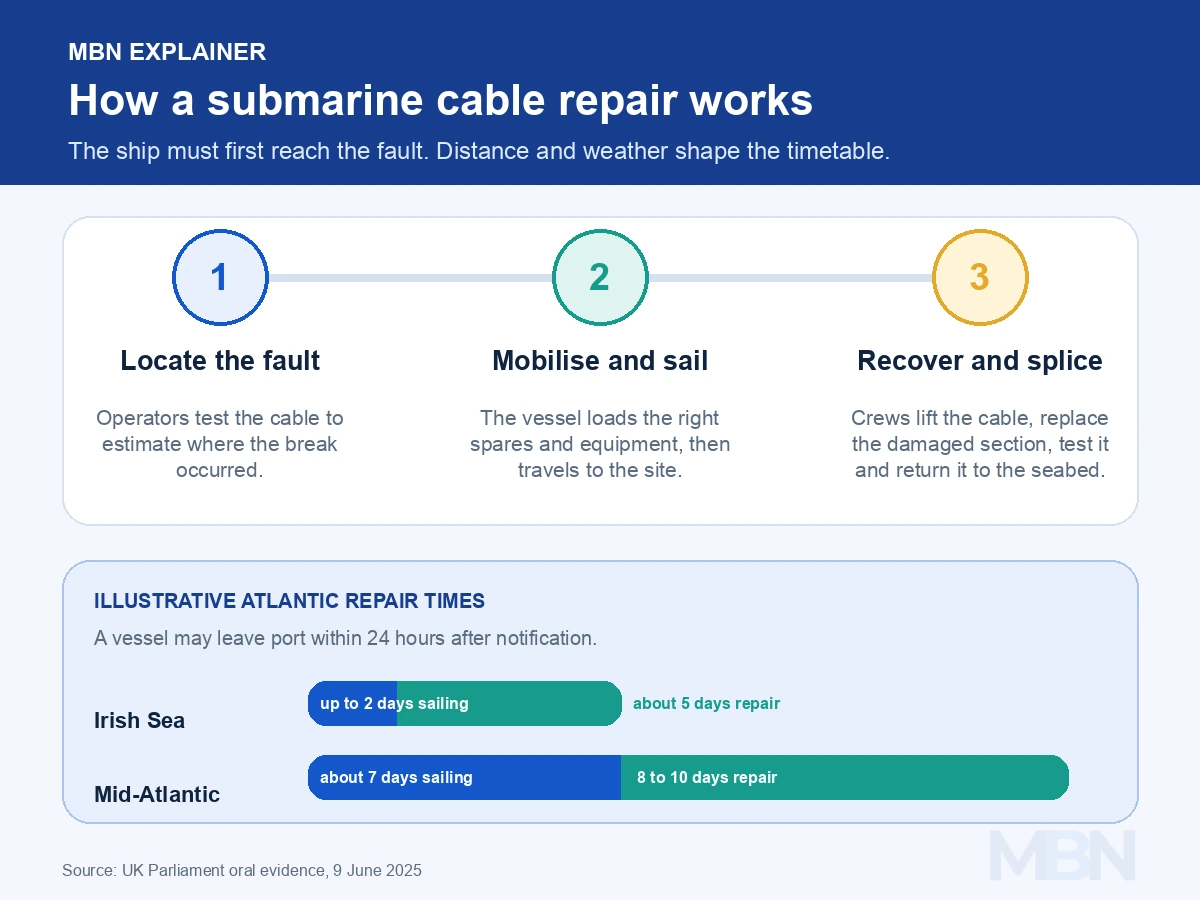
Weather can extend those times considerably. Wilkie said a job that might normally take two weeks could last more than a month in poor conditions. A capable vessel based on the wrong side of an ocean cannot provide a rapid response.
An ageing fleet faces a larger network
The ICPC says annual fault numbers have remained broadly stable even as the network expanded from approximately one million kilometres in 2014 to 1.7 million in 2025. Better route planning, protection and installation have reduced the fault rate per kilometre.
TeleGeography and Infra-Analytics nevertheless expect the total workload to increase. Their baseline model projects a 48% net increase in global cable length between 2025 and 2040. It also projects a 36% rise in annual repairs, to 287, even though it assumes that fault rates per kilometre continue declining.
The fleet is ageing at the same time. The report estimates that 64% of maintenance vessels will reach its assumed 40-year service-life threshold by 2040. Fifteen would need replacing, including 13 between 2026 and 2035. It identifies a further requirement for up to five vessel equivalents in Asia, where repair demand is concentrated.
The resulting $3 billion estimate assumes that all 20 are new-build, multipurpose ships. It does not include replacements or expansion in the separate cable-installation fleet.
These numbers are sensitive to the assumptions. The model’s baseline requirement for 2040 is 21.7 vessel equivalents. Allowing maximum utilisation to rise from 60% to 70% reduces that figure to 18.6, but the report warns that higher utilisation could create more repair queues. If bandwidth demand grows 10% faster than assumed, the requirement rises to 26.4.
The report found that the number of vessels available in 2025 was sufficient for most major regions under its baseline assumptions. Asia was the exception. This is more a regional response-time problem than a simple global ship count.
Who pays for ships that spend time waiting?
Cable maintenance commonly operates through cooperative agreements. Cable owners pay into regional arrangements that provide access to vessels, depots, spare cable and specialist crews. Sharing those costs is more practical than asking every owner to maintain a ship.
It can still leave vessel operators with a difficult investment case. A new ship requires a large capital commitment, while maintenance customers want competitive fees and may be reluctant to pay more for capacity that appears idle.
The study was sponsored by the SubOptic Association, a submarine cable industry body. Its forecast should therefore be read as an industry model, not as a government procurement commitment. Even so, the model makes the funding tension unusually clear. Longer maintenance contracts can give shipowners more certainty, but they also commit cable owners to paying for readiness years before a vessel may be urgently needed.
Europe starts paying for repair readiness
Governments have begun treating repair capacity as part of infrastructure policy. The EU Action Plan on Cable Security proposes a multipurpose Cable Vessels Reserve in the medium term, depending on assessed need. The reserve remains a proposal rather than an operating fleet.
In February 2026, the European Commission opened a €20 million call for adaptable repair modules to be stationed at ports or shipyards. In June, it announced €5.8 million for regional cable hubs in the Baltic and Mediterranean and launched a separate €40 million call for cable-repair capacity.
Modular equipment may reduce the need to build a dedicated ship for every contingency, but it cannot create an experienced crew or move a suitable vessel rapidly across the world. Regional capacity still matters.
Prevention also reduces pressure on the fleet. Accurate nautical charts, early route planning, appropriate cable burial and communication with fishing and shipping operators can lower the chance of accidental damage. Diverse cable routes give operators more time to complete repairs without interrupting service.
Building a new cable creates capacity that customers can use immediately. A repair ship sells something less visible: the option to restore that capacity after a failure. As Asia’s repair queues demonstrate, that option only works when the right vessel, equipment and crew are within practical reach.
