

Prejudice against women in power might be greater than the statistics indicate, a new study has found. Prejudice may be greater because some people in surveys may not answer honestly. Specifically, in this case, participants in surveys investigating attitudes towards women and men.
Participants are more likely to answer honestly if they are completely sure that their answers are confidential. If respondents’ opinions are not ‘politically correct,’ some might not want other people to know.
This is what Adrian Hoffmann and Jochen Musch found in a new study. They are both from Heinrich-Heine-University Düsseldorf in Germany. They wrote about their study and findings in the journal Sex Roles (citation below).
The authors used an indirect questioning technique to gather data on how people truly felt about women leaders.
The technique showed that respondents are not always honest when survey organizers ask their opinion of socially sensitive questions. They are not always honest because they prefer to answer in a way that other people will accept.
Gender-oriented prejudice and gender stereotypes
Gender-oriented prejudice and gender stereotypes are major obstacles in women’s careers. They are also causes of gender bias in the workplace.
Theorists say that prejudice against women leaders emerges from an incongruity in women’s gender role and the more masculine social role of a leader.
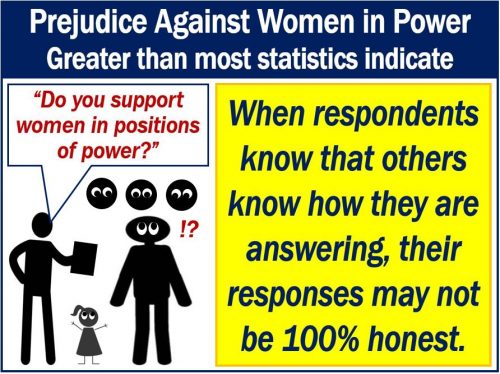
Researchers commonly use self-reports when studying people’s prejudice against women leaders. These studies have helped gather important data regarding the form that stereotyping and intolerance against women in power takes.
However, such methods may not produce accurate results because of some respondents’ reluctance to let other people see them breaking social norms.
Crosswise Model
To address this problem, Musch and Hoffmann gathered responses from 1,529 German students. They answered either a conventional direct question or an indirect question. The indirect question was in the Crosswise Model format.
According to a Survey Methods article that David Johann and Kathrin Thomas wrote:
“The Crosswise Model was designed to ensure anonymity and confidentiality in order to reduce Social Desirability Bias induced by the tendency of survey respondents to present themselves in a favorable light.”
The researchers then compared the answers from the conventional direct questions and the Crosswise Model method.
Prejudice against women
The Crosswise Model results showed that 37% of respondents were prejudiced against women, compared to 23% from the direct questions.
This suggests that more respondents were willing to acknowledge prejudice against women if they were granted full confidentiality.
When they knew their answers were completely confidential, twenty-three percent of women and 45% of men in the sample suggested they thought women were less qualified than men for leadership positions. Men showed more prejudice than women across both study methods.
However, 10% and 28% of women showed prejudice in the conventional direct questions method and Crosswise Model respectively. Among men, the percentages came in as 36% and 45% respectively.
It seems, therefore, that women respond more strongly when they know their answers are completely confidential. In other words, women seem to be more reluctant to respond honestly when they know other people are aware of their answers.
Musch said:
“Given that even many women have reservations against women leaders, the societal and political promotion of gender equity has obviously not been successful at changing the attitudes of every potential future leader.”
“It, therefore, does not seem unreasonable to expect the further persistence of workplace bias.”
Citation
“Prejudice against Women Leaders: Insights from an Indirect Questioning Approach,” Hoffmann, A. & Musch. Sex Roles (2018). Print ISSN: 0360-0025, Online ISSN: 1573-2762. DOI: https://doi.org/10.1007/s11199-018-0969-6.
