
Africa needs $16 billion in funding to help the continent and its people adapt to climate change, says The World Bank. Africa urgently needs to improve its resilience to climate shocks and prevent millions of people from sliding back into poverty because of global warming. The World Bank says it can finance one third of the $16 billion it is calling for.
As global warming and climate variability significantly affect Sub-Saharan Africa’s development agenda, a new World Bank plan – Accelerating Climate-Resilient and Low-Carbon Development: The Africa Climate Business Plan – outlines the actions needed to improve climate resilience and low-carbon development in an effort to push current and protect future growth and poverty reduction targets.
 Source: The World Bank
Climate shocks major cause of poverty
The authors say that climate drives the majority of shocks that either keep or push African households into poverty. The new Plan aims to both bring world attention to and accelerate resource mobilization for priority climate-resilient and low-carbon projects in the region.
Benoit Bosquet, World Bank Practice Manager in the Environment & Natural Resources Global Practice, said:
“The consequences of climate change for Africa are devastating and threaten to push millions of people into extreme poverty by 2030, largely due to lower crop yields and higher food prices, and negative health impacts.”
“In light of the huge financing gap and the need for urgent action, the World Bank prepared the Africa Climate Business Plan as an important step in mobilizing climate finance to fast-track Africa’s climate adaptation needs in the context of development priorities.”
Three factors that hinder tackling poverty
The plan’s authors say climate-related factors will make it more difficult for African nations to tackle extreme poverty in the future for three main reasons:
1. Warming is unavoidable: because of past emissions of greenhouse gases, which will result in the loss of cropland, lower crop production, worsening malnutrition, greater drought risks, and fewer fish catches.
2. Further warming may occur: which will be disastrous for the region in the form of heat extremes, a greater risk of severe and prolonged droughts, crop failures every two years, a 20% decline in major food crop yields, and up to 18 million people affected by floods annually by the end of this century.
3. Who knows what warming impact will be: on local weather patterns and hydrological cycles? Development planners will be faced with formidable challenges, say the Plan authors. Designing effective projects related to water management such as hydropower and irrigation, and more generally climate-sensitive infrastructure such as bridges and roads, will become crucial.
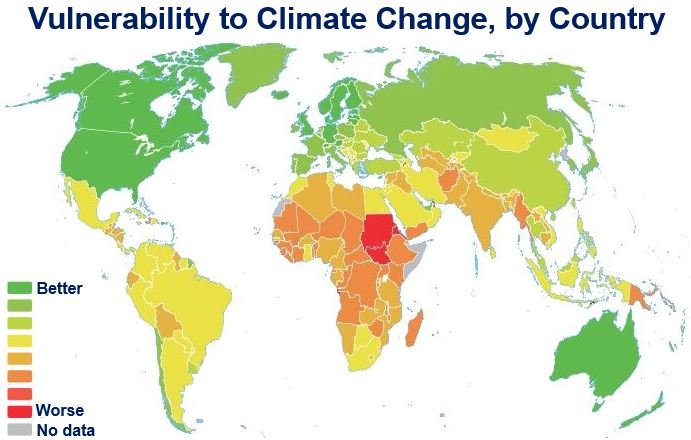 African countries are significantly more vulnerable to climate variability and change than much of rest of the developing world. (Image: World Bank)
To address the climate challenge in collaboration with the governments of African nations and regional and international partners, the plan concentrates on increasing adaptation through twelve priority areas grouped into three clusters:
Strengthening resilience: this involves initiatives aimed at improving Africa’s natural capital (oceans, forests and landscapes), physical capital (transport infrastructure and cities), and human & social capital, including social protection for more vulnerable individuals against climate shocks. It is also necessary to tackle the climate-related causes of migration.
Powering resilience: which involves helping the continent increase low-carbon energy sources, given that societies with deficient energy sources are more severely affected by climate shocks.
Enabling resilience: by providing the required data and decision-making tools for promoting climate-resilient development across all sectors through fortifying hydro-met systems at both national and regional levels, through building the capacity to plan and design investments focused on climate-resilience.
$16.1 billion needed by 2020
Funding levels for adaptation currently stand at $3 billion annually, which is nowhere near enough to finance the continent’s current needs. Funding is not increasing at the required rate to meet future needs.
The near-to-medium term implementation of the Plan will cost approximately $16.1 billion, which needs to be raised by 2020. The International Development Association (IDA) is expected to contribute $5.7 billion, while the rest will come from several different sources, including donor nations, the private sector, and dedicated finance sources.
The Plan’s authors add that even greater results could be achieved by 2025 at a cost of approximately $21 billion.
Makhtar Diop, Vice President, Africa Region, The World Bank, wrote in the Foreword of the Plan:
“While this Plan is arguably only a partial contribution to meet Africa’s financial needs for climate action, it is a meaningful one. The World Bank Group looks forward to working with African governments, Africa’s development partners and the private sector to implement the activities included in the Plan.”
“By galvanizing climate action, deploying expertise and mobilizing financing, together we can support Africa in its quest for a greener and more resilient future.”
