

The results for domestic manufacturing and exports in Q3 could be “the first alarm bell” warning us of slower economic growth ahead, John Longworth, Director General of the British Chambers of Commerce (BCC) said on Thursday. A manufacturing sector slowdown in the rate of growth in the third quarter reinforces the BCC’s prediction that GDP expansion would ease leading into 2015.
The BCC calls for multipartisan support for the proposal within its Business Manifesto: ‘A Business Plan for Britain’, which it believes is the country’s best hope for growth and enterprise.
Mr. Longworth says that even though the UK economy has rebounded considerably since the Great Recession, to simply say this growth cannot be sustained is not good enough. The UK must steer clear of measures that undermine business confidence and push for reforms that enhance the business environment, he stressed.
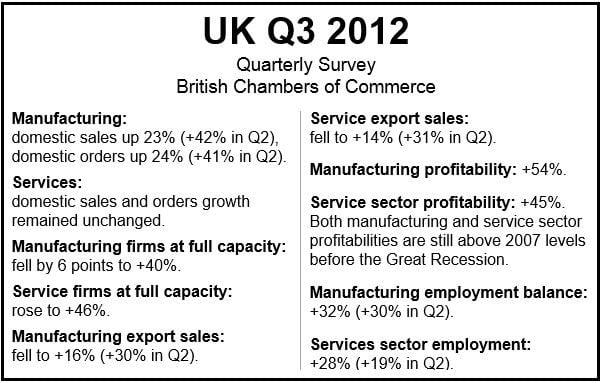
(Data source: British Chambers of Commerce)
Mr. Longworth said:
“As we predicted in our economic forecast, the strong upsurge in UK manufacturing at the start of the year appears to have run its course. We may be hearing the first alarm bell for the UK economy, but this need not be the case.”
“The share of manufacturing firms operating at full capacity fell in Q3, signaling that there is more spare capacity in our production sector than previously thought. Concerns over the strength of the pound are also high and rising. Together with a worsening outlook for the Eurozone, these factors reinforce the case against an early interest rate rise.”
Radical change needed
The decline in exports shows that something radically different needs to be done, the BCC says. Improving the UK’s trade performance will not be easy; the country needs to seize opportunities in markets that offer sustained growth.
If Britain is really serious about promoting business investment it needs to remove some longstanding barriers. There is a lack of proper access to finance for small businesses. UK firms pay the highest rates in Europe, a major factor that discourages investment.
Mr. Longworth calls on the government to freeze business rates for all businesses “until 2017’s planned full revaluation of premises, and perform a review and reform of the broken business rates system by 2022.”
Chief Economist at the BCC, David Kern says the latest UK economic figures show that GDP growth continues, but at a more moderate pace. The slowdown in manufacturing is particularly marked.
Mr. Kern added:
“The multiplier effects of a rise or fall in industrial production are important, not least for those regions of the UK whose traditional dependence on manufacturing industries remains high. Services remain more resilient than manufacturing, but there were disappointing declines in the service export balances between Q2 and Q3 2014. In contrast the Q3 results are positive for employment, cashflow and business confidence.”
“Noticeable falls in all the export balances and increased signs of slower growth require a forceful policy response. UK growth cannot rely permanently on consumer spending, and on unsustainable current account and budget deficits. Unless exports and investment play a bigger role in growth, the recovery will stall.”
Higher interest rates could hurt the economy
The BCC warns the Bank of England not to raise interest rates too early, a move that could seriously damage economic growth. With inflation well below target and wages rising by less than 1% per year, there are clearly no serious pressures to justify a rates rise, it added.
Mr. Kern said:
“To sustain growth, the MPC (Monetary Policy Committee of the Bank of England) must reassure businesses that rates will only start edging up if and when objective circumstances require such a move. On its part, the Government must strengthen support for exporters and improve access to finance for growing businesses.”
The UK housing market is already slowing down, with prices predicted to fall in 2014. After rising by 0.8% in August, property prices fell by -0.2% in September.
