

Is the American economy worse today than before the global financial crisis? According to a new national study carried out at Rutgers, the State University of New Jersey, the US economy has changed for the worse … and permanently.
Seventy percent of Americans believe the impact of the Great Recession on the US economy is permanent, compared to 50% when the recession officially ended in 2009, says the John J. Heldrich Center for Workforce Development.
The survey was conducted between July 24 and August 3, with a nationally representative sample of 1,153 US citizens.
The study, titled “Unhappy, Worried and Pessimistic: Americans in the Aftermath of the Great Recession,” the latest Work Trends report from the center, found that:
- Economic perspective: In spite of sustained employment growth and lower levels of joblessness, the majority of US citizens do not believe their country’s economy has improved over the past 12 month. Neither do they think things will get better in the year to come.
- Future job opportunities: Out of every six Americans, just one believes that job prospects will be better for the next generation. In 2009, four in every 10 held this belief.
- Confidence in the Government: Approximately four out of every five US citizens have little-to-no confidence that the Federal Government will make progress on the country’s key problems over the next twelve months.
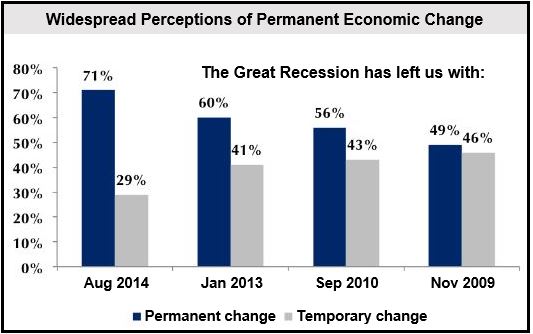
(Data source: Rutgers, The State University of New Jersey)
Beliefs resulting from personal experience
According to report co-author, Carl Van Horn, much of people’s pessimism is rooted to direct experience.
Mr. Van Horn said:
“Fully one-quarter of the public says there has been a major decline in their quality of life owing to the recession, and 42 percent say they have less in salary and savings than when the recession began.”
“Despite five years of recovery, sustained job growth and reductions in the number of unemployed workers, Americans are not convinced the economy is improving.”

(Data source: Rutgers, The State University of New Jersey)
Recession produced 5 “types”
The analysis classifies Americans into one of five different categories, according to how much their quality of life was affected by the recession, and whether the change was permanent or temporary. It found that:
- 38 million people, or 16% of the population, were “devastated” because their quality of life underwent a “permanent change”.
- 46 million people, or 19% of the population, were “downsized” as a result of a “permanent but minor” change in their standard of living.
- 24 million people, or 10% of the population, were “set back” after their quality of life underwent a “major, but temporary” change.
- 53 million people, or 22% of the population, were “troubled” and experienced only a “minor and temporary” change.
- Of the United States’ 240 million adults, only 80 million (one in three) said they came out of the recession “unscathed”.
Professor Cliff Zukin, who along with Mr. Van Horn is co-director of Work Trends, said:
“Looking at the aftermath of the recession, it is clear that the American landscape has been significantly rearranged. With the passage of time, the public has become convinced that they are at a new normal of a lower, poorer quality of life. The human cost is truly staggering.”
