

Canada’s trade surplus widened to $2.6 billion in July from $1.8 billion in June as exports rose +1.4% and imports declined by -0.3%, according to figures published by Statistics Canada. In July, Canada posted its largest surplus since October 2008.
A trade surplus is when the total value of all exports exceeds that of imports.
A lower Canadian dollar is finally paying off as are Canada’s close ties with the US economy, which is growing rapidly. Approximately three-quarters of Canadian exports go to the United States.
Exports increased to $45.5 billion, driven by motor vehicles and parts. Overall, prices rose by +0.3% and volumes by +1.1%.
Imports slipped to $43 billion as prices fell -0.6% while volumes grew +0.4%. Higher imports of motor vehicles and parts were more than offset by a fall in imports of consumer goods, metal and non-metallic mineral products, aircraft and other transportation equipment parts.
Trade with the United States increased
Trade with the US in July increased as follows:
- Exports: $34.4 billion, a +1.9% increase.
- Imports: $29.2 billion, a +1.2% rise.
- Trade surplus with the US: $5.1 billion in July compared to $4.9 billion in June.
Trade gains with the US – both exports and imports – were mainly driven by motor vehicles and parts.
Trade with other countries
Canadian exports elsewhere (other than the US) grew by +0.1% in July to $11.2 billion, while imports declined by -3.2% to $13.7 billion.
Imports from the European Union fell by -3.7% in July.
Canada’s July trade deficit with countries other than the US shrank to $2.6 billion in July from $3 billion in June.
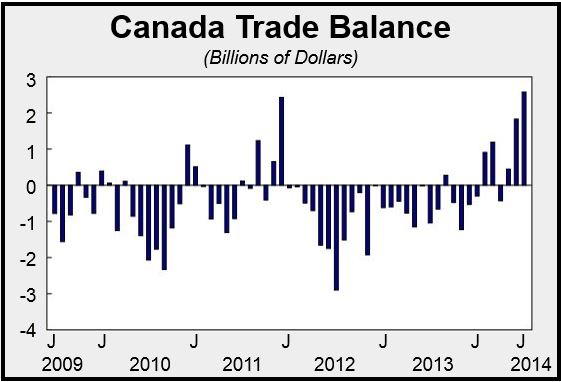 2014 has been a good year so far for Canada’s trade balance.
Below are some highlighted data on July trade from Statistics Canada:
- Exports of motor vehicles and parts: $6.9 billion, a +9.7% rise. The fifth increase in seven months. Vehicle sales in the US and Canada have been at record highs since the beginning of 2014.
- Exports of passenger cars & light trucks increased by +10.2%.
- Exports of motor vehicle engines and motor vehicle parts rose by +8.9%.
- Exports of energy products: down -2.1% to $11.3 billion, with prices and volumes falling by -1.8% and -0.3% respectively.
- Exports of crude oil and crude bitumen: $8.5 billion, a fall of -1.6% compared to June’s $8.6 billion.
- Exports of natural gas: $1.1 billion, a decline of -6.3%, with volumes and prices falling by -4.6% and -1.8% respectively.
- Imports of aircraft and other transportation equipment: $1.4 billion, down by -11.9%.
- Imports of consumer goods: $8.6 billion, a decline of -1.9%. The third successive month posting a fall.
- Imports of metal and non-metallic mineral products: $3.5 billion, a -4.4% fall.
- Imports of motor vehicles and parts: $7.8 billion, a +2.7% increase.
Economic growth and interest rates
According to economists, the export surge could lead to a second successive quarter of over 3% GDP growth. The economy expanded by 3.1% in Q2 2014, with much of it coming from an improving balance of trade.
Royal Bank of Canada predicts 3.3% GDP growth for Q3 2014, compared to Bank of Canada’s (the country’s central bank’s) 3% forecast.
Should the economy grow any faster, Stephen Poloz, Governor of Bank of Canada, and colleagues may have to consider raising interest rates, which could trigger a sharp downturn in the housing sector, push up the currency and undermine investment.
