
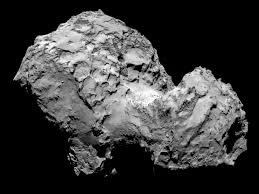
Comets are cosmic balls composed of frozen gases, rock and dust. They are characterized by their coma and a tail that stretches millions of kilometers away from the Sun. Because of their composition and characteristics comets are commonly described as being “dirty snowballs”.
The orbital inclinations of comets are typically high and they are usually very far away from other space objects. Even though they are so distant, occasionally they are visible in the night sky.
The main difference between asteroids and comets is that the latter have an extended, gravitationally unbound atmosphere that surrounds their central nucleus.
Comets are classified depending on the length of their orbital periods, which can range from several years to several millions of years.
Sometimes comets can break up, such as the Comet Biela (which broke up in the 19th century). In 1994 Comet Shoemaker-Levy 9 broke up, with parts of it hitting the planet Jupiter.
Comets have been observed by humanity for thousands of years. Before the 16th century they were regarded as bad omens of deaths of kings or noble men, or catastrophes.
Most comets are discovered using wide-field telescopes and there are over 5,000 known comets, with the number steadily rising.
Etymology of the word “comet”
The word comet comes from the Latin word comēta which is from the Greek word (aster) kilometers, which translates into “long-haired (star)”.
Hubble’s Last Look at Comet ISON:
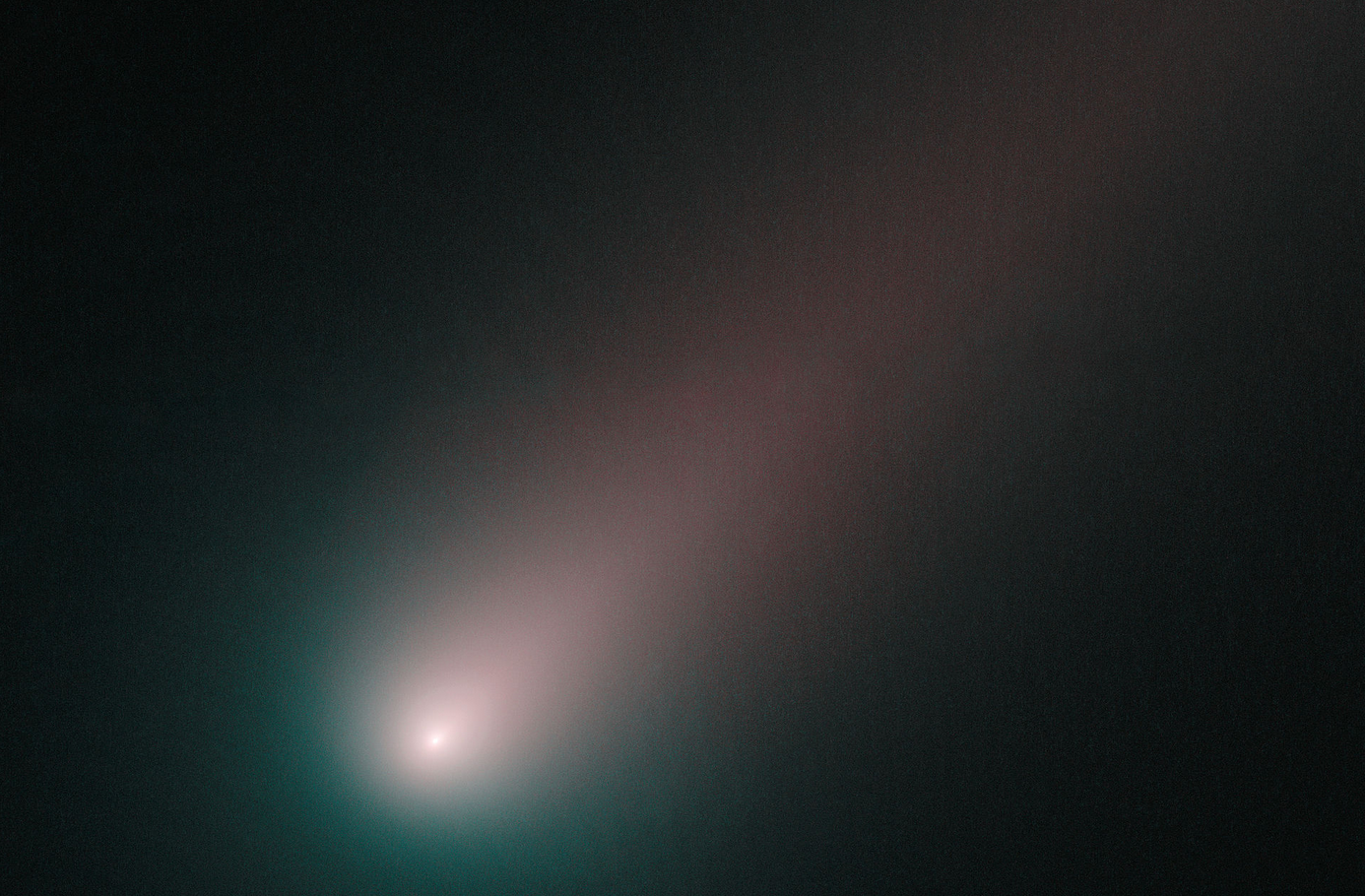
Photo Credit: NASA, ESA, and the Hubble Heritage Team (STScI/AURA)
Physical characteristics of a comet
Comets are composed of a nucleus, a coma, and a tail.
The nucleus is the solid, central part of a comet made of rock, dust, and frozen gases. The nucleus is typically less than 16 kilometers across. It is one of the darkest objects in the solar system. This was observed when light shone on the nucleus of Halley’s Comet, as it only reflected 4% of the light back to us.
The dust and gas released from the comet form a thin atmosphere known as the coma.
The coma is mainly composed of H2O and dust and can be thousands or millions of kilometers across.
The dust and gas each released from a comet create a distinct tail that points in different directions (but always away from the Sun). The tail of dust in the comet’s orbit forms a curved tail called the type II or dust tail. Dust tails point away from the Sun but curve toward the comet’s orbital path. There is also an ion tail, which is made of gases, pointing directly away from the Sun as it is strongly affected by solar wind.
Short-period comets and long-period comets
Short-period comets are those that orbit the sun in less than 200 years. They are located in the icy region called the Kuiper Belt beyond the orbit of Neptune.
Long-period comets are those with long and unpredictable orbits. They are located in the far-off reaches of the Oort Cloud.
Impact on Earth
There were various comets that collided into Earth in its early stages. There is a theory that comets that collided with Earth, around 4 billion years ago, and brought large amounts of water that now fill a portion of our oceans.
