
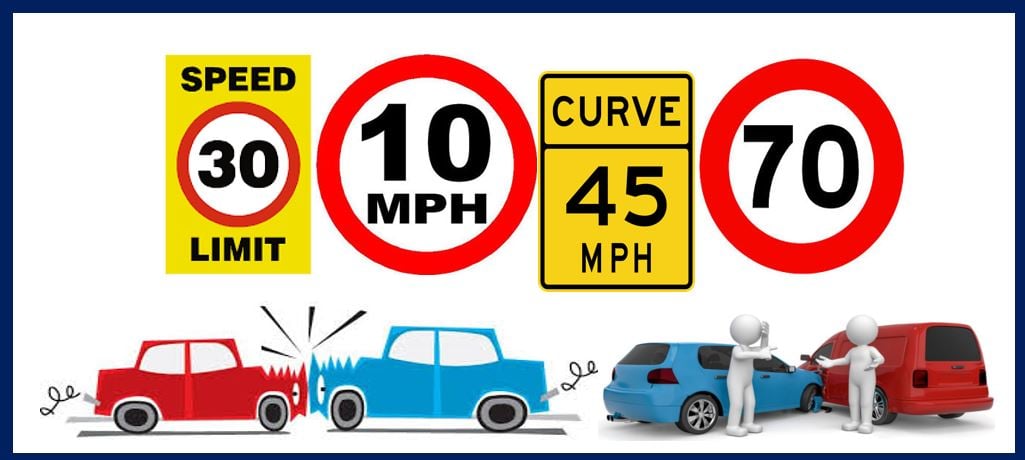
There are fewer fatal and injury crashes when speed limits are set 5 mph below engineering recommendations, says a team of researchers. However, if you set the speed limit far below the guidelines, the risk of fatalities and injuries increases.
Vikash Gayah, an Assistant Professor of Civil Engineering at Pennsylvania State University, said:
“If you lower the speed limit by 10, 15, 25 miles per hour, or more, drivers stop paying attention. We found there was an increase in fatal and injury crashes at locations with posted speed limits set 10 miles per hour or more below engineering recommendations.”
Prof. Gayah, Eric T. Donnell, Zhengyao Yu, and Lingyu Li wrote about their study in the journal Accident Analysis and Prevention (citation below).
Setting speed limits
We usually set speed limits by gathering and analyzing data from engineering studies and using a statistical model. These studies collect free-flow traffic data.
However, sometimes, pressure from citizens or political groups may push the limits below engineering guidelines. Perceived safety issues and school zones may also contribute to the practice of lowering the speed limit.
Prof. Gayah said:
“When doing speed research, we are looking at free-flow speeds – the speed that drivers select based on geometric and prevailing weather conditions.”
The researchers gathered speed data from twelve roadway segments in Montana on three different occasions. Montana sets many maximum speeds lower than engineering recommendations.
In eight of the twelve sites, speed limits had changed 5, 10, 15, or 25 mph below engineering recommendations. The other four sites’ limits were equal to engineering recommendations. The researchers used those four sites as comparison locations.
Each period of data collection considered either the presence of heavy, light, or no law enforcement.
Gathering speed data
The researchers gathered speed data using hidden pavement sensors in fair weather conditions during daylight hours. They did not include data on cars traveling too close together. The same applied to trucks traveling too close to other vehicles.
They also excluded ‘speed outliers.’ A speed outlier is a vehicle traveling 10+ mph miles slower or 20+ mph faster than the speed limit.
The analysis included a four-year period before and after speed limits were altered.
Drivers’ adherence
Drivers were twice as likely to obey a speed limit of 50 or 55 mph compared to a limit below 50 mph, the researchers found. Also, when speed limits were between 60 and 70 mph, drivers were four times more likely to obey.
In zones with heavy law enforcement, drivers’ traveled 4 mph slower than their counterparts in other zones. They were also more likely to adhere to the speed limit, the researchers found.
Prof. Gayah said:
“The practice of setting speed limits lower than what would be recommended from an engineering study is okay if it’s only by a little – by five miles per hour.”
Penn State wrote the following in a press release:
“Such a difference showed an increase in speed-limit compliance, a decrease in property damage only, and total, fatal and injury crashes.”
“Larger differences between the posted and engineering-recommended speed-limit values were found to increase crash frequency and reduce speed limit compliance.”
Will driverless cars – no speeding tickets
In a different study, researchers forecast that in the future, driverless cars will mean no more traffic lights or speeding tickets.
Driverless technology will control vehicles’ speeds so that their movements are in harmony with other vehicles. When a vehicle in front accelerates, so will your driverless car.
Citation
“Safety and operational impacts of setting speed limits below engineering recommendations,” Vikash V. Gayah, Eric T. Donnell, Zhengyao Yu, and Lingyu Li. Accident Analysis & Prevention, Volume 121, December 2018, Pages 43-52. DOI: https://doi.org/10.1016/j.aap.2018.08.029.
