
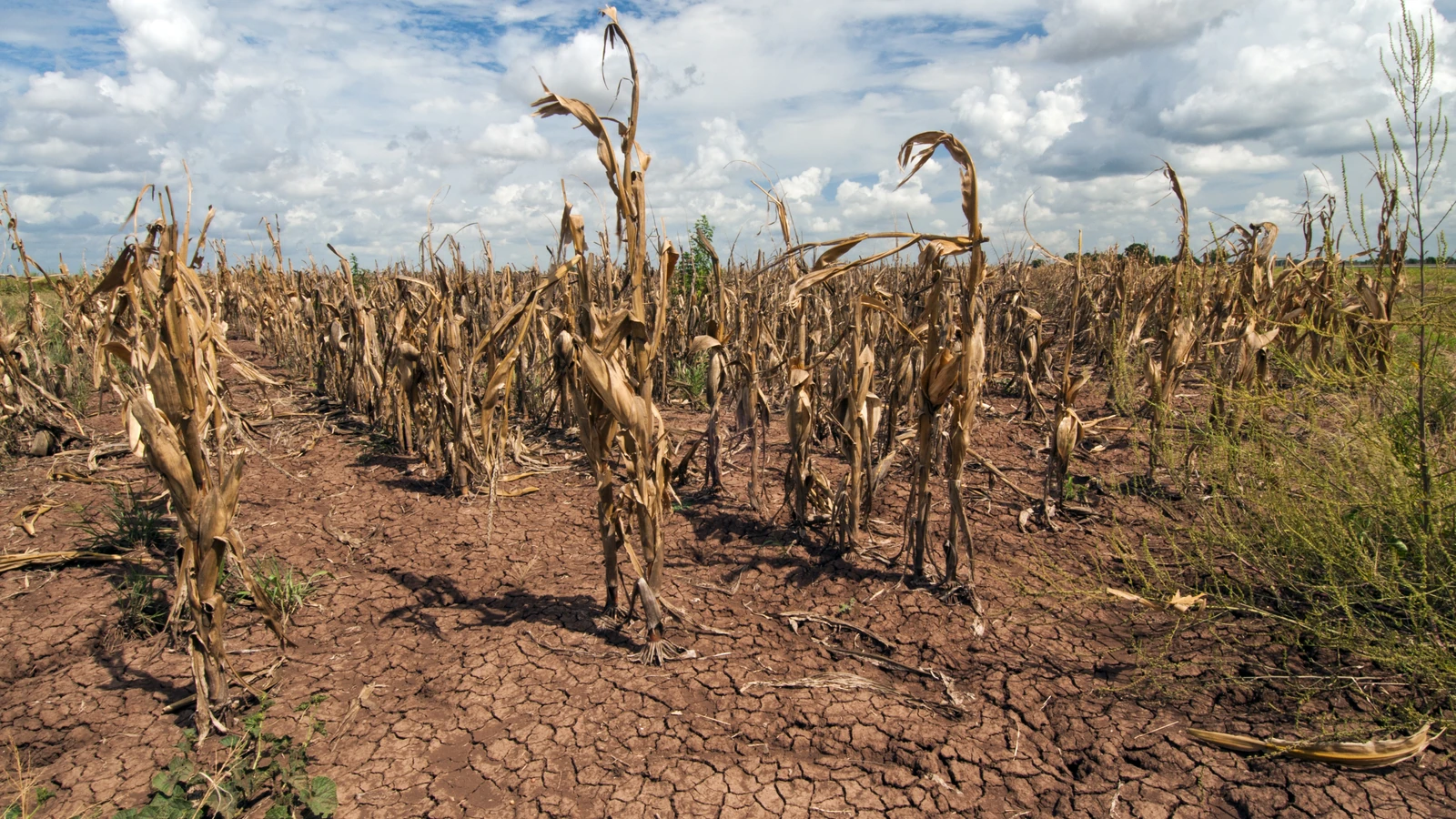
A simulation of Sweden’s food supply network found that drought-related farm losses could leave remote northern communities facing the largest shortages, even where local agricultural damage was negligible.
The scenario reduced national agricultural production by 13.86% and left 14.59% of modelled demand unmet, equivalent to about 2.28 million tonnes. These are simulated outcomes, not documented Swedish food shortages or a forecast of what the next drought will cause.
The study in Frontiers in Sustainable Food Systems, published on 17 September, examines how agricultural losses can spread through processing, distribution and retail networks. The Stockholm Environment Institute highlighted the research on 13 October.
For food manufacturers, wholesalers and retailers, the findings suggest that assessing suppliers’ exposure to dry weather provides only part of the picture. The organisation of deliveries can determine which customers face the greatest difficulties when supplies fall.
What is a cascading supply chain disruption?
A cascading supply chain disruption occurs when a problem in one part of a supply network creates difficulties elsewhere. A smaller grain harvest, for example, can leave processors with less material, distributors with fewer products and retailers unable to obtain their usual deliveries.
The consequences can reach places with normal rainfall because those places depend on production elsewhere. MBN’s coverage of how port disruptions can affect inland factories examines a related problem: geographical distance offers little protection when businesses share the affected supply network.
Noor Bosman, Samuel Jonson Sutanto, Zahra Kalantari and Marlon Vieira Passos built a synthetic Swedish network using public geographical and statistical data. Their affiliations include Wageningen University & Research, KTH Royal Institute of Technology and the Stockholm Environment Institute.
The network contained 832,442 nodes and approximately 22.8 million potential connections. Nodes represented locations involved in production, processing, distribution, retail and consumption, rather than a count of individual food businesses.
The team used minimum cost flow optimisation, a mathematical method for allocating available supplies while minimising the cost of moving them. Straight-line distance served as a proxy for transport cost.
The largest shortages emerged far from the damaged farms
The researchers applied a severe drought scenario analogous to the European drought of 2018. Estimated agricultural losses were concentrated in southern and central Sweden, but unmet demand emerged mainly in the north.
Some northern municipalities, including areas within Västerbotten and Norrbotten counties, had more than 95% of their modelled demand unmet despite negligible local yield losses. Several southern municipalities experienced production losses approaching 49% while their consumer demand remained almost fully satisfied.
Within the model, southern locations retained better connections to unaffected production and imports. Minimising overall transport costs also favoured supplying the more populous producing regions, leaving remote demand harder to serve.
That allocation reflects the model’s objective. A system designed to limit the worst local shortage, rather than minimise total transport costs, could distribute the shortfall differently.
Rerouting also changed the importance of particular locations. A distribution node in Hässleholm became more central to the simulated network, while previously prominent hubs in Arvika and Boden became less important.
The researchers measured centrality, an indicator of a node’s position within network routes. An increase identifies a possible dependency requiring further investigation. It is not evidence that a real warehouse became congested, handled a corresponding percentage increase in deliveries or exceeded its capacity.
Actual delivery data must come next
The authors describe the work as a demonstration of a modelling framework, rather than a definitive assessment of Sweden’s food supply risks. Its network was constructed from public data instead of actual contracts and shipment records.
Real distribution involves independent businesses responding to prices, inventories and customer requirements. The simulation instead assumes central coordination and treats food as one undifferentiated commodity. It cannot show whether consumers would substitute one product for another, which may overstate the severity of shortages.
The model represents an annual balance, without tracking how stocks run down or demand changes over time. It also omits detailed road routes and binding facility or transport capacity limits. Its potential bottlenecks therefore concern network structure and cost-driven allocation, not measured congestion.
For businesses, the approach could help identify dependencies worth checking. Apparently separate suppliers may rely on the same farming region, warehouse or transport corridor. A facility that seems secondary during normal operations may become essential when deliveries are redirected.
Reserve stocks and alternative routes are possible responses, but this study did not establish their costs or measure how effectively they would prevent shortages. Validation against actual freight volumes and distribution routes is needed before the model can identify specific locations for investment.
