

Electricity is the force of an electric charge. It is the form of energy that we use to power machines and electrical devices.
There are two types of electricity; static electricity and dynamic electricity. Static energy is when the charge does not move and dynamic electricity is when the charge moves as a current.
Before the 19th century electricity wasn’t part of our everyday lives, it was just a force that we would see in nature (lightning).
However, since then the advent of harnessing its energy is been part of our lives and we use electricity to power light, electrical devices, and produce heat.
There is now a huge demand for electricity, hence why we generate enormous amounts of electric energy at power generators.
How does electricity work?
Electricity works because of electric charges pushing and pulling each other. There are positive and negative charges.
When there are two similar charges (two positive charges for example) they repel each other, meaning that if you put two positive charges together they will move away. But different charges don’t repel, they attract each other. If you have a positive charge and a negative charge close together they close in more.
Each charge has an electric field around itself, which is an area that surrounds a charge. The electric field points in a certain direction at each point near a charge.
If there is a positive charge at that point it will push in that direction, whereas if there is a negative charge at that point it will move in the opposite direction.
Matter is made up of positive charges, called protons and negative charges, called electrons. Protons are a lot heavier than electrons but they both have the same electric charge. Protons and electronics attract – as opposites attract.
Electric current
In certain materials electrons stay in place and don’t move, but in other materials electrons can move around. Protons are not able to move in a solid object because they are heavy (at least compared to electrons).
A conductor is a material that allows electrons to move around. An insulator is a material that keeps electrons stuck in place. Examples of conductors include copper, silver, gold, and aluminum. Examples of insulators include wood, plastic, and rubber.
Copper is frequently used as a conductor, especially as there is so much of it in the world compared to other conductors (such as gold) and it has the highest electrical conductivity rating of all non-precious metals.
Electrons bounce around inside a conductor. If there is an electric field inside the conductor then electrons will all move in the opposite direction of where the field is pointing. A battery is capable of creating an electric field inside a conductor. If you have a wire with both ends attached to a battery then you have created an electric circuit in which electrons will flow around – as an electric current.
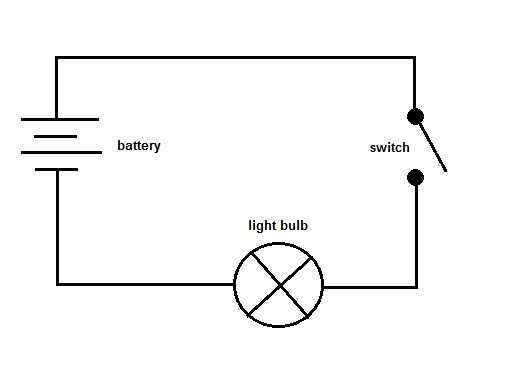
Diagram of an electrical circuit. The battery creates an electrical field and the electrons in the wire flow in the opposite direction (creating an electric current). The electric current is able to power the light bulb. The circuit has a switch which can turn it off or on.
Generating electricity
Electricity is generated at power stations. The majority of these stations use heat to boil water into steam, turning a steam engine. The turbine of the steam engine turns a generator. The generator has wires inside which spin inside a magnetic field. Electricity then flows through the wires because of electromagnetic induction.
