
If we all went on a healthy diet, there would not be enough fruit and vegetables to feed us all. Canadian and British researchers compared nutritionists’ consumption recommendations with global food production. They found that we are not producing enough fruit and vegetables to feed all humans on the planet.
The researchers are from the University of Guelph, the University of Waterloo, and the University of British Columbia, all in Canada; and the University of Leeds in the UK.
They wrote about their study and findings in the journal PLOS ONE (citation below).
Not enough fruit and veg production
Co-author Prof. Evan Fraser said:
“We simply can’t all adopt a healthy diet under the current global agriculture system.”
“Results show that the global system currently overproduces grains, fats, and sugars, while production of fruits and vegetables and, to a smaller degree, protein is not sufficient to meet the nutritional needs of the current population.”
Prof. Fraser is the holder of the Canada Research Chair in Global Food Security. He is also Director of the University of Guelph’s (UoG’s) Arrell Food Institute.
Global human food consumption vs. production
The researchers calculated how many servings of each food group each person alive today required on a ‘healthy diet.’ They based the diet on the ‘Healthy Eating Plate,’ a Harvard University guide. The guide recommends that fruit and vegetables should make up half our diet. The rest should consist of 25% wholegrain and 25% protein, fat, and dairy.
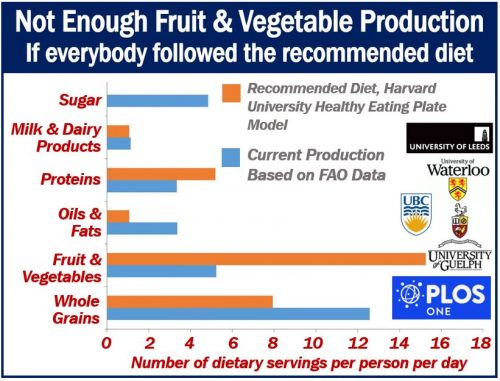
The authors calculated how much land we currently use for farming. They also calculated how much we would need if we all followed the ‘Healthy Eating Plate’ guide.
Then, they projected those numbers for the middle of this century. The global population is expected to reach 9.8 billion by 2050.
The authors found that we don’t produce enough fruit and vegetables, but in some food groups, we produce more than enough. Below is a list of global production vs. global consumption requirements:
Global production too low
- Fruit and vegetables: production of 5 servings per person vs. global requirement of 15 servings per person.
- Protein: production of three servings vs. requirement of 5.
Global production more than enough
- Grains: production of 12 servings per person vs. requirement of 8.
- Oil and Fat: production of 3 servings per person vs. requirement of one.
- Sugar: production of 4 servings per person vs. requirement of none (zero).
Prof. Fraser said:
“What we are producing at a global level is not what we should be producing according to nutritionists.”
Lead author, Krishna Bahadur KC, explained that developing nations focus on growing grains because carbohydrates are relatively easy to produce. Krishna KC is a Research Scientist (Postdoctoral Fellow) at UoG’s Department of Geography, Environment and Geomatics.
Krishna KC added that the advanced economies have subsidized corn and grain production for several decades. They have done this so that they could become self-sufficient. The advanced economies also wanted to establish global leadership regarding production. They have spent considerably more on R&D for these crops than on R&D for fruit and vegetables.
In this context, an ‘advanced economy’ is a ‘developed country.’
KC said:
“Also fat, sugar and salt are tasty and are what we humans crave, so we have a real hunger for these foods. All of these factors combined have resulted in a world system that is really overproducing these types of foods.”
Healthy diet also good for planet Earth
Not only is a healthy diet good for our health, but also for the health of our planet, the authors wrote.
KC explained:
“If we do switch to nutritious diets, we would see a drop in the amount of land required to feed our growing population.”
If we switched production to match dietary guidelines, we would need fifty-million fewer hectares of farmland. We’d need less land because fruit and vegetable production take up less land than fat, sugar, and grain.
Plant-based proteins
However, humans would need to eat less meat to achieve this decrease. The agri-food sector would need to produce more plant-based proteins.
Prof. Fraser said:
“Major players in the protein industry are investing in alternative protein options such as plant-based proteins, and consumers are taking advantage of the recent increase in alternative protein options hitting the market.”
Prof. Fraser added that without any change, we’d need 12 million more hectares of farmland to feed 9.8 million people. We would also require at least one billion hectares of pasture land.
Regarding the challenges facing this century, Prof. Fraser said:
“Feeding the next generation is one of the most pressing challenges facing the 21st century.”
“For a growing population, our calculations suggest that the only way to eat a nutritionally balanced diet, save land and reduce greenhouse gas emission is to consume and produce more fruits and vegetables as well as transition to diets higher in plant-based protein.”
Citation
“When too much isn’t enough: Does current food production meet global nutritional needs?” Krishna Bahadur KC, Goretty M. Dias, Anastasia Veeramani, Clarence J. Swanton, David Fraser, Dirk Steinke, Elizabeth Lee, Hannah Wittman, Jeffrey M. Farber, Kari Dunfield, Kevin McCann, Madhur Anand, Malcolm Campbell, Neil Rooney, Nigel E. Raine, Rene Van Acker, Robert Hanner, Samantha Pascoal, Shayan Sharif, Tim G. Benton, and Evan D. G. Fraser. PLOS ONE 13(10): e0205683. DOI: https://doi.org/10.1371/journal.pone.0205683.
