
Eurozone GDP (gross domestic product) has slowed dramatically in the second quarter – economic growth was 0.3% in Q2 compared to 0.6% in the first quarter. Most of the second quarter (April-May-June) consists of pre-Brexit-vote time. Britons voted to leave the European Union on 23rd June.
These figures are the first estimate published by Eurostat, the EU’s official statistical agency.
The Brexit quake has not only hurt the British economy, the Eurozone is also feeling the consequences – in fact, the whole world has been affected in some way. If growth halved before the referendum, third quarter results will probably be even more depressing, economists warn.
 Since 2005, Eurozone GDP has been either expanding at less than 1% per year or shrinking. The slight turnaround in the first quarter of this year had everybody excited about the possibility of long-term stronger growth. However, this was not to be. (Image: Eurostat)
On the year, GDP growth was down from 1.7% to 1.6%, while in the wider 28-nation EU – including EU nations that do not have the euro as their national currency – growth came in at 0.4% in the second quarter, compared to 0.5% in the first. The economy of the 28 nations grew by 1.8% on the year.
This initial GDP report includes no breakdown of the growth drivers. Eurostat says its final report will be published in August.
Eurozone recovery not to be?
Earlier today, France reported that its economy is beginning to stagnate again. Spain’s quarterly growth was 0.7% in Q2 compared to 0.8% in Q1.
Economists across the EU and much of the world had hoped the 0.6% increase posted in the first quarter was a sign of a stronger recovery for the Eurozone, whose economy has been struggling for years.
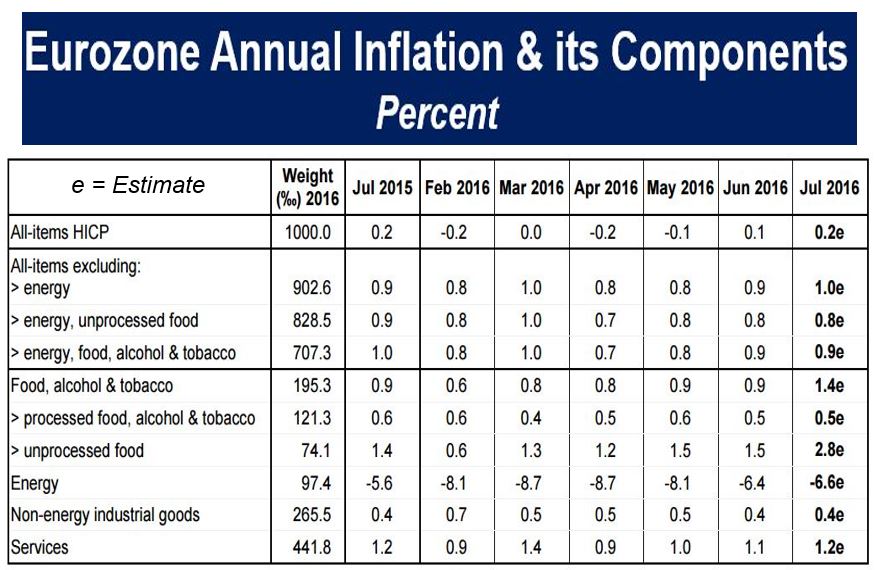 Annual inflation is the change of the price level between the current month and the same month of the previous year. (Image: Eurostat)
Eurozone inflation picks up slightly
According to Eurostat, the Eurozone’s annual inflation rate increased from 0.1% in June to 0.2% in July.
German annual inflation rose from 0.3% in June to 0.4% in July. Germany is the EU’s largest economy.
Tobacco, alcohol and food rose by 1.4%, services by 1.2%, and non-energy industrial goods by 0.4%. Energy, however, was 6.6% down year-on-year.
The European Central Bank has a target of 2% annual inflation, as does the Bank of England, Bank of Japan and the US Federal Reserve System.
Eurozone unemployment
The Eurozone’s unemployment rate stood at 10.1% in June, the same as the previous month and down from 11% in June 2015.
Unemployment in the Eurozone, although still high, is lower than at any time since July 2011.
The EU28 unemployment rate in June was 8.6%, which was also unchanged compared to May but down from 9.5% in June 2015.
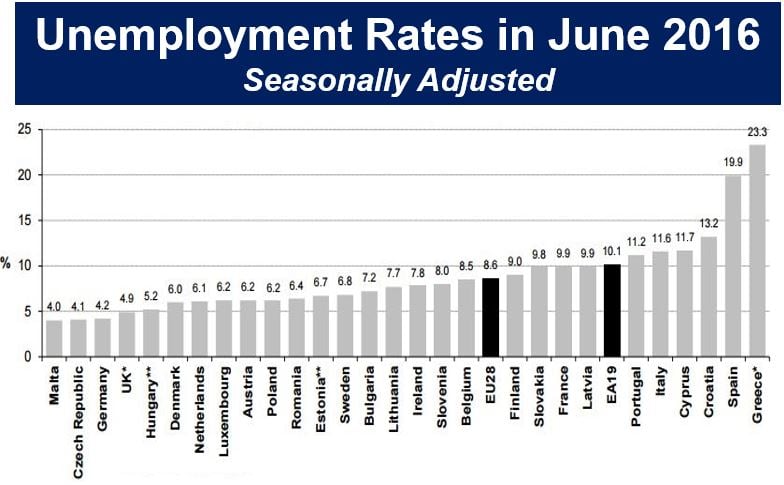 Malta is the only Mediterranean country with an unemployment rate of less than 9.9%. All the northern European countries, with the exception of Latvia and Ireland, have an unemployment rate below 7.8%. (Image: Eurostat)
According to Eurostat, there were an estimated 20.986 million unemployed adults in the EU28 in June – 16.269 million of them fromm the Eurozone.
The lowest unemployment rates were recorded in Malta with 4%, the Czech Republic with 4.1% and Germany with 4.2%. Greece has the highest unemployment rate (23.3%), followed by Spain (19.9%).
In the United States, unemployment in June was 4.9%, compared to 4.7% in May and 5.3% in June 2015.
The United Kingdom’s unemployment rate fell to 4.9% in the three months to May, from 5% in the previous 3-month period.
Video – 4 weeks after EU referendum
This ITV News video looks at the economic indicators that are starting to emerge in the UK four weeks after Britons voted for Brexit. The EU is also bracing itself for a series of negative statistics.
