
Fabrinet reported record quarterly revenue of $1.316 billion and a 60% increase in GAAP net income, but its cash flow tells a more complicated story. Inventory, customer receivables and capital spending absorbed enough cash to reduce full-year free cash flow from $207.3 million to $4.2 million.
The advanced manufacturer’s revenue rose 45% in the fourth quarter ended June 26, 2026, from $909.7 million a year earlier. GAAP net income increased to $139.3 million from $87.2 million, while diluted earnings per share climbed to $3.83 from $2.42.
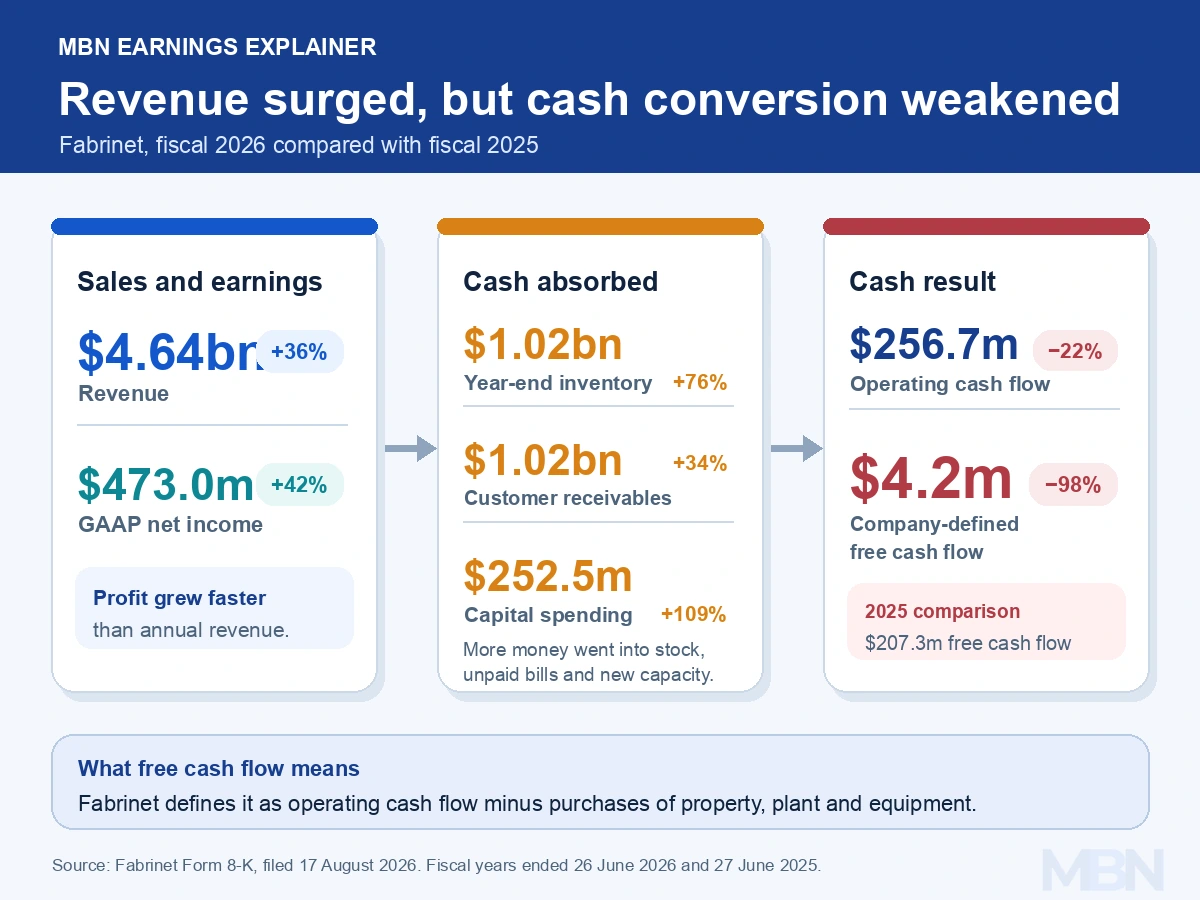
For the full fiscal year, revenue increased 36% to $4.64 billion and GAAP net income rose 42% to $473.0 million, according to the company’s results filed with the US Securities and Exchange Commission.
Chief executive Seamus Grady called the fourth quarter “exceptional” and said Fabrinet was seeing several growth drivers across the business. The company expects revenue of between $1.375 billion and $1.425 billion in the first quarter of fiscal 2027. That is guidance based on information available on August 17, not a guaranteed result.
What Fabrinet actually makes
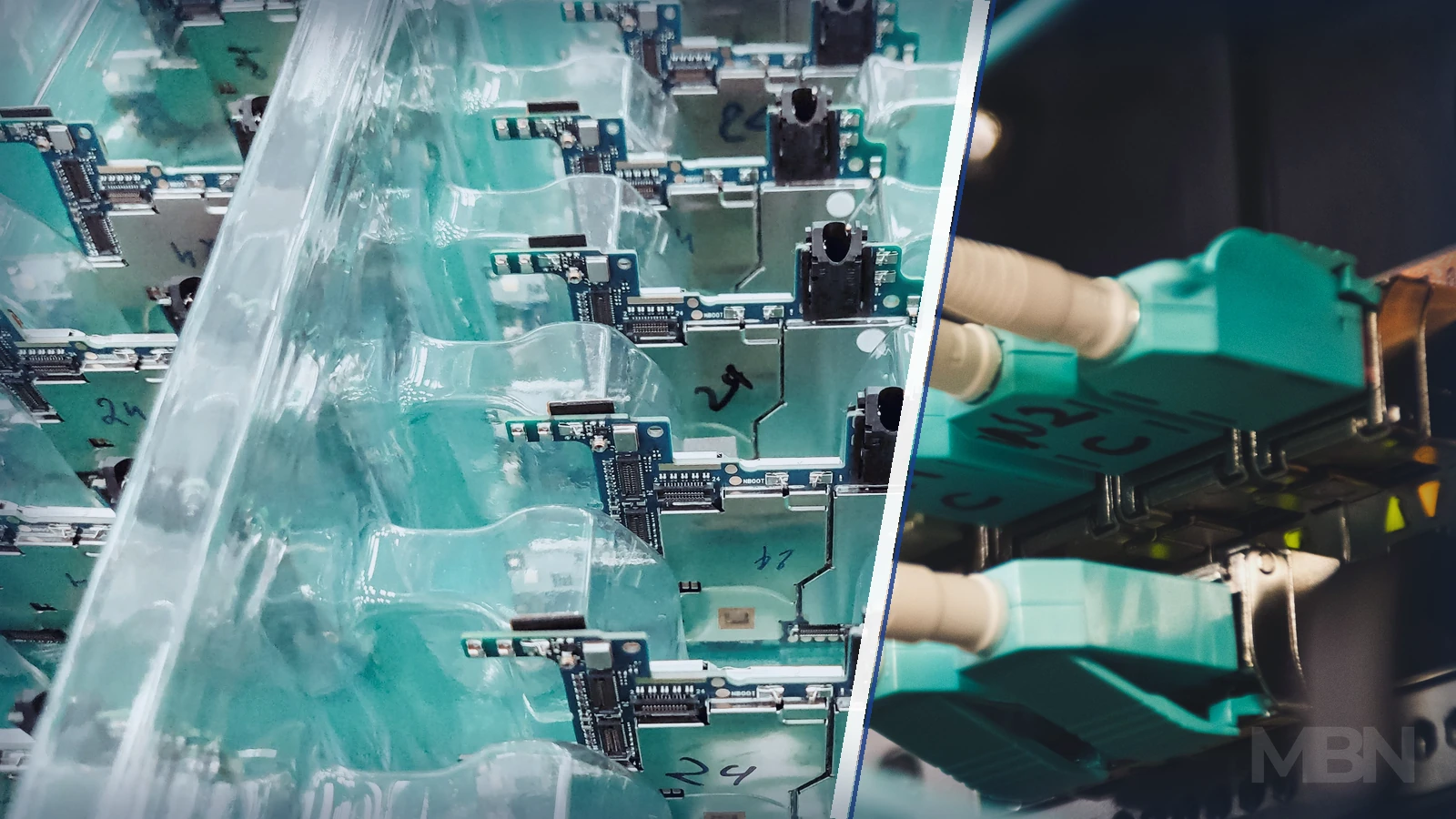
Fabrinet is not a consumer electronics brand. It is a contract manufacturer that builds complex components, modules and subsystems for original equipment manufacturers, or OEMs. An OEM is the company that designs and sells the finished system under its own name, while a specialist such as Fabrinet handles some of the engineering, supply chain, assembly and testing.
The company’s work includes advanced optical packaging, printed circuit board assembly, integration and final testing. Its customers operate in optical communications, high-performance computing, industrial lasers, automotive equipment, medical devices and sensors.
Optical communications remains central to the business. In the quarter ended March 27, the latest period for which Fabrinet provided a detailed end-market breakdown before the year-end release, optical communications generated 73.2% of revenue. The company said growth in that quarter included telecommunications products, data-centre interconnect equipment and high-performance computing. Those comments appear in its latest quarterly report; the new year-end release does not identify which customers or programmes produced the fourth-quarter increase.
Revenue and profit reached new highs
Fabrinet’s fourth-quarter gross profit rose 42% to $158.1 million. Gross margin, the percentage of revenue left after the direct cost of manufacturing, slipped to 12.0% from 12.2%.
Operating margin improved to 10.2% from 9.8%. That suggests the company kept overhead growth below the increase in revenue, even though the direct manufacturing margin narrowed slightly.
Fabrinet also reported non-GAAP diluted earnings of $4.10 per share, up from $2.65. Non-GAAP figures are company-defined measures that remove selected items. In this case, the exclusions include share-based compensation, certain legal and restructuring costs, changes in the value of non-marketable investments and charges related to the OECD’s global minimum tax framework. GAAP earnings retain those items and provide the standard accounting comparison.
Why free cash flow almost disappeared
Accounting profit and cash generation are not the same thing. Fabrinet produced $256.7 million of operating cash flow during fiscal 2026, down from $328.4 million a year earlier, even as net income increased.
Capital spending then more than doubled to $252.5 million from $121.1 million. Fabrinet defines free cash flow as operating cash flow minus purchases of property, plant and equipment. On that basis, only $4.2 million remained, compared with $207.3 million in fiscal 2025.
The fourth quarter was cash-flow negative under the same measure. Operating activities supplied $55.0 million, but capital spending reached $91.9 million, producing negative free cash flow of $36.9 million.
This does not mean the company lost money or ran out of cash. It means most of the cash generated by operations was reinvested, while more money was tied up in the day-to-day funding of the business.
Inventory grew twice as fast as annual revenue
Year-end inventory increased 76% to $1.02 billion, while accounts receivable rose 34% to another $1.02 billion. Receivables are bills sent to customers that have not yet been paid.
Together, inventory and receivables are part of working capital, the cash needed to keep normal operations moving before customers pay. Fabrinet’s cash-flow statement shows that higher inventory absorbed $442.9 million during the year and higher receivables absorbed $259.3 million.
An increase in trade payables, or money Fabrinet owed its suppliers, provided a $370.8 million offset. Supplier credit therefore financed part of the expansion, but not all of it.
The important point is the speed of the inventory build. Inventory grew about twice as fast as annual revenue. That can be consistent with buying components for future orders and preparing new capacity, but the filing does not show how much of the stock is already matched to firm customer demand.
That uncertainty matters in Fabrinet’s business model. The company says manufacturing work is generally awarded project by project and is not guaranteed by its master supply agreements. Its quarterly risk disclosures also warn that customer concentration can leave it with potentially unrecoverable inventory if a customer fails to pay or sharply reduces orders.
The next few quarters will therefore test whether the working-capital build converts into sales and cash. Rising inventory is not automatically a warning sign during rapid expansion, but it becomes less comfortable if revenue slows or operating cash flow does not recover.
A $75 million loan supports capital spending
On August 17, Fabrinet’s Thai subsidiary borrowed 2.50 billion baht, approximately $75 million, from Bank of Ayudhya. The parent company guaranteed the term loan, and Fabrinet said the proceeds, together with cash on hand, were used to support capital expenditure.
The same SEC filing says the bank also increased the wider credit facility to 2.61 billion baht, approximately $78.3 million, plus $100 million. That figure is the facility ceiling across its credit uses, not an additional $178.3 million loan. The amount actually borrowed under the term-loan agreement was about $75 million.
The financing is better read as part of the expansion programme than as evidence of an immediate liquidity problem. Fabrinet ended June with $346.7 million of cash and $528.3 million of short-term investments, a combined $875.1 million.
What to watch in fiscal 2027
The midpoint of Fabrinet’s first-quarter revenue guidance is $1.40 billion, about 6% above the record just reported. Management also expects GAAP diluted earnings of $3.39 to $3.54 per share and non-GAAP diluted earnings of $4.10 to $4.25.
Revenue growth is only one part of the test. Investors also need to see whether inventory begins growing more slowly than sales, whether customers pay the larger receivables balance and whether the new capacity and equipment lift operating cash flow.
If those conversions happen, the near-zero free cash flow of fiscal 2026 will look like the cost of preparing for a larger business. If inventory remains elevated while cash generation stays weak, the expansion will have placed more capital at risk without yet producing a corresponding cash return.
