

In countries where there is more gender equality, gender-specific work preferences differ more widely, a new study has found. This is also the case when economic development is greater, say two researchers.
The researchers wrote about their study and findings in the journal Science (citation below). The authors were Armin Falk, from the Department of Economics at the University of Bonn, and the BRIQ Institute on Behavior & Inequality; and Johannes Hermle, from the Department of Economics at the University of California, Berkeley.
The researchers gathered and analyzed survey data from almost eighty nations.
Gender-specific preference hypothesis confirmed
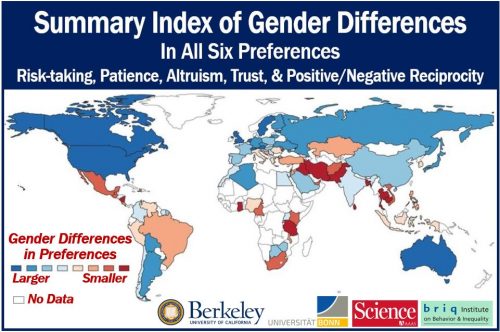
The authors’ findings reinforced the hypothesis regarding the gender gap in fundamental preferences. Specifically preferences regarding risk, time, and social interactions. The hypothesis suggests that in populations where economic development and gender equality are more advanced, gender-specific preferences differ more.
A hypothesis is an explanation for a given phenomena. The person who makes the hypothesis bases it on available evidence.
The study findings offer a key explanation for the choices and outcomes between males and females regarding occupation decisions. It also explains the differences between men and women’s educational and financial decisions and their variability across nations and cultures globally.
We have long been interested in gender-specific preferences and their effect on the economic gap between the genders. We have also been interested in the social gap. However, nobody has had a good understanding of what contributes to those differences.
Gender-specific work preferences – two hypotheses
There are two main competing hypotheses:
- Gender differences in preferences become narrower in more developed countries with greater gender equality.
- Gender differences in preferences become wider in such settings. In such settings, both males and females have enough access to resources to “independently develop and express their intrinsic preferences.”
Prof. Falk and Hermle assessed gender-specific preferences in relation to economic development. They also assessed them in relation to gender equality. They used data from the Global Preference Survey, which includes 80,000 people in 76 countries globally.
The dataset was collected as part of a 2012 Gallup World Poll. It contains measures of six fundamental preferences:
- willingness to take risks,
- altruism,
- patience,
- trust, and
- positive and negative reciprocity.
The researchers compared preference data at country level. They also looked at how the data related to levels of gender inequality and GDP. GDP stands for Gross Domestic Product, a measure of production that equals everything that a country produces within a set period.
As gender equality increased, gender-specific preferences became more distinct, the authors found. The same also occurred as economic development increased.
Citation
“Relationship of gender differences in preferences to economic development and gender equality,” Armin Falk and Johannes Hermle. Science 19 Oct 2018: Vol. 362, Issue 6412, eaas9899. DOI: 10.1126/science.aas9899.
