

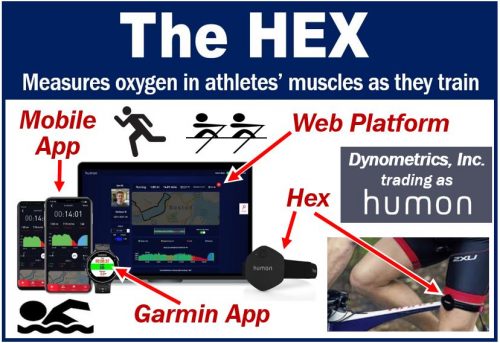
A wearable device – The Hex – gives athletes real-time data on the levels of oxygen in their muscles during workouts. Maximizing performance is not only about training hard but training smart. Unless you do all your workouts in a lab, however, getting real-time data about your body is not easy.
Humon, a startup, is one of an increasing number of companies trying to change that. They are trying to create wearable sensors and other technologies to help athletes train ‘smart.’
Dynometrics Inc., which trades as Humon, has a product it calls the Hex. It measures oxygen in the muscles of athletes during their workouts. The device visualizes those data so that athletes can tailor their workouts according to their body’s needs.
Humon co-founder and CEO (Chief Executive Officer), Alessandro Babini, said:
“The goal was to create the most useful and personalized training tool today. (To achieve that) we needed both amazing, lab-grade data and the expertise of a personal coach combined in a consumer product.”
Hex straps onto your thigh
The Hex straps onto the athlete’s thigh. It determines oxygen levels by emitting light into muscle tissue. It then measures the muscle tissue’s absorption of light. Scientists refer to this process as near-infrared spectroscopy.
The device then relays the data to the athlete’s phone or laptop via Bluetooth or ANT+technology. It can also relay the information to a smartwatch. The user sees a simple graph with personalized insights.
During a workout, the Hex tells users whether their muscles are consuming oxygen faster than they are getting it. In other words, whether their muscles’ oxygen supply rate is lower than their oxygen consumption rate.
With this data, they can determine whether their pace is sustainable.
Hex idea emerged in 2015
Babini and his co-founder, Daniel Wiese, got the idea for Hex three years ago. They were working on a class project at the Sloan School of Management at MIT.
Babini was studying for a Master’s degree in Management Studies. Wiese was pursuing his PhD in mechanical engineering and minoring in technology, innovation, and entrepreneurship.
Babini said:
“The only thing we knew is we wanted to start a company centered around the human body because we see no scenario in the future in which you’ll wake up in the morning knowing as little information about your body as you know today.”
Martin Trust Center for MIT Entrepreneurship
They decided to set up a company. The Martin Trust Center for MIT Entrepreneurship supported them financially. They subsequently secured office space. The support also helped them speak with founders of established businesses and connect with mentors.
Regarding setting up a company, Wiese said:
“I hadn’t thought about starting a company before, much less had any experience with that process. I didn’t know the first thing about it, so it was just incredible to have all these resources.”
They also received a grant while taking part in MIT’s delta v accelerator and participated in the MIT Fuse program to carry out market research.
Babini recalls:
“We realized we had very similar views on where we wanted to be in the future, and we knew we wanted to work together. So we embarked on this market research project to figure out how to get there.”
Finding a target
Nobody is more relentless than elite athletes in their quest to gain the slightest edge on their rivals.
Babini explains:
“We realized the early adopters were the athletes because they have a problem, strong purchasing power, and the education to voice their problem.”
“The problem is they don’t have the information they need to optimize their training.”
Athletes have not been able to track much noninvasively except for their heartbeat. Many factors can influence our heartbeat. Caffeine intake and lack of sleep, for example, can alter our heartbeat.
Muscle oxygen levels
Babini and Wiese wanted to track a metric that offered more value during workouts. They decided that the best metric of exertion was muscle oxygen levels.
According to an MIT press release:
“Data on muscle oxygen levels can be useful in each stage of a workout: Prior to a training session, athletes can use muscle oxygen data to determine when their muscles are warmed up (helping to prevent injuries); during a training session, such as a long run, they can use the data to determine if their current pace is sustainable; and after a workout, they can use the data to monitor their muscle’s recovery and know exactly when they’re ready for more exertion — a particularly useful insight during interval training.”
The core technology behind the Hex, near-infrared spectroscopy, has been used to gather physiological data in labs for many years. However, the founders wanted to make it work seamlessly during an athlete’s training session.
A trial with 250 athletes
After speaking with hundreds of athletes in 2016, they began a small pilot trial. A pilot trial is a small, preliminary trial that determines whether a larger trial is worth it. The researchers wanted to get a feel for the sensor’s ideal weight and size. They also wanted to determine how best to display the data.
Later in 2016, they carried out a larger trial with 250 athletes. The founders designed the trial to ensure that the Hex solved a significant pain point.
As they spoke with more athletes, they added features to the Hex. In February 2018, the company started shipping the Hex.
Wiese breaks Humon’s journey to the market into three steps:
- Developing the technology.
- Making it convenient for users (athletes).
- Building out the software features.
Wiese says:
“All we’re doing going forward is software and analytics, mining all of these insights and gleaning everything we can, then communicating that to the user via our app. We’re building out new features all the time and adding functionalities to integrate with user’s habits.”
The Hex – an AI coach
Humon markets the Hex as the world’s first real-time AI coach. It is a ‘coach’ because it can prompt athletes to adjust their pace based on the response of their body to current training intensity. It can also tell users when to do another interval set, i.e., when their muscles are ready for one.
AI stands for Artificial Intelligence, i.e., software technologies that make computers think like we do. AI can also make them behave like we do.
As the company gathers and analyzes more data, it will probably add more features.
Humon has sold thousands of devices in forty-six countries since the beginning of this year. Month-over-month, sales are growing by 40%, says Babini.
The startup has focused so far on athletes. However, they are also mindful of their technology’s role in the context of the larger wearables movement.
Babini says:
“We’re big believers in the smart clothing industry. We think that’s the future of the wearables industry, and (with the Hex) we want to make sure we become a leader in this market using existing sensors and data.”
