
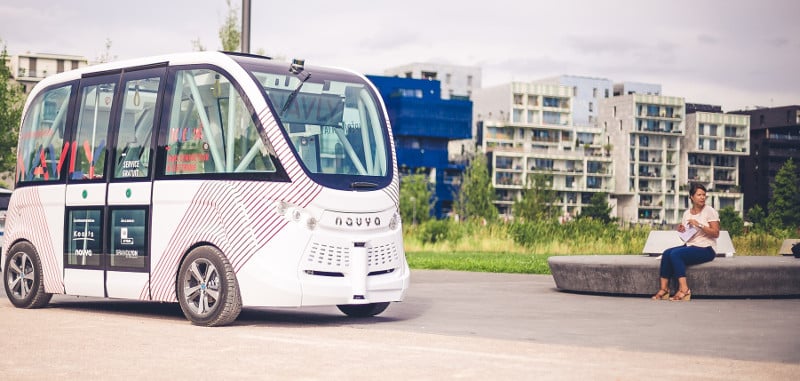
Heathrow airport in London recently showcased a driverless bus made by Navya, a French company that specializes in developing electric autonomous systems.
The event – which was reported and filmed by IBTimes UK – marks the first time that a Navya ARMA fully autonomous, electric shuttle bus has been demonstrated in the United Kingdom.
 Driverless buses are already being tested as part of a public transport system in the Confluence district of Lyon, France. Image: Navya.
The demonstration took place in a busy car park at Heathrow airport. The driverless bus covered a route of about 600 metres that the engineers had previously plotted and loaded onto the vehicle’s computer.
On-board route map and real-time sensing
The bus drives autonomously by comparing the stored route to what it currently perceives and also by working out where it is. To this end, it sports a range of devices, such as:
– LIDAR sensors that map the 3-D environment to enable precise positioning and obstacle detection
– GPS technology that talks to a base station to determine precise location of the vehicle
– odometer that estimates vehicle speed and position
– stereovision cameras for detecting obstacles and their position relative to the bus and for conveying key information in its environment (for instance road signs and traffic lights)
Navya driverless buses are already operating in Australia, France, Germany, New Zealand, Singapore, Switzerland, and Taiwan.
Henri Coron, Navya’s vice president of sales, says that last year, the company deployed 30 vehicles worldwide, covered over 50,000 kilometers, and ferried over 100,000 passengers.
Off-road sites and urban areas
The buses currently in operation are transporting people on off-road sites. However, once legislation allows it, Navya says the ARMA will also be available for use on public roads and spaces, such as pedestrian zones.
The company says their driverless buses are ideal for:
– urban areas: moving people around large town centres
– amusement parks: transporting visitors between parking lots, attractions, eating areas
– industrial sites: moving personnel from/to train and bus stations to/from work or catering zones
– hospitals: ferrying staff, visitors, people with low mobility to and from parking lots, buildings, and public transport stations
– holiday resorts: helping move holiday-makers and their luggage from drop-off point to villas, leisure centres
The latest version of the ARMA lasts 5-13 hours between charges, depending on configuration and traffic conditions.
In September last year, a Navya ARMA started operating on an experimental public transport system in Lyon, France. It travels a route of 1,300 metres comprising 5 stops, 3 terminuses, and 3 intermediary stops, serving different buildings in the district.
The route is free of traffic lights, pedestrian crossings, and cross-roads. The driverless buses travel at an average of 15 km/h (about 9 mph) and the average route takes about 13.5 minutes.
Ferrying customers from airport car parks to terminal buildings
The driverless bus showcased at Heathrow is an earlier ARMA model that seats 15 passengers and travels at nearly 30 mph.
Heathrow currently have no plans to commission ARMA buses, which could be used to ferry customers from the airport’s car parks to terminal buildings.
Steve Armitage, manager of IT futures at Heathrow, says it is still early days and their main interest in hosting the driverless bus demonstration was to “start the debate among the Heathrow community.”
Heathrow invested £11bn between 2003 and 2014, a move that took the airport from the bottom 25 percent of EU airports for passenger satisfaction to the top 25 percent.
First/last mile problem
Navya see their ARMA driverless bus helping to solve the “first/last mile problem.”
The problem is a particular challenge for urban planners who want to get people using public transport more and their cars less.
The first/last mile of a journey is often the clincher in whether people choose to use public transport.
Even if there is a fast, efficient, and frequent public transport service, if travellers are left a mile from their destination, with poor connecting options, they will look for another solution.
Also, the first/last mile of the journey is the most costly – especially in less densely populated areas.
As most of the cost of running public transport is the cost of wages and benefits, solutions that are not labour-intensive become very attractive as ways to solve the first/last mile problem and increase the coverage of public transport routes.
Video – the Navya ARMA showcased at Heathrow
The following video from IBTimes UK shows the ARMA demonstration that took place at Heathrow airport on 24th January 2017.
