
Melting glaciers do not only contribute to rising sea levels, they also release massive amounts of organic carbon which could significantly affect high-latitude marine ecosystems, especially those surrounding the major ice sheets, a new study has found.
Marine ecosystems that surround major ice sheets typically receive very small amounts of land-to-ocean fluxes of organic carbon. Melting glaciers could change that flow considerably.
What will happen to all the organic carbon held in glaciers when they melt, scientists from Florida, Alaska and Switzerland wonder.
This study, the first to estimate what the global impact of melting ice sheets might be, has been published in Nature Geoscience.
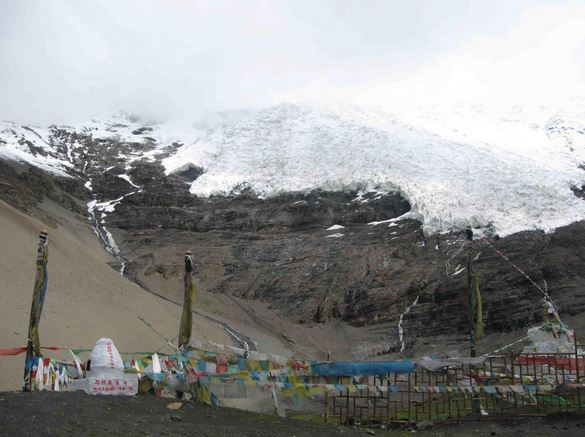
Scientists have carried out field work in Alaska and Tibet, among other places as part of this study. (Robert Spencer/Florida State. Image: Eurekalert)
Team member, Florida State University assistant professor Dr. Robert Spencer said:
“This is the first attempt to figure out how much organic carbon is in glaciers and how much will be released when they melt. It could change the whole food web. We do not know how different ecological systems will react to a new influx of carbon.”
Ice sheets and glaciers contain approximately 70% of the Earth’s freshwater. Their melting is a major contributor to rising sea levels. However, glaciers also hold carbon derived from both primary production on the glaciers themselves and deposition of materials such as soot or other fossil fuel combustion byproducts.
The scientists studied readings from ice sheets in mountain glaciers worldwide, the Greenland ice sheet, and the Antarctic ice sheet. Their aim was to measure the total amount of organic carbon stored in the global ice reservoir.

Carbon release from melting glaciers could change the whole food web, says Dr. Spencer (Image: Florida State University)
A lot of carbon stored there
The authors calculated that over the next 35 years, the amount of organic carbon exported in glacier outflow will rise by 50%. That’s an awful lot of carbon – equivalent to half the amount of carbon in the Mississippi River being added to our oceans annually from melting glaciers.
Lead author, Eran Hood Ph.D., a scientist with the University of Alaska Southeast, said:
“This research makes it clear that glaciers represent a substantial reservoir of organic carbon. As a result, the loss of glacier mass worldwide, along with the corresponding release of carbon, will affect high-latitude marine ecosystems, particularly those surrounding the major ice sheets that now receive fairly limited land-to-ocean fluxes of organic carbon.”
Dr. Spencer and colleagues say they are carrying out further studies to determine what the impact will be when the carbon is released into existing bodies of water.
Dr. Spencer said:
“The thing people have to think about is what this means for the Earth. We know we’re losing glaciers, but what does that mean for marine life, fisheries, things downstream that we care about? There’s a whole host of issues besides the water issue.”
Citation: “Storage and release of organic carbon from glaciers and ice sheets,” Eran Hood, Tom J. Battin, Jason Fellman, Shad O’Neel & Robert G. M. Spencer. Nature Geoscience (2015). doi:10.1038/ngeo2331. Received 15 March 2014. Accepted 21 November, 2014. Published online 19 January, 2015.
