
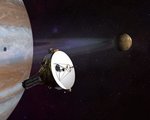
NASA’s New Horizons spacecraft finally nears its long-awaited encounter with Pluto, the first of many approach phases that will conclude with the first close-up flyby of the Pluto system in six months’ time.
Jim Green, director of NASA’s Planetary Science Division at NASA Headquarters, Washington, said:
“NASA’s first mission to distant Pluto will also be humankind’s first close up view of this cold, unexplored world in our solar system. The New Horizons team worked very hard to prepare for this first phase, and they did it flawlessly.”
New Horizons, a NASA space probe launched in January 2006 to study the dwarf planet Pluto, its moons and one or two other Kuiper belt objects, will soar close to its target after more than three billion miles, on July 14th.
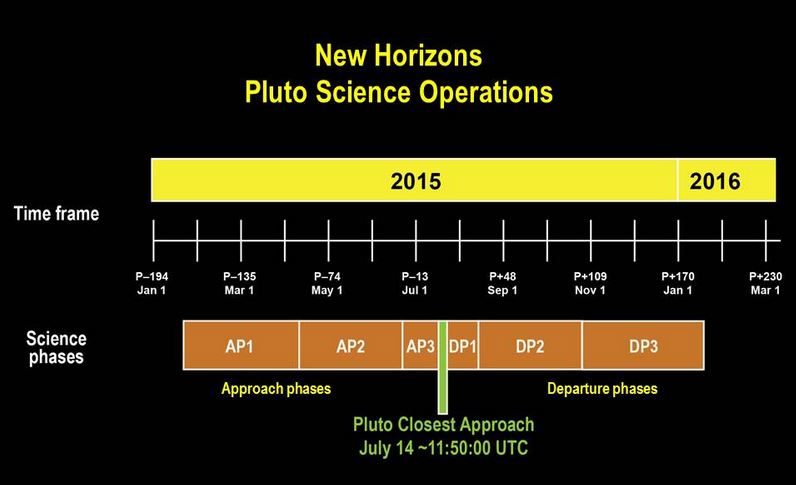
Approach timeline and departure phases — surrounding close approach on July 14, 2015 — of the New Horizons Pluto encounter. (Image: The Johns Hopkins University Applied Physics Laboratory)
The fastest spacecraft ever launched woke up from its final hibernation period in early December, 2014. Since waking up, its mission’s teams have configured the piano-sized probe for distant observations of the Pluto system. A long-range photo shoot is scheduled for January 25th (today).
The photographs, taken by New Horizons’ telescopic Long-Range Reconnaissance Imager (LORRI), will give scientists a continually improving look at the dynamics of the moons that orbit the dwarf planet. They will also play a critical role in navigating New Horizons as it covers the remaining 135 million miles (220 km) to Pluto.
Alan Stern, New Horizons principal investigator from Southwest Research Institute in Boulder, Colorado, said:
“We’ve completed the longest journey any craft has flown from Earth to reach its primary target, and we are ready to begin exploring!”
Over the coming months, LORRI will take hundreds of photographs of Pluto against star fields to better measure the spacecraft’s distance to Pluto.
Until May, the images will show little more than bright dots. Mission navigators will use them to design course-correction maneuvers in order to get the spacecraft’s flyby route accurately calculated.
Mark Holdridge, the New Horizons encounter mission manager from the Johns Hopkins University Applied Physics Laboratory in Laurel, Maryland, said:
“We need to refine our knowledge of where Pluto will be when New Horizons flies past it. The flyby timing also has to be exact, because the computer commands that will orient the spacecraft and point the science instruments are based on precisely knowing the time we pass Pluto — which these images will help us determine.”
New Horizon operators also track the spacecraft using radio signals from NASA’s Deep Space Network. However, the “optical navigation” campaign that starts this month marks the first time photographs from New Horizons will be utilized to help pinpoint the dwarf planet’s location.
According to The Johns Hopkins University Applied Physics Laboratory:
“This first approach phase, which lasts until spring, also includes a significant degree of other science. New Horizons will take essentially continuous data on the interplanetary environment where the Pluto system orbits, with its two charged-particle sensors measuring the high-energy particles streaming from the Sun, and its dust counter tallying dust-particle concentrations in the inner reaches of the Kuiper Belt — the unexplored outer region of the solar system that includes Pluto and potentially thousands of similar icy, rocky small planets.”
In the spring, more intensive Pluto studies will commence, when cameras and spectrometers aboard the spacecraft can provide resolutions better than most Earth telescopes.
“Eventually, New Horizons will obtain images good enough to map Pluto and its moons better than has ever been achieved by any previous first planetary reconnaissance mission,” say the scientists.
Reference: “NASA’s New Horizons Spacecraft Begins First Stages of Pluto Encounter,” NASA.
