
Global greenhouse gas emissions from petrochemical production could rise by about 50% between 2023 and 2050 under a business-as-usual scenario, according to a new study. Its facility-level analysis also identifies a concentration of emissions that could help governments and companies decide where to direct investment: roughly one-tenth of facilities account for 53% of the total.
The research, published in Nature Sustainability on September 9, models production across 37,379 facilities and 81 chemicals. The team includes researchers from the universities of Sheffield, Cambridge and Bath and the University of California, Santa Barbara.
The projected increase is a scenario, not an inevitable outcome. Cleaner electricity, changes in production and lower demand would alter the path. The study compares combinations of those measures and finds that their timing and location can substantially affect the emissions avoided.
What the emissions estimate covers
Petrochemicals provide materials for products including plastics, synthetic fibers and fertilizers. Their climate footprint comes from several stages: obtaining and processing raw materials, supplying energy and running chemical reactions at plants.
The researchers estimate annual production emissions at 2.0 billion metric tons of carbon dioxide equivalent in 2023, rising to 3.0 billion in 2050 in the business-as-usual case. Carbon dioxide equivalent expresses the warming effects of different greenhouse gases in a common unit.
Both estimates carry substantial uncertainty. The paper reports 2.0 ± 0.8 billion metric tons for 2023 and 3.0 ± 1.2 billion for 2050. The headline increase compares the central estimates.
These are model calculations rather than a complete inventory of measurements taken at every plant. The historical production analysis runs through 2020, with later years estimated using production-capacity projections and other assumptions.
The totals cover emissions from raw-material extraction through chemical production, a boundary known as “cradle to gate.” They exclude subsequent product use and disposal. The study therefore does not calculate the entire climate footprint of plastics or fertilizers, or their other environmental effects.
Large emitters offer a starting point for investment
The concentration of 53% of emissions in 10% of facilities suggests that a targeted program could achieve more early reductions than one spreading upgrades uniformly across the industry.
A high total does not automatically identify an inefficient plant. A large facility can emit more because it produces more, because its process releases particular gases, or because of its energy supply. Choosing an upgrade requires understanding those causes.
The model includes carbon dioxide, methane and nitrous oxide. Although the latter two are emitted in smaller quantities, their stronger warming effects can make controlling them particularly valuable at certain types of chemical plant.
Better disclosure would also improve the targeting. The authors report that public information often fails to specify a facility’s exact manufacturing process, while production volumes are missing for many sites. Those gaps contribute to the uncertainty in the estimates.
Cleaner processes depend on the surrounding infrastructure
Electrifying production can reduce emissions when the power supply is sufficiently clean. In regions reliant on carbon-intensive electricity, the model shows that switching too early can increase near-term emissions instead.
Plants can also share heat, power and chemical inputs between production units. Replacing a combustion process may remove a source of heat used elsewhere, requiring wider engineering changes. A technology that works at a standalone plant may be harder to install in an integrated complex.
Carbon capture and storage, which collects carbon dioxide for permanent underground storage, introduces another set of requirements. Plants need access to transport infrastructure and suitable storage sites, alongside the capture equipment itself.
Funding can remain unresolved even after permission is granted. In a separate power-sector example, Drax received a carbon-capture permit while operation remained dependent on government funding.
Demand changes remain part of the calculation
Even the study’s highly optimistic combination of cleaner electricity, capture at eligible facilities and extensive replacement of fossil raw materials leaves residual emissions in 2050. Plant-based alternatives also face limits, including competition for land and the environmental effects of expanding biomass production.
In the scenarios examined, reducing demand delivers larger cuts than any single supply-side measure. That comparison does not mean it outperforms every production measure combined.
The authors consequently argue that cleaner manufacturing must be accompanied by lower demand for petrochemical products. Decisions about plant upgrades will need to account for both the emissions they can remove and the future volume of material those plants are expected to supply.
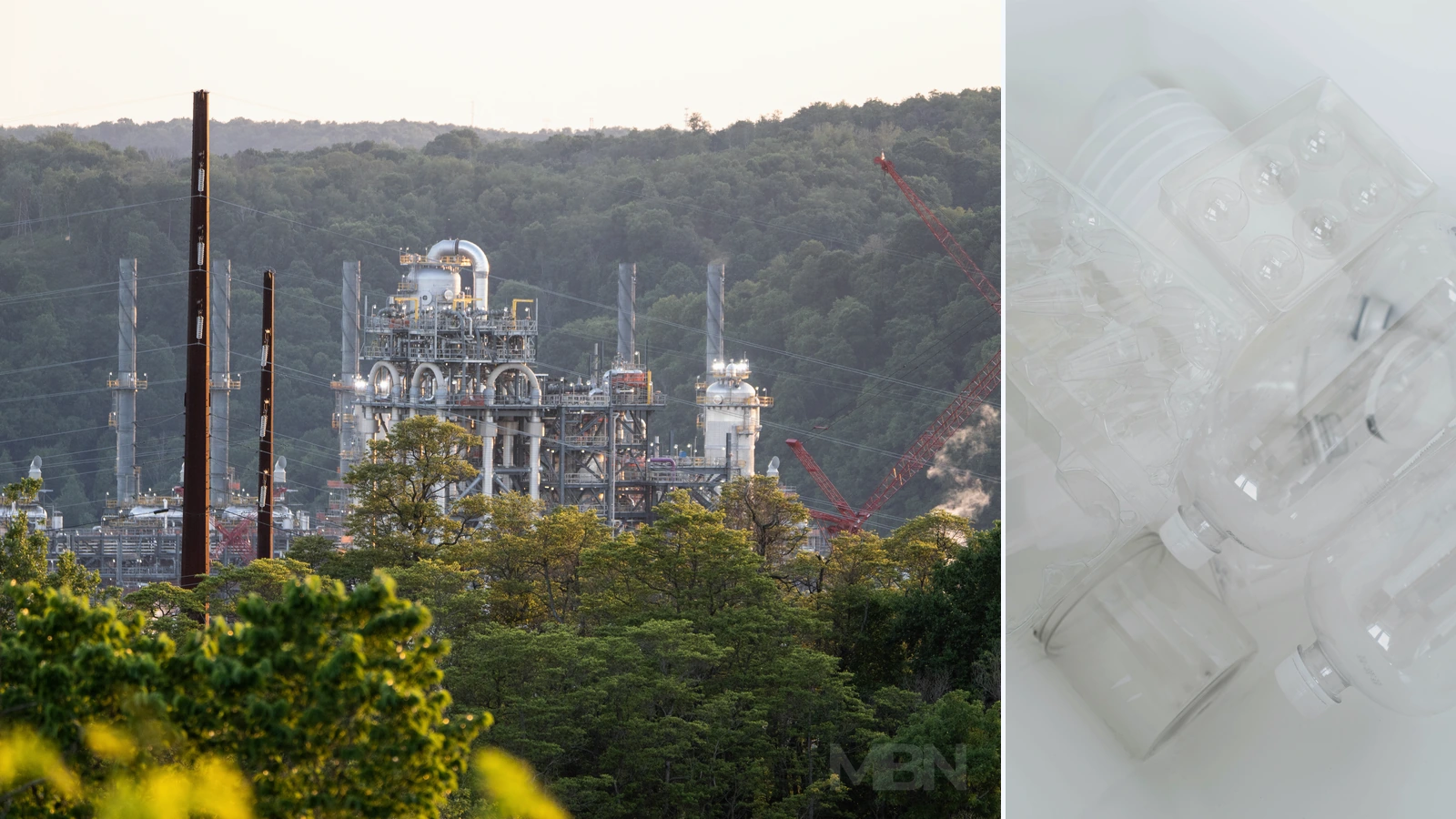
Cover image: Editorial composite of a historic photograph of Shell’s petrochemical facility in Beaver, Pennsylvania, and separate plastic bottles. Neither a study ranking for this plant nor a supply relationship is implied. Facility: “220603-Shell-Evening-3-1002130” by Mark Dixon, CC BY 2.0, cropped and color-adjusted. Bottles: Ron Lach / Pexels.
