
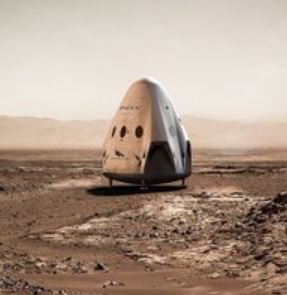
SpaceX, founded by business magnate, engineer, and inventor Elon Musk, announced yesterday that it plans to send a spacecraft and capsule to Mars in 2018. Scientists across the world have expressed admiration for Mr. Musk, but wonder whether this latest challenge might be just too ambitious.
Mr. Musk said the move will be our first step towards colonizing Mars – something we will eventually have to do if we want to guarantee the long-term survival of the human race. The company plans to send one of its Dragon capsules to the Red Planet. However, it will not carry any astronauts.
Scientists say that everything about Dragon since it was first created was done with Mars in mind.
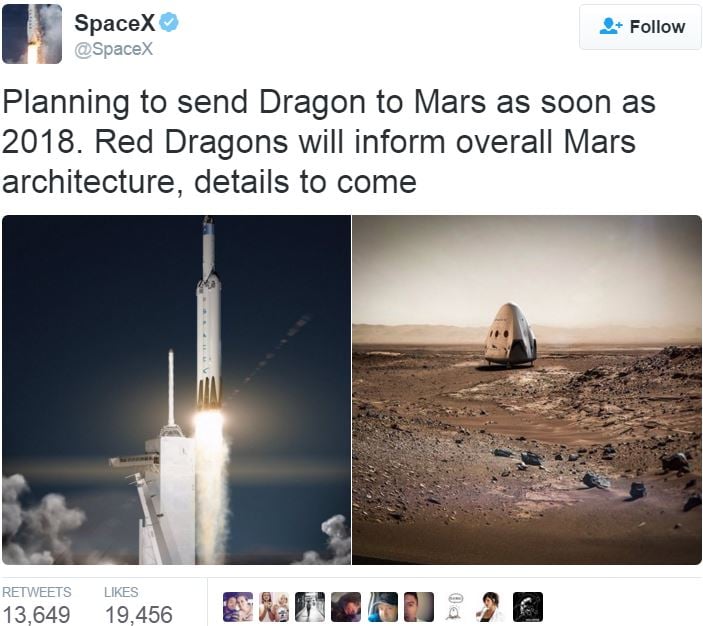 The first we heard about Elon Musk’s ambitious SpaceX Mars plan was when this message was posted on Twitter. (Image: twitter.com/SpaceX)
Hard part is landing on Mars
Getting near the Red Planet is not the hardest part – getting a spacecraft or capsule safely down to the surface is. SpaceX will not be able to pull this off on its own – it will need help from a major space agency such as NASA.
NASA and SpaceX already work closely together. The SpaceX Falcon 9 lifted off from Cape Canaveral Air Force Station on 8th April carrying a Dragon capsule loaded with 7,000 pounds of cargo which was delivered to the International Space Station (ISS) – NASA was the client.
The Falcon 9 rocket has been lifting off since 2008, and its Dragon capsule has been carrying cargo to the ISS for the past four years.
The New Scientist quoted Brian Glass, who works at NASA’s Ames Research Center in California, as saying:
“This is not out of the blue. It’s not just boom, two years off the block. This is more like a seven-year effort that culminates with launch in 2018 and goes from there.”
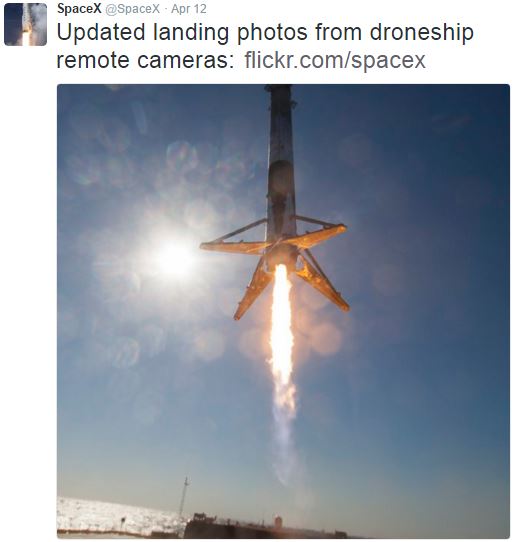 SpaceX managed to successfully land a leftover Falcon booster at sea earlier this month. Re-using parts of a rocket makes space exploration much more economically viable. (Image: twitter.com/SpaceX)
The voyage to Mars will use enhanced versions of both the rocket and capsule. The rocket (Falcon Heavy) will consist of three stages of the Falcon 8. The Dragon 2 capsule is planned for transporting ISS crew members to and from the space station.
SpaceX’ capsule is too small to carry astronauts further than the Moon – it is about the size of a large family car. In a tweet, Mr. Musk wrote “Wouldn’t be fun for longer journeys.”
But wouldn't recommend transporting astronauts beyond Earth-moon region. Wouldn't be fun for longer journeys. Internal volume ~size of SUV.
— Elon Musk (@elonmusk) 27 April 2016
Lots to do to meet 2018 deadline
If all goes according to plan and there are no delays, Falcon Heavy and the Dragon 2 capsule should be ready by 2018. However, if there are any hiccups or delays, the 2018 target for a Mars missions starts looking less likely.
Neither the Dragon 2 or Falcon Heavy have been thoroughly tested, that takes time. Falcon Heavy is due for its first launch later this year, while Dragon 2 will be submitted to test flights later this year and in 2017.
SpaceX has a history of announcing ambitious plans with ultra-tight schedules, which nearly always end up not meeting their deadlines – but the projects do eventually get done.
Jonathan McDowel, who works at the Harvard-Smithsonian Center for Astrophysics, told the New Scientist:
“You can’t guarantee that the first few launches of this big rocket will be trouble-free. I think 2018 is going to be pushing it. I could believe 2019, but I wouldn’t mortgage my house on it. They’ll do it. It’s just a question of when.”
Human missions an ‘insurance plan’
Mr. Musk believes that a successful Mars mission would soon be followed by human missions, which he sees as a type of insurance plan for life on Earth.
Recently tested Dragon 2’s SuperDraco propulsive landing system at our McGregor, TX facility. Key for Mars landing pic.twitter.com/dV1nhKDMhr
— SpaceX (@SpaceX) April 27, 2016
SpaceX says its upgraded Dragon is designed to land on any planet or moon in our Solar System. Engineers recently tested its propulsive landing system at the SpaceX plant in McGregor, Texas.
Regarding SpaceX’ Mars plan, Mr. Musk has promised additional details soon. After landing a leftover Falcon booster successfully at sea earlier this month, he said he would explain in more detail his approach to establishing a major human settlement on Mars at an aerospace meeting in September in Mexico.
At a press conference, Mr. Musk said “I think it’s going to sound pretty crazy. So it should be at least entertaining.”
He believes that re-using rockets is vital for reducing overall launch costs and making space exploration more economically viable.
NASA says it plans to send humans to Mars in the 2030.
Video – SpaceX Misson to Mars
Elon Musk would like to send SpaceX’ Red Dragon to the Red Planet in two years’ time. Can he do it?
