
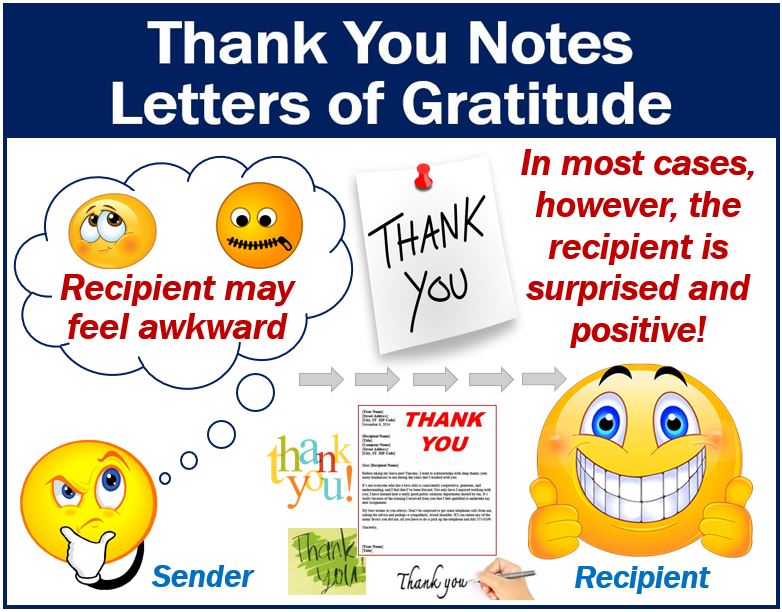
Thank you notes are much more powerful than we realize, say researchers from the University of Texas at Austin. Writing thank you notes is a pro-social experience we should commit to more often. Jimmy Fallon’s ‘Thank You Notes,’ for example, are extremely powerful gestures.
Not only do thank you notes improve well-being for the letter writer, but also for the recipients.
Amit Kumar and Nicholas Epley wrote about their study and findings in the journal Psychological Science (citation below).
Prof. Kumar is Assistant Professor of Marketing in the McCombs School of Business at the University of Texas (UT). Prof. Epley is John T. Keller Professor of Behavioral Science at the University of Chicago Booth School of Business.
We also call thank you notes ‘letters of thanks,’ ‘thank you letters,’ as well as ‘letters of gratitude.’
Thank you notes – three experiments
The researchers carried out three different experiments. Study participants had to write a letter of gratitude to somebody who had done something nice for them. The authors also asked them to anticipate their recipients’ reaction.
In all three experiments, the participants had overestimated how awkward the receivers of the letters would feel.
They had also underestimated how positive and surprised the recipients would feel. In other words, the participants had thought the recipients might feel embarrassed and not as positive as they did.
Letters of gratitude – what drives our choices?
Prof. Kumar said:
“We looked at what’s correlating with people’s likelihood of expressing gratitude – what drives those choices – and what we found is that predictions or expectations of that awkwardness, that anticipation of how a recipient would feel – those are the things that matter when people are deciding whether to express gratitude or not.”
People shy away from writing letters of gratitude because they fear the recipient may misinterpret their gesture. Anxiety about what to write also puts them off.
Probably not a societal thing
Prof. Kumar added:
“I don’t think it’s a societal thing,” said Kumar. “It’s more fundamental to how the human mind works and a well-established asymmetry about how we evaluate ourselves and other people.”
“When we’re thinking about ourselves, we tend to think about how competent we are, and whether we are going to be articulate in how we’re expressing gratitude.”
People should write more letters of gratitude
What is significant about their research and findings, Prof. Kumar says, is that we should write letters of gratitude more often.
Regarding the effort involved versus the benefits we get from writing letters of gratitude, Prof. Kumar said:
“What we saw is that it only takes a couple of minutes to compose letters like these, thoughtful ones and sincere ones. It comes at little cost, but the benefits are larger than people expect.”
In an Abstract that precedes the main article in the journal, the authors wrote:
“Expected awkwardness and mood were both correlating with participants’ willingness to express gratitude. Wise decisions are guided by an accurate assessment of the expected value of action.”
“Underestimating the value of prosocial actions, such as expressing gratitude, may keep people from engaging in behavior that would maximize their own – and others’ – well-being.”
Perhaps this study’s finding also applies to people who work in client-centric companies. In client-centric businesses, the customer or client is the center of its effort.
Citation
“Undervaluing Gratitude: Expressers Misunderstand the Consequences of Showing Appreciation,” Amit Kumar and Nicholas Epley. Psychological Science – First Published June 27, 2018. https://doi.org/10.1177/0956797618772506.
