
Dutch scientists have created a tiny temperature sensor chip which powers itself using radio waves that are part of its own wireless network.
The sensor does not require a single wire, nor a battery that would have to be replaced.
Researchers at Eindhoven University of Technology said that the new type of sensor could play a huge role in the future of consumer electronics and the Internet of Things.
Sensor chips measuring temperature are becoming increasingly popular around cities and in smart homes and offices.
However, making these sensors battery-free has been one of the industry’s biggest hurdles.
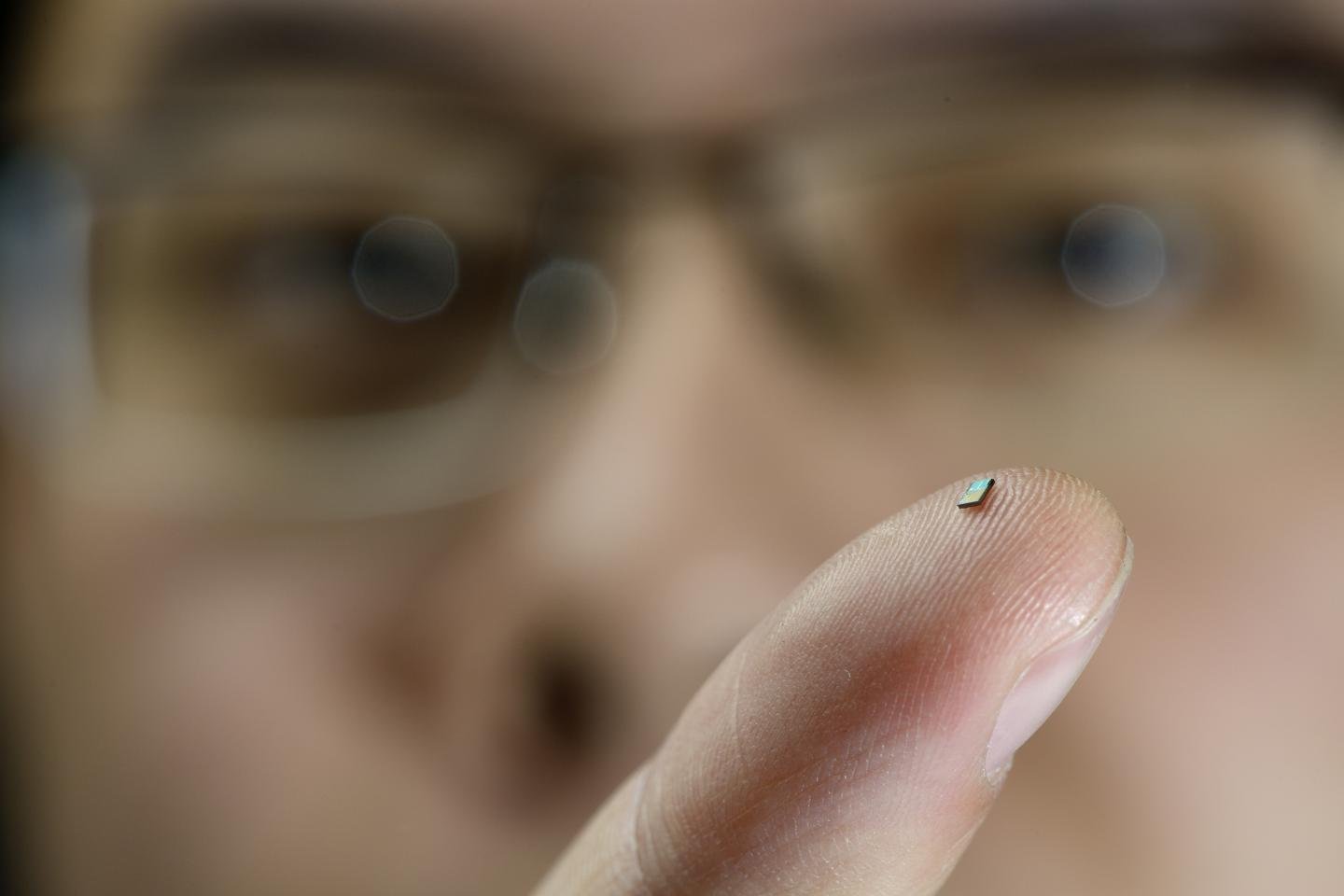
The tiny temperature sensor on the finger tip of Ph.D.-student Hao Gao of Eindhoven University of Technology.
TU/e professor of wireless technology, Peter Baltus, told the BBC that other sensors measuring different data (such as light and humidity) could also be developed using similar technology.
“We don’t want hundreds of these sensors around our homes if we have to go around swapping the batteries all the time,” said lead researcher Prof Peter Baltus.
The current version of the sensor has a range of 2.5 centimeters, with the researchers expecting to extend this to a meter within a year, and ultimately to 5 meters.
It has a specially developed router, with an antenna that sends radio waves to the sensors to power them. Because the energy transfer is targeted at the sensor the router consumes very little electricity and the way the sensors are made means that their energy consumption is extremely low.
According to Peter Baltus, the sensor is also capable of working beneath a layer of paint, plaster or concrete, making it easy to incorporate in buildings.
The researchers said: “The sensor contains an antenna that captures the energy from the router. The sensor stores that energy and, once there is enough, the sensor switches on, measures the temperature and sends a signal to the router. This signal has a slightly distinctive frequency, depending on the temperature measured. The router can deduce the temperature from this distinctive frequency.”
The sensor is also cheap, Prof Baltus said, with the cost of an individual chip at around 20 cents.
The project, called PREMISS, has received funding from the STW technology foundation. The title of Hao Gao’s thesis is ‘Fully Integrated Ultra-Low Power mm-Wave Wireless Sensor Design Methods’.
