
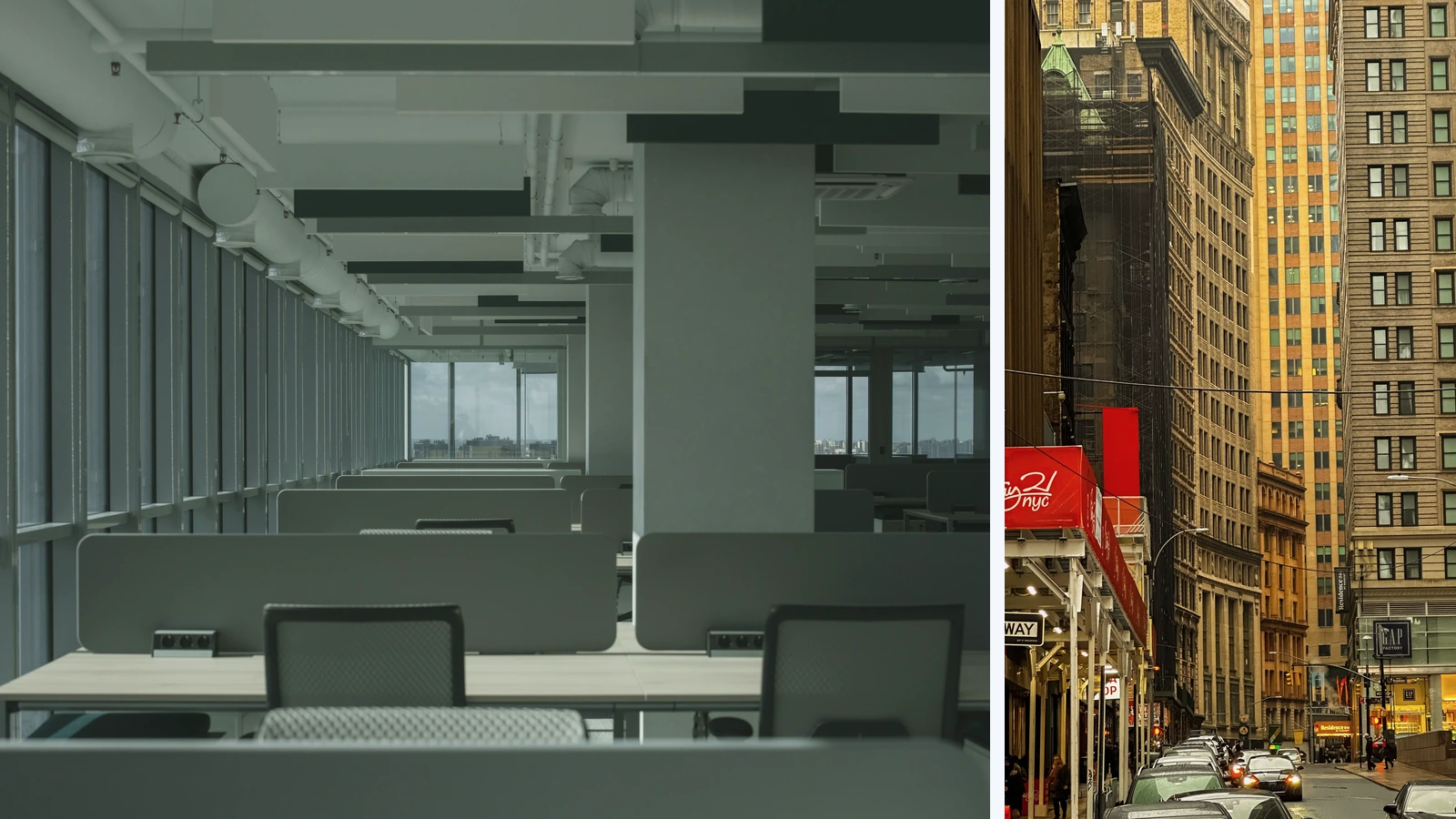
US office vacancy fell to 18.3% in the second quarter of 2026, according to CBRE, offering landlords some relief. But properties that struggle to attract tenants can still put pressure on lenders, nearby businesses and city finances.
The vacancy rate dropped by 0.3 percentage points during the quarter, its largest quarterly decline since 2015. CBRE’s July report also recorded 12.6 million square feet of positive net absorption, meaning the amount of occupied space increased by that much.
The recovery is uneven. Vacancy in CBRE’s prime, or top-quality, office category was considerably lower, at 12.3%.
For owners of harder-to-let buildings, a stronger national market does not necessarily deliver enough rental income to cover their costs.
What is commercial real estate?
Commercial real estate, often abbreviated to CRE, is property held for business activity or rental income. It includes offices, stores, warehouses, hotels and income-producing apartment buildings.
Owners commonly finance purchases with a secured loan, using the property as collateral, an asset backing the borrowing. To generate positive cash flow from rents, rental income must cover outgoings such as maintenance, insurance, property taxes and loan payments.
When tenants leave and stop paying rent, income falls while many of those expenses continue. An owner may also need to spend money upgrading the building or offering incentives to attract replacements.
Tenants can move without restoring demand
Remote and hybrid work allow some employers to operate with less space. The effect can take years to reach landlords as long-term leases gradually expire and tenants reconsider their requirements.
A company renewing its lease may decide to rent a smaller office in a better building. That can improve its facilities without increasing its total property budget.
This shift, often called a flight to quality, helps one landlord while leaving another with space to fill. It also explains why increased leasing does not benefit every property equally.
Less construction should limit additional competition. CBRE recorded 15.4 million square feet under construction nationally in the second quarter, 87% below the second-quarter 2020 peak.
Lower income makes refinancing harder
Rental income also influences a building’s value and how much a lender will advance against it.
When a mortgage matures, the owner must repay it or arrange replacement financing. If the building has lost tenants and value, a new loan may be insufficient to pay off the old one.
The owner may need to contribute more money, negotiate an extension or sell. If repayment becomes impossible, the lender can face losses.
The Federal Reserve’s May 2026 Financial Stability Report said commercial property prices, measured using inflation-adjusted transaction indexes, had continued to stabilize after substantial declines. It nevertheless warned that vulnerabilities associated with upcoming refinancing remained.
That risk depends on the property and the lender’s exposure. A national improvement in vacancy does not settle the financing problems of an individual building.
Nearby businesses face a different problem
Office vacancy and daily attendance are separate measures. A business can keep paying rent while its employees come in less frequently.
Nearby coffee shops, restaurants and retailers can therefore lose customers even when an office remains leased. Spending can move to residential neighborhoods rather than disappearing, but that offers little comfort to a business dependent on downtown lunch trade.
City governments also have an interest in office values because commercial property contributes to their tax base. The effect varies with local assessment rules and other revenue sources.
Sharp fiscal declines are not inevitable. A November 2025 New York City Comptroller report found that Manhattan office property tax levies for fiscal 2025 and 2026 tracked closely with its earlier optimistic scenario.
Converting offices into housing can provide another use, but suitability matters. New York City’s 2023 adaptive reuse study identified building depth, window arrangements and the position of elevators and stairs as important constraints.
For owners and lenders, the decision is practical: can renovation or conversion generate enough income to justify the additional investment? A building with fewer tenants still needs maintenance, and any outstanding borrowing still has to be serviced or renegotiated.
