
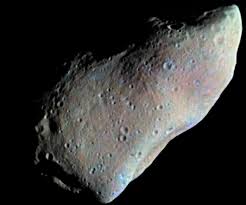
Asteroids are irregularly shaped small rocky objects in the Solar System (smaller than a planet) that move around the Sun. In ancient Greek the word “asteroid” means “like a star”, which makes sense because they look similar to stars in the sky, but they are actually very different.
In 1801 an Italian priest and astronomer called Giuseppe Piazzi discovered the first asteroid and named it Ceres. Ceres was found orbiting between Mars and Jupiter. However, because of advancements made in the classification of objects in space, Ceres is now considered to be a dwarf planet (as it is much larger than the average asteroid) and no longer an asteroid.
Nowadays thousands of asteroids are identified and discovered every month thanks to computerized telescopes.
The size of an asteroid can range from 1 km to over 1000 km across. Some are even large enough to have their very own moons. One of the smallest asteroids ever discovered, called 1991 BA, is only 6 meters across. The temperature of an asteroid can range too, but the average surface temperature is typically minus 73 degrees Celsius (minus 100 degrees Fahrenheit).
How are asteroids formed?
They are essentially just the leftover rock and other material from the creation of the Solar System. They were not big enough to create a planet and never collided with anything else to form one, so they just continue to float around in space.
Asteroids are mostly made of rock, but some contain metal or carbon. The surfaces of most asteroids are believed to be covered in dust.
There are classified into different kinds, depending on what’s on their surface, such as Type C (dark carbonaceous objects), Type S (silicaceous or “stony” objects), and Type M (metallic objects).
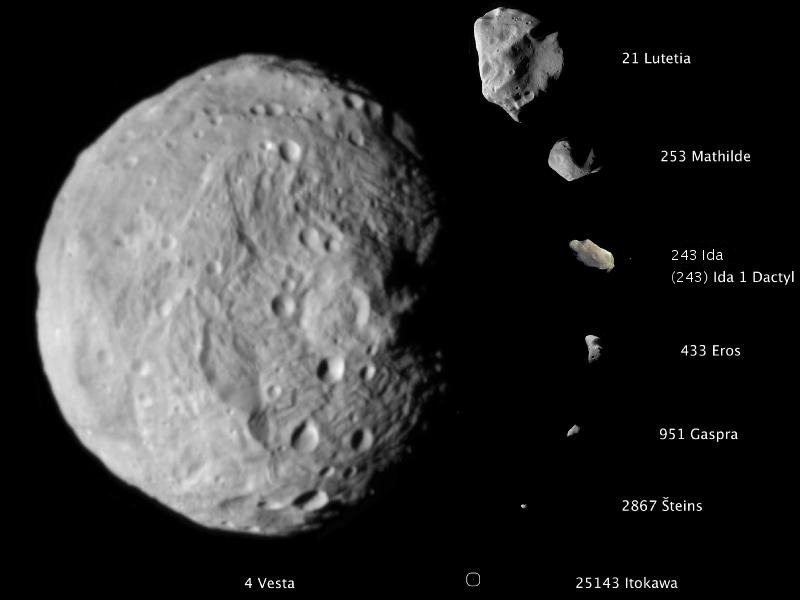
A composite image, to scale, of asteroids that have been imaged at high resolution.
Where are there asteroids in our Solar System?
The majority of asteroids in our Solar System are found in the asteroid belt between Jupiter and Mars. This belt contains somewhere between 1.1 and 1.9 million asteroids larger than 1 km in diameter, as well as millions of smaller ones.
However, it is important to note that not all the asteroids in our Solar System are in that belt. Some asteroids actually make their way very close to Earth (these are known as Near-Earth asteroids). As of November 2014, 11,600 near-Earth asteroids are known. In fact, many scientists believe that dinosaurs were killed off because of asteroids striking the Earth’s surface. When an asteroid, or a part of it, crashes into our planet, it’s called a meteorite.
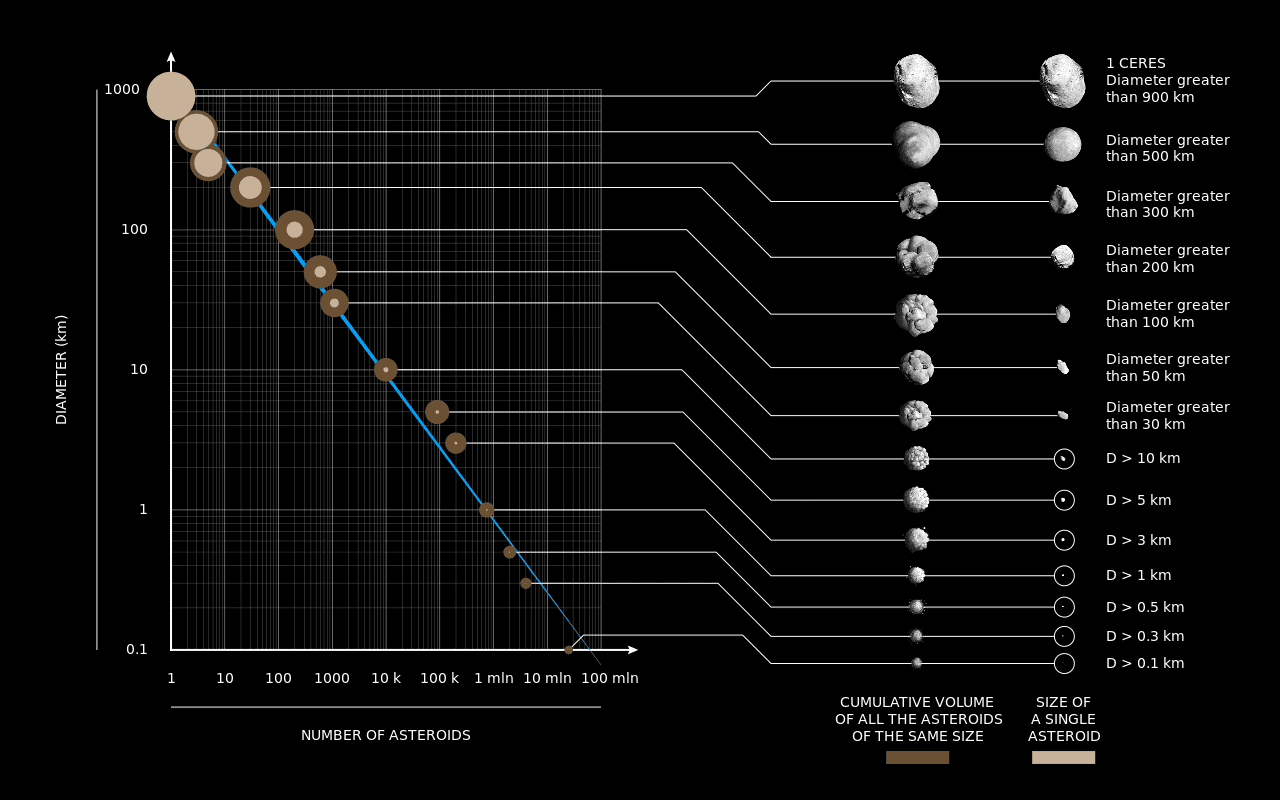
The asteroids of the Solar System, categorized by size and number.
